If you are just stepping into the world of welding, you have probably heard veterans talk about old-school hoods or fixed shade lenses. These traditional devices are known as passive welding lenses, and they remain a staple in the industry despite the rise of modern auto-darkening technology. Understanding the differences between lens types is crucial for protecting your vision and improving your welding technique.
A passive lens is not just a piece of dark glass, it is a meticulously engineered filter designed to block harmful radiation. Whether you are a beginner learning to strike an arc or a seasoned pipeliner working in the field, understanding the mechanics and benefits of a passive lens can make you a safer, and often better, welder. This guide will break down the technology, the benefits, and the drawbacks to help you decide if a fixed shade lens belongs in your gear bag.
Table of Contents
Defining a Passive Welding Lens
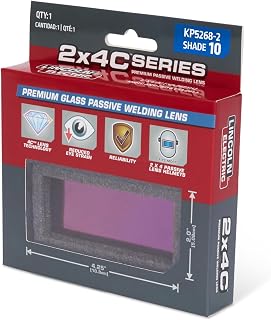
Lincoln Electric 2x4C Premium Glass Lens
Check PriceA passive welding lens is a protective glass filter with a fixed shade level. Unlike an auto-darkening filter, it does not rely on electronics, sensors, or batteries to change its tint. The lens remains constantly dark, usually ranging from Shade 8 to Shade 13, regardless of whether an arc is lit or the environment is bright daylight.
This consistency is achieved through a substrate of glass or polycarbonate infused with specific metals to filter light. The primary function is to block 100% of harmful ultraviolet (UV) and infrared (IR) radiation while reducing visible light to a safe level. The passive nature means your eyes are the trigger, not a circuit board.
How Passive Lens Technology Works
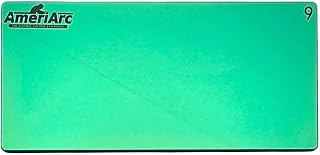
AMERIARC True Color Single Replacement Lens
Check PriceThe science behind the protection lies in the metallurgical coating applied to the lens. Layers of silver, aluminum oxide, and other compounds are sandwiched between layers of glass. These layers create a Goldilocks filter, it lets enough visible light through to see the puddle but blocks the UV and IR rays that cause arc eye or permanent retinal damage.
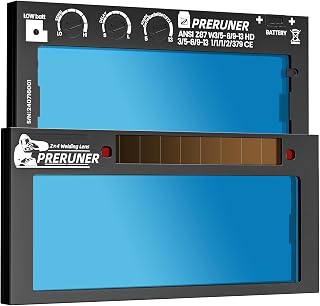
Because there are no LCD layers to polarize light, a passive green or gold lens offers superior optical clarity regarding true color and arc definition. The shade does not oscillate. When you nod your helmet down to strike an arc, the puddle is immediately visible without a millisecond of delay, which can be a critical factor in precise techniques like TIG welding at low amps.
The Gold Lens Advantage
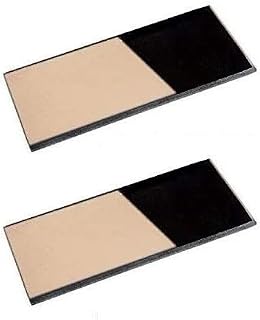
Within the passive lens category, the gold welding lens deserves a special mention. These premium lenses use a coating of 24-karat gold to reflect infrared heat away from the operator’s face. The gold coating creates a cooler work environment and, critically, reflects the amber/yellow light spectrum produced by the welding arc.
This reflection results in a crisp blue-violet viewing spectrum. For professional welders, this blue tint makes it far easier to read the molten puddle, separate slag from metal, and avoid undercut. It is widely considered the superior view for pipe welding and critical x-ray joints.
Passive vs. Auto-Darkening Lenses, A Detailed Comparison
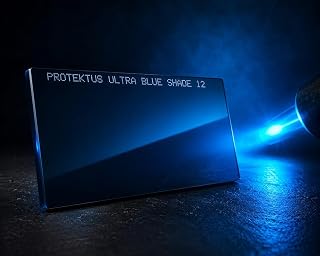
Protektus Ultra Blue Lens Shade 12
Check PriceTo truly understand what a passive lens is, you must measure it against its modern competitor. The choice between passive and auto-darkening often comes down to the work environment and personal philosophy. An auto-darkening helmet simplifies setup by allowing you to see your electrode placement clearly before the arc begins, but it introduces variables a passive lens eliminates entirely.
For high-stakes environments, you might want to read our complete breakdown of the differences between auto-darkening and passive helmets. The table below highlights the key functional differences between the two lens technologies in isolation.
- Reaction Time: Passive lenses have zero reaction time. Auto-darkening lenses have a switching speed measured in 1/25,000th of a second. While incredibly fast, this is not instantaneous.
- Fail-Safe Operation: A passive lens always provides full protection, even if it cracks. If an auto-darkening module fails or the battery dies, it usually defaults to a light state, which can cause severe flash burn.
- Visibility Before Arc: Auto-darkening wins here, allowing hands-free setup in the light state. Passive lenses require the nod technique to drop the hood after positioning.
- Reliability in Extreme Weather: Passive lenses work identically in minus 40-degree cold or dusty environments. Auto-darkening lenses can have sluggish LCD response in extreme cold.
Why Professionals Still Choose Fixed Shades
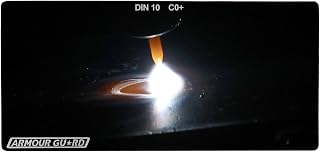
Armour Guard Golden Eye True Color Lens Shade 11
Check PriceYou might wonder why someone would choose a lens that seems harder to use. The answer lies in dependability and optical purity. Pipeline welders, often working miles from a repair shop, cannot afford a helmet malfunction. A passive lens has no solar panel to crack, no battery to replace, and no sensor to block with smoke.
There is also the factor of the human moment. The physical act of nodding your hood down to the dark state forces a ritualistic rhythm. This kinetic memory helps welders establish a consistent body position and breathing pattern before the arc starts. For many, this physical cue is essential for laying a high-quality bead in confined spaces or on critical structural welds.
Durability and Simplicity
A passive lens is essentially a solid-state optical device. It cannot be bricked by grinding dust shorting a circuit board. If it gets covered in spatter, you can wipe it off. If the outer cover lens gets scratched, you replace a cheap piece of plastic rather than an expensive electronic cartridge. This simplicity translates to a lower total cost of ownership over a career, especially when combined with durable traditional hoods like those found in our guide to top-rated passive welding helmets.
The Art of the Nod
Gold Plated Shade 10 Lens 2-Pack
Check PriceThe most common criticism of a passive lens is the difficulty of finding the start point. Beginners often struggle to strike an arc precisely because they must position the electrode blindly and then flip the hood down, a technique known universally as The Nod. However, this challenge is easily overcome.
Professional welders use their off-hand to stabilize the rod or torch tip against the workpiece before the nod. Once the tip is braced, a quick snap of the neck brings the helmet down while the steady hand perfectly holds the start point. With practice, this motion becomes more precise than searching for an auto-sensor to wake up.
Choosing the Right Shade Number
Flex Series HD Auto-Darkening Lens
Check PricSince you cannot adjust a passive lens on the fly, picking the correct fixed shade is vital. The selection depends primarily on amperage. A lens that is too dark forces you to get too close to the puddle, while a lens that is too light can cause eye strain and fatigue over a long day.
You must match the lens to your process. Using the wrong shade for high-amperage flux-core work will leave you seeing spots after just a few minutes. Here is the standard safety chart for selecting a fixed shade lens based on your application.
- Shade 8 to 9: Low amperage TIG (under 50 amps) and light plasma cutting.
- Shade 10: General MIG welding (100 to 175 amps). A comfortable all-around starter shade for hobbyists.
- Shade 11: Heavy MIG and stick welding (175 to 300 amps). The industry standard for structural stick welding.
- Shade 12 to 13: High-amperage stick welding, heavy flux-core, and carbon arc gouging (300+ amps).
Comfort and Eye Fatigue
Your personal sensitivity plays a role. If you have blue or light-colored eyes, you might find that you need one shade darker than the standard recommendation. It is better to err on the side of darkness. You want to see the puddle and the immediate heat-affected zone clearly, but you should not see the general room environment around the arc.
If you suspect your current fixed shade might be causing strain, you might want to check out these high-performance passive welding lenses known for superior optical clarity. A high-end lens provides a sharper view without needing to step down to a lighter, less protective shade.
Frequently Asked Questions
HARFINGTON Shade 10 Glass Lens 2-Pack
Check PriceCan you use a passive lens for TIG welding?
Absolutely. In fact, many high-end TIG welders prefer a passive gold lens. Because TIG requires a very steady arc length and precise filler rod placement, the zero-flicker image of a passive lens provides an unmatched view of the tungsten and the molten pool. It eliminates the glitch some sensitive eyes perceive in lower-quality auto-darkening filters.
Are passive welding lenses safe?
Yes, they are arguably safer in terms of mechanical reliability. A passive lens always provides UV and IR protection, regardless of the state of the helmet. There is no risk of a sudden lens failure mid-arc, which is a rare but possible risk with battery-powered helmets. As long as the shade is appropriate for the amperage, the safety is absolute.
Why are gold passive lenses so expensive?
The cost reflects the manufacturing precision. Gold lenses filter light through interference reflection rather than just absorption. A very thin, consistent layer of gold blocks IR heat efficiently and alters the visible light spectrum to a cooler blue color. This process requires higher precision than a simple tinted green glass, hence the higher price tag for the clarity and comfort they provide.
Do I still need a cover plate with a passive lens?
Definitely. The glass lens itself is the expensive filter, and it is easily scratched by sparks and spatter. You must always place a clear polycarbonate or glass cover plate on the outside (and often the inside) of the actual shade lens. These are cheap and disposable, meant to take the abuse of the welding environment to preserve the integrity of your main lens.
Conclusion
A passive welding lens represents the purest form of arc protection, prioritizing optical clarity and absolute reliability over modern convenience. It is a fixed shade filter that forces the welder to develop a deliberate nod and a rhythmic approach to the work. This deliberate practice often creates a more intimate connection with the welding process itself.
While an auto-darkening helmet might be the right choice for high-speed production shops, every serious welder should learn to work behind a passive lens. It trains your muscle memory, sharpens your arc-starting technique, and provides a fail-safe backup tool. For the clearest view of the puddle and zero electronic lag, the old-school fixed shade remains a champion in the trade.
For those interested in exploring this timeless technology further, we recommend reading more about the wider category of how different welding helmet technologies function from the experts at the American Welding Society. Understanding the physics of light filtration will help you make the best choice for your eyes and your career.
check out the detailed resources at Lincoln Electric’s education hub. When the circuitry breaks, you will be glad you know how to go dark the old-school way.