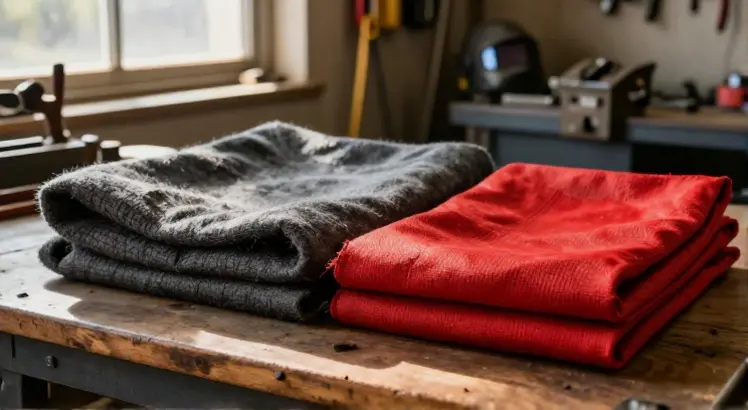
If you are welding overhead, forging steel, or brazing copper pipes, protecting the surrounding area from sparks and slag is non-negotiable. You might have seen black, soft blankets draped over sensitive surfaces and wondered about their material. Specifically, you might wonder: is carbon felt fireproof? The short answer is that carbon felt is not fireproof in the traditional sense, like a brick.
It is, however, extremely heat resistant and non-flammable up to incredibly high temperatures, which often makes it superior to standard fire-resistant fabrics. This article breaks down the science of carbon felt, its limits, and how it compares to other protective textiles, especially for welding applications on your site.
kanhiro 4×6 Feet Large Welding Blanket Fireproof Pad
Check PriceTable of Contents
Defining True Fireproof vs. Heat Resistant
Before throwing a piece of fabric over an engine block during a tricky repair, it is crucial to understand the terminology. In the world of industrial safety, fireproof is a misleading term. Under intense enough heat, almost everything will melt, degrade, or burn. A more accurate term is non-flammable or heat resistant. Carbon felt falls into the non-flammable category in standard atmospheric conditions. It will not burst into flames when you hit it with a direct spark. However, it does have a specific failure point involving oxygen that you must understand to stay safe.
What Is Carbon Felt Made Of?
To grasp why it handles heat so well, we need to look at the source material. Carbon felt is typically produced from polyacrylonitrile (PAN) fibers, similar to the precursor used for high-strength carbon fiber. These precursor fibers are heated to extreme temperatures, often exceeding 1000°C (1832°F), in an oxygen-free environment. This process, called carbonization, drives off all the non-carbon atoms, leaving behind a skeleton of pure carbon; almost like making charcoal, but with a flexible, fibrous structure.
The Science of Carbon Oxidation
This is where the answer to whether carbon felt is fireproof gets nuanced. Carbon itself does not melt. It is an incredibly stable element. However, in the presence of oxygen and at high temperatures, it undergoes oxidation. Think of a charcoal briquette on your grill. It does not liquefy; it glows red and gradually turns to ash. This is exactly what happens to carbon felt. In open air, carbon felt begins to oxidize around 400°C (752°F) to 500°C (932°F). If you heat it to glowing orange temperatures in the open air, it will slowly disappear, turning to dust and carbon dioxide without necessarily producing a sustained flame.
Temperature Limits in Different Environments
5mm 72″x96″ Large Fireproof Welding Blanket
Check PriceThe performance of carbon felt changes dramatically based on the atmosphere. This makes it a dual-purpose material depending on how you use it.
Performance in Inert Atmospheres
Inside a vacuum furnace or an environment flooded with inert gas like argon, carbon felt is practically indestructible. It maintains its flexibility and structure at temperatures exceeding 3000°C (5432°F). This is why it is the premium insulation choice for high-temperature vacuum brazing and heat-treating ovens. It outclasses most refractory ceramics here because it does not become brittle during thermal cycling.
Performance in Open Air (The Welding Reality)
Your workshop is not a vacuum furnace. When you use a welding blanket, it is sitting in an oxygen-rich environment. In open air, the continuous operating temperature of carbon felt usually caps around 300°C (572°F) for long-term durability. For short-term contact, such as a splash of molten slag, it withstands much higher peak temperatures, roughly up to 1800°F (982°C), but it will degrade a tiny bit each time. It sacrifices its surface to oxidation to protect the surface underneath it.
Carbon Felt vs. Fiberglass vs. Silica for Welding Guards
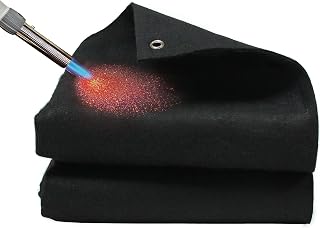
Carbon Felt Welding Blanket 4x6ft, 1800°F Fireproof
Check PriceWhen shielding a hardwood floor or a painted surface from sparks, you need to know which shield wins. Let’s compare the big three materials you’ll find on a job site.
- Fiberglass: Often coated with silicone. It handles continuous heat around 550°C (1000°F). It is cheap and strong but sheds glass fibers that can embed in your skin. It is flammable if the coating burns off.
- Silica Fabric: The big brother of fiberglass. It handles continuous heat up to 1000°C (1832°F) and is truly non-flammable. However, it is extremely expensive, brittle, and hazardous to breathe in if frayed.
- Carbon Felt: Sits in a sweet spot. It is non-respirable, meaning it does not release sharp, airborne shards like fiberglass. It handles intense splash heat instantly, and it is soft and flexible. It is the material you want if you are tired of itching after handling your welding blanket for a smoker or general fabrication table.
Why Carbon Felt Is Safe for Human Contact
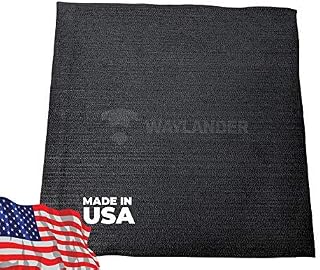
Waylander Carbon Felt Welding Blanket – Made in USA
Check PriceA primary reason welders gravitate toward carbon felt is safety beyond just heat. Standard fiberglass blankets must be handled with gloves because they cause contact dermatitis. Carbon felt is amorphous and soft. It does not create needle-like shards. This makes it one of the best fabrics for welding PPE and secondary protection barriers. You can grab it, fold it, and drape it without a single itch, making setup significantly faster.
Can You Directly Subject Carbon Felt to Open Flame?
Let’s run a mental test. You take a propane torch and aim the blue flame directly at a sheet of carbon felt. The area where the flame touches will instantly glow bright orange. Because the flame consumes the ambient oxygen, the felt does oxidize, but slowly. It will not catch fire and propagate.
It will simply glow until it physically erodes a hole through the oxidation process. It acts as an ablative shield. This is distinctly different from how a cotton or polyester blanket reacts, where the material becomes a fuel source and spreads the flame. You can learn more about the distinction between specialized spark shields and standard emergency fire blankets in our comparison guide.
Practical Welding and Workshop Scenarios
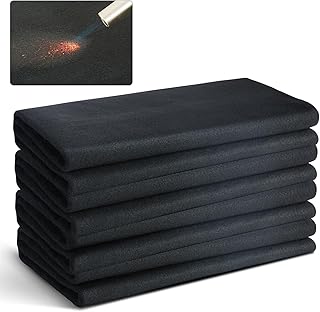
VEVOR Carbon Felt Welding Blanket 4 Pack
Check PriceHow does this translate to your daily grind in the shop? Here are a few examples where the fireproof nature of carbon felt is tested.
- Overhead Stick Welding: Carbon felt is king here. Heavy globs of 6010 slag land on the blanket. The carbon fiber will neutralize the heat instantly without melting a sticky, gooey mess into your floor. The slag just flakes off.
- Plasma Cutting: Plasma tables create a shower of fine, molten dust traveling at high velocity. Carbon felt catches these particles without through-burning. The high surface area of the fibers dissipates the heat faster than a solid sheet of metal.
- Brazing Pipes: When soldering copper lines in a tight wall cavity, a thin strip of carbon felt is safer than a damp rag. It will not burst into flames from the swirl of the torch, and it provides 100% non-itch comfort when stuffing it behind a stud.
Understanding LOI (Limiting Oxygen Index)
To quantify fire resistance, engineers use the Limiting Oxygen Index. This number tells you the percentage of oxygen in the atmosphere required for a material to sustain a flame. Ambient air is about 21% oxygen. Cotton has a low LOI, burning easily. Carbon felt has an LOI that exceeds 60%. This means you need to pump the atmosphere with well over half pure oxygen to get carbon felt to sustain a flame. In normal shop conditions, a spark cannot chemically support a flame on carbon felt. This is the technical reason you can trust it next to your expensive carbon felt welding blanket without fear of a chain reaction fire.
Longevity and the Aging of Carbon Felt
Is carbon felt fireproof forever? No. As it oxidizes, the fibers become thinner and more brittle. A brand-new carbon felt blanket is soft and pliable, a deep velvet black. An aged one turns grey and feels papery. Once the surface has oxidized heavily, it loses density and becomes less effective at blocking heat. If you press your finger on an old blanket and it leaves a dent or the fibers crumble like dry leaves, it is time to replace it. It will still not burn, but a heavy gob of molten metal might punch right through the weakened structure.
Health and Safety Precautions
While carbon felt spares you the itch of fiberglass, oxidized carbon dust is not something you want to breathe. Over time, the surface abrasion generates a fine black soot. When folding or shaking out your blanket, this dust becomes airborne. It is a nuisance particulate. Wearing a dust mask during cleanup is wise, and washing the blanket is not recommended, as water turns the oxidized dust into a conductive sludge. Instead, use compressed air outside your workspace to clean it.
High-Temperature Industrial Uses Beyond the Shop
To truly appreciate the fireproof nature of this material, look at where it lives full-time. It lines the hot zones of sintering furnaces, acts as a diffusion barrier in crystal growing furnaces, and is accepted as a standard engineering material for nuclear and aerospace applications. These industries do not ask Is carbon felt fireproof, they ask how many cycles will it last at 2000°C in a vacuum?” This high-grade pedigree ensures that the sheet you use to catch your MIG welding berries is coming from a background of extreme safety engineering.
According to the Protective Textiles Information Network (PTIN), understanding the specific certification of your PPE is vital for on-the-job safety. Not all heat-resistant materials perform identically under the same conditions, so always check if your blanket meets the recognized safety standards for protective textiles before trusting it with a critical task.
Frequently Asked Questions
Will carbon felt burn if exposed to a cutting torch?
No, it will not produce a flame. A cutting torch preheat flame will cause the carbon felt to glow and eventually dissolve into dust on the contact spot, but the material will not catch fire and spread.
Does carbon felt produce toxic fumes when heated?
Unlike silicone coatings or plastic-based fabrics, pure carbon felt does not produce significant smoke. The primary byproduct of oxidation is carbon dioxide, plus trace carbon monoxide if ventilation is very poor. Always work with ventilation, but toxic fume events are rare compared to burning plastics.
Can I use carbon felt to protect rubber hoses?
Yes, this is an excellent application. The felt insulates so well that heat radiating from the blanket’s backside is often low enough to keep rubber hoses from melting or surface-scorching during close-quarters work.
Why does my carbon felt blanket turn grey?
This is surface oxidation. The top layer of carbon atoms has reacted with air and turned to ash. Light grey coloring usually indicates surface aging, but if the blanket is deep grey and brittle throughout, its structural integrity is gone.
Conclusion: Is It the Right Tool for Your Safety?
So, is carbon felt fireproof? It is the closest thing to a truly fireproof textile blanket you can find, short of a solid ceramic mat. Its inability to sustain a flame, combined with its staggering temperature resistance in open air, sets it apart from almost every other soft shield. It ablates and vaporizes under direct, high-energy abuse without melting or sticking, which is exactly what you want safety gear to do.
It sacrifices itself for the surface below it. For welders who value their time and skin, the switch from fiberglass to carbon felt eliminates the daily annoyance of itching and vastly improves heat management. If you value non-flammability, longevity, and comfort, upgrading your workspace with a high-quality carbon shield is a decision you will not regret every time you lay down a hot bead.