
MIG welding produces intense light and heat, making eye protection an absolute priority. A low-quality helmet can lead to eye strain, slow reaction times, and a poor fit that distracts you from the weld puddle. You need a reliable auto-darkening hood that darkens instantly, offers true color clarity, and stays comfortable all day. This guide sorts through the top options to help you find the right helmet for your MIG workflow.
Short Answer: The YESWELDER LYG-M800H is the best overall welding helmet for MIG welding. It combines a large true color viewing area, four arc sensors, an incredibly fast 1/30000s response, and a versatile shade range for weld, cut, and grind modes. The blue light blocking lens adds extra eye comfort, and the price makes it an unbeatable value for both hobbyists and professionals.
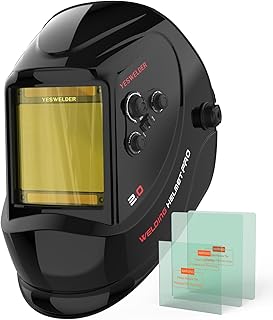
YESWELDER LYG-M800H Auto Darkening Welding Helmet
Check PriceTable of Contents
Best Welding Helmet For Mig Welding of 2026
When you are looking specifically for protection during wire feed welding, a focused guide can help you match lens shade and response time to your process. The resource on selecting a MIG welding helmet breaks down what to consider for this type of arc, and the welding helmet overview on Wikipedia provides helpful background on how modern auto darkening filters work. These two guides together make it easier to understand both the standards and the practical features you need before you buy.
1. YESWELDER LYG-M800H – Best Overall Large View True Color Helmet
YESWELDER LYG-M800H Auto Darkening Welding Helmet
Check PriceWhy it stands out
This helmet delivers premium features at a fraction of the cost of big-name brands. The 1/1/1/1 true color lens reduces eye fatigue and gives you a clear view of the weld puddle. Its four arc sensors and 1/30000s response time virtually eliminate flash, even when out of position.
Key points
- Large viewing area with 1/1/1/1 true color technology
- Shade range 3/5-9/9-13 for weld, cut, and grind modes
- Four arc sensors and 1/30000 second response
- Blue light blocking lens for extra eye protection
Pros
- Exceptional optical clarity and true color view
- Extremely fast auto-darkening response
- Versatile shade range covers most processes
- Comfortable headgear and lightweight design
- Great value compared to premium helmets
Cons
- Headgear may require occasional readjustment
- Battery replacement procedure can be a bit fiddly
Best for
Welders who want a full-featured, true color auto-darkening helmet for MIG welding without spending a fortune. Ideal for hobbyists, fabrication shops, and anyone who switches between weld, cut, and grind modes frequently.
2. Lincoln Electric K4983-1 – Lightweight All-Process Performer
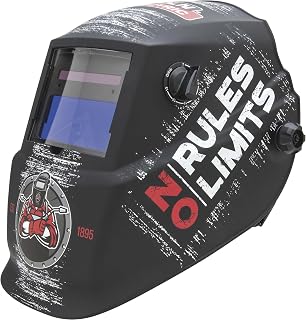
Lincoln Electric K4983-1 No Rules No Limits Helmet
Check PriceWhy it stands out
Lincoln Electric built this helmet for the welder who moves between processes constantly. It handles MIG, pulsed MIG, TIG, Stick, and even gouging with a shade range of 7 to 13. The lightweight design reduces neck fatigue during long shifts, and the grind mode adds convenience.
Key points
- Auto-darkening shade 7-13 with grind mode
- Compatible with Stick, TIG, pulsed TIG, MIG, pulsed MIG, flux core, and gouging
- Lightweight construction for all-day comfort
- Reliable Lincoln Electric arc sensors
Pros
- Extremely versatile process coverage
- Noticeably lightweight, reduces neck strain
- Simple controls that are easy to use with gloves
- Grind mode prevents accidental darkening
- Trusted brand with solid warranty support
Cons
- Viewing area is slightly smaller than some competitors
- Lacks a true color lens, clarity is good but not 1/1/1/1
Best for
Welders who need one lightweight helmet for MIG, TIG, and Stick welding without switching gear. A great fit for maintenance technicians and multi-process fabrication shops.
3. Miller Classic Series – Reliable HD Optics for MIG and TIG

Miller Classic Series ClearLight Helmet
Check PriceWhy it stands out
Miller’s Classic Series brings the company’s trusted ClearLight lens technology to an affordable price point. The HD optics provide a crisp view of the arc, and the variable shade 8-13 covers MIG welding with ease. The comfortable headgear is a hallmark of Miller design.
Key points
- ClearLight variable shade 8-13 auto-darkening filter
- Designed for MIG and TIG welding
- HD optics reduce eye strain
- Comfortable, adjustable headgear with Metal Matrix design
Pros
- Excellent optical clarity for the price
- Durable construction from a reputable brand
- Headgear fits securely and remains comfortable
- Fast and consistent arc detection
- Good heat and spatter resistance
Cons
- No grind mode, which limits convenience
- Shade range starts at 8, not ideal for low-amp TIG
Best for
MIG welders who want a dependable, no-fuss helmet with Miller reliability and clear optics. Perfect for auto body work, farm repairs, and light industrial use.
4. ARCCAPTAIN Large View with Light – Illuminated Welding Hood
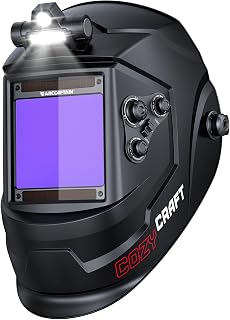
ARCCAPTAIN Helmet with Light, Large View
Check PriceWhy it stands out
This ARCCAPTAIN model stands out with a built-in LED light that illuminates the workpiece before striking an arc. The large 3.94″x3.66″ viewing area and 1/1/1/1 true color lens make it easy to see the puddle. Four arc sensors and a 1/25000s response time keep your eyes safe during MIG welding.
Key points
- Built-in LED work light for setup and low-light environments
- Large viewing area with 1/1/1/1 true color clarity
- Shade range 4/5-8/9-13, solar powered with replaceable battery
- Four arc sensors and 1/25000s response
Pros
- Integrated light is handy for tight spaces
- True color lens reduces eye fatigue
- Wide shade range covers grinding and cutting
- Solar panel extends battery life
- Comfortable headband with good weight distribution
Cons
- Light adds a bit of weight to the helmet
- Replaceable battery may need changing sooner than expected
Best for
Welders who frequently work in dimly lit shops, under vehicles, or in tight corners. The integrated light and large view make MIG welding in challenging positions much easier.
5. ARCCAPTAIN 180° Panoramic – Ultimate Peripheral Vision
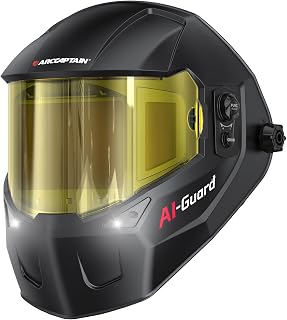
ARCCAPTAIN Intelligent 180° Panoramic Helmet
Check PriceWhy it stands out
The ARCCAPTAIN 180° helmet offers a panoramic view that dramatically improves situational awareness. The 1/1/1/1 true color lens, 1/30000s response, and one-touch grind mode make it a tech-forward choice. Memory and gradient modes add a level of customization rarely seen in this price range.
Key points
- 180° panoramic true color lens for unmatched visibility
- One-touch grind mode, LED light, and memory modes
- 1/30000s response time with four arc sensors
- Gradient mode for comfortable shade transitions
Pros
- Huge field of view reduces blind spots
- Intelligent memory settings for different processes
- Extremely fast response time
- One-touch grind mode is very convenient
- LED light helps with pre-weld inspection
Cons
- Panoramic lens is more exposed to scratches
- Price is higher than standard ARCCAPTAIN models
Best for
Welders who want the widest possible view of the workpiece and surroundings. Excellent for MIG fabrication where you need to see the entire joint and nearby obstacles.
6. ARCCAPTAIN Large Viewing Screen – Budget-Friendly True Color
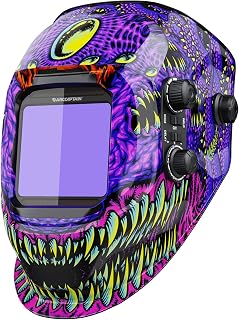
ARCCAPTAIN 3.94″x3.66″ True Color Helmet
Check PriceWhy it stands out
This ARCCAPTAIN helmet packs a large 3.94″x3.66″ screen and 1/1/1/1 true color lens into a very affordable package. The 1/25000s auto-darkening, four arc sensors, and wide shade 4/5-9/9-13 make it a capable MIG welding hood. Solar power plus a replaceable battery ensures you are never caught without power.
Key points
- Large viewing area with true color 1/1/1/1 lens
- Shade range 4/5-9/9-13 includes grind and cut
- Four arc sensors and 1/25000s response
- Solar powered with replaceable battery backup
Pros
- Excellent value for a true color helmet
- Large screen improves visibility
- Reliable auto-darkening performance
- Lightweight and comfortable for extended use
- Dual power source adds reliability
Cons
- No built-in work light
- Headgear adjustment knobs could be more durable
Best for
DIYers and entry-level MIG welders who want a large true color view without spending a lot. A solid choice for automotive repair, light fabrication, and farm work
7. ARCCAPTAIN Dual Solar Panel – Reliable All-Day Power

ARCCAPTAIN Helmet with Dual Solar Panels
Check PriceWhy it stands out
Dual solar panels and two CR2450 batteries give this helmet impressive power reliability. The 1/1/1/1 optical clarity and true color view let you see the MIG puddle in vivid detail. A 1/25000s response time and four arc sensors keep your eyes protected even during rapid tack welds.
Key points
- Dual solar panels plus two CR2450 batteries
- 3.94″x3.66″ viewing area with 1/1/1/1 clarity
- Shade range 4/5-9/9-13, four arc sensors
- 1/25000s switching speed
Pros
- Outstanding battery life and power backup
- Crisp true color optics
- Consistent darkening even in low light
- Good weight balance for its size
- Replaceable batteries extend overall lifespan
Cons
- No grind mode indicator light
- External controls are slightly small for gloved hands
Best for
Welders who work long hours and need a helmet that won’t quit due to battery drain. The dual power system is perfect for remote job sites or all-day MIG welding sessions
8. Miller Digital Infinity – Cost-Effective Professional Quality
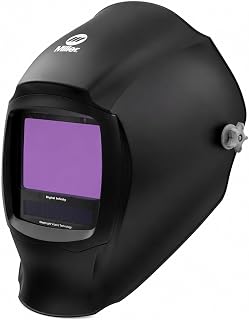
Miller Digital Infinity ClearLight 4X Helmet
Check PriceWhy it stands out
The Miller Digital Infinity brings ClearLight 4X technology into a professional hood that balances cost and performance. It handles MIG, TIG, and grinding with ease, and the digital controls allow precise shade and sensitivity adjustments. The headgear is among the most comfortable in its class.
Key points
- ClearLight 4X HD optics for superior clarity
- Digital controls for shade, sensitivity, and delay
- Designed for MIG, TIG, and grinding
- Professional-grade headgear with multiple adjustment points
Pros
- Excellent optical clarity and true color
- Precise digital adjustment settings
- Comfortable headgear reduces fatigue
- Works well for low-amp TIG as well as MIG
- Durable shell and lens cover
Cons
- Higher price point than entry-level helmets
- Digital interface may take time to learn
Best for
Serious hobbyists and professionals who want a Miller digital helmet with premium optics without stepping up to the top-tier Elite series. Perfect for daily MIG and TIG work.
9. Miller Digital Performance – Smart Value for Daily Welding
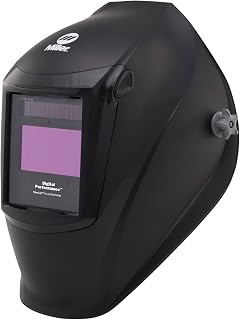
Miller Digital Performance ClearLight 4X Helmet
Check PriceWhy it stands out
This helmet offers Miller’s ClearLight 4X lens and digital performance features at a more accessible price. It is built for MIG and TIG welding, with a grind mode and a comfortable, lightweight shell. The responsive arc sensors and crisp optics make it a strong daily driver.
Key points
- ClearLight 4X variable shade auto-darkening filter
- Digital controls with grind mode
- Lightweight, balanced design for all-day wear
- Suitable for MIG, TIG, and grinding
Pros
- Great value from a trusted brand
- Clear, true color view reduces eye fatigue
- Quick and easy digital adjustment
- Comfortable headband with good padding
- Durable shell withstands spatter
Cons
- Viewing area is slightly smaller than Infinity model
- No memory settings for multiple users
Best for
Welders who want a digital Miller helmet with ClearLight optics but need to keep the budget in check. A solid upgrade for anyone doing regular MIG and TIG welding at home or in a small shop.
10. ESAB Sentinel A60 – Low-Profile High Impact Design

ESAB Sentinel A60 Low-Profile Helmet
Check PriceWhy it stands out
The ESAB Sentinel A60 combines a sleek, low-profile shell with high impact resistance nylon. The large 4.65″x2.80″ viewing area offers excellent visibility, and the true color lens makes MIG welding more precise. It is designed for professionals who demand both protection and style.
Key points
- Low-profile design with high impact nylon shell
- Large viewing area of 4.65″x2.80″
- True color auto-darkening lens
- Comfortable, ergonomic headgear
Pros
- Striking low-profile shape reduces neck strain
- Excellent clarity and color recognition
- Very sturdy and impact resistant
- Comfortable even during long welding sessions
- Looks great and feels premium
Cons
- Price is on the higher side
- Replacement lenses are more expensive than average
Best for
Professional MIG and TIG welders who want a durable, low-profile helmet that performs flawlessly in tight spaces. The high impact resistance also makes it ideal for heavy fabrication environments.
11. Hobart 770890 – Widescreen PureColor MIG Hood
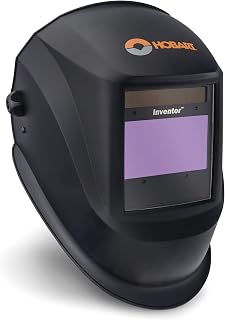
Hobart 770890 Large Auto-Darkening Helmet
Check PriceWhy it stands out
Hobart’s 770890 features a generous 9.3 square inch widescreen view and a PureColor lens that delivers a natural, clear view of the arc. Four arc sensors and analog shade controls make it simple to dial in the right shade for MIG welding. The grind mode adds versatility without complicating the design.
Key points
- 9.3 sq in widescreen PureColor lens
- Four arc sensors and analog shade controls
- Grind mode built in
- Large size fits comfortably over most respirators
Pros
- Wide viewing area enhances visibility
- PureColor provides excellent arc clarity
- Simple analog controls are easy to adjust
- Comfortable headgear with good weight distribution
- Reliable arc detection from four sensors
Cons
- Analog dials can be accidentally moved
- Heavier than some compact helmets
Best for
Welders who want a large, widescreen view and prefer simple analog controls. Ideal for MIG welding in fabrication shops where you need to see the whole workpiece clearly.
12. Sellstrom Advantage+ – Lightweight True Color with 1/1/1/2 Clarity

Sellstrom Advantage+ ADF Welding Helmet
Check PriceWhy it stands out
The Sellstrom Advantage+ offers a 9.3 sq in viewing area and true color technology with 1/1/1/2 optical clarity, which is excellent for the price. The lightweight, ergonomic shell and weld/grind modes make it a great all-around MIG helmet. It meets ANSI Z87.1 standards for reliable protection.
Key points
- 9.3 sq in viewing area with true color
- 1/1/1/2 optical clarity rating
- Weld and grind modes
- Solar and battery powered, lightweight design
Pros
- Impressive optical clarity close to 1/1/1/1
- Large viewing area for the price
- Lightweight and comfortable for all-day use
- Reliable auto-darkening and grind mode
- ANSI Z87.1 certified
Cons
- Slightly slower response than premium models
- Headgear padding may wear over time
Best for
Budget-conscious MIG welders who still want a large, true color view and lightweight comfort. An excellent choice for education, farm, and general maintenance welding.
13. Hobart 770866 – Simple, Dependable Auto-Darkening Shield

Hobart 770866 Auto-Darkening Helmet
Check PriceWhy it stands out
The Hobart 770866 is a straightforward, no-frills auto-darkening helmet that gets the job done. It offers a fixed shade control and reliable arc detection, making it a solid backup or starter hood for MIG welding. The black shell is durable and easy to clean.
Key points
- Auto-darkening filter with fixed shade control
- Lightweight, durable black shell
- Basic analog controls
- Affordable entry-level price
Pros
- Very affordable and easy to use
- Dependable auto-darkening reaction
- Lightweight, reduces neck fatigue
- Minimal setup required
- Good for occasional use or as a spare
Cons
- No grind mode or variable shade adjustment
- Viewing area is smaller than higher-end models
Best for
Beginners, occasional welders, or anyone needing a reliable backup helmet for MIG welding. It keeps things simple and provides essential protection at a low cost.
How to Choose the Right MIG Welding Helmet
Start with the lens. A true color or 1/1/1/1 optical clarity rating gives you a natural view of the weld puddle, which is crucial for MIG. You will see the wire and base metal clearly, reducing mistakes. A shade range of 9 to 13 is standard for MIG, but a wider range that includes grind mode adds flexibility.
Arc sensor count matters. For MIG, four sensors are ideal because they detect the arc from multiple angles, preventing the lens from flickering if you move your head. A fast response time of 1/25000s or faster is essential to avoid flash burn. Look for helmets that switch at least that quickly.
Comfort is non-negotiable. A lightweight helmet with adjustable headgear and good weight distribution will keep you focused on the weld, not on neck pain. The viewing area size also impacts comfort, a larger window helps you see the joint and your surroundings without constantly repositioning your head.
Finally, consider power source. Solar-assisted helmets with replaceable batteries offer the best reliability. They charge from the arc light and have a backup when the sun is not an option. This ensures your helmet is always ready, even after sitting in a dark toolbox for weeks.
Common Mistakes to Avoid When Buying a MIG Helmet
One big mistake is ignoring the optical clarity rating. Many cheap helmets advertise auto-darkening but have a low clarity lens that makes the puddle look green or blurry. This forces you to squint and leads to eye fatigue. Always aim for at least 1/1/1/2 clarity, and 1/1/1/1 if your budget allows.
Another error is choosing a helmet with too few arc sensors. For MIG welding, two sensors can be blocked by your hand or the gun, causing the lens to lighten mid-weld. Four sensors provide redundancy and far more reliable darkening. Do not skimp on sensor count just to save a few dollars.
Many people also forget to check the headgear before buying. A helmet that feels heavy or pinches after ten minutes will ruin your welding experience. Look for models with padded, fully adjustable headbands and a balanced center of gravity. If possible, try one on or read reviews that mention long-shift comfort.
Finally, do not overlook the importance of a grind mode. If you frequently switch between welding and grinding, a helmet that locks into a light state without needing to flip it up is a huge time-saver. Buying a helmet without grind mode often leads to frustration and wasted motion.
Frequently Asked Questions
What shade lens is best for MIG welding?
For most MIG welding, a shade 10 to 12 is recommended depending on amperage. A variable shade helmet that covers 9 to 13 gives you the flexibility to adjust for different material thicknesses and wire sizes. A shade 10 is a good starting point for general mild steel MIG welding under 200 amps.
How does auto-darkening work?
Auto-darkening helmets use arc sensors to detect the bright light of the welding arc. A liquid crystal display (LCD) filter instantly darkens to the preset shade. When the arc stops, the filter returns to a light state. This allows you to see your workpiece clearly without flipping the helmet up.
What is true color technology?
True color lenses use optical coatings to reduce the green or yellow tint common in standard auto-darkening filters. The result is a more natural, clear view of the weld puddle and surrounding metal. This reduces eye strain and helps you see the weld bead formation more accurately.
Do I need a large viewing area for MIG welding?
A larger viewing area helps you see the full joint and your surroundings without moving your head. It is especially helpful for MIG welding where you need to monitor the wire stickout and puddle. However, large lenses can add weight, so balance your preference for size with comfort.
Are solar-powered helmets reliable?
Yes, solar-powered helmets are very reliable. They use the arc’s light to charge a battery, and most have a replaceable backup battery. This dual power system ensures the helmet will darken even if the solar cell has not been used recently. Just remember to store the helmet in a light area or replace the battery periodically.
How do I adjust the headgear for a proper fit?
Most helmets have a ratcheting knob at the back to tighten or loosen the headband. The top strap adjusts the height on your head, and the tilt mechanism changes the angle of the helmet. Adjust these until the helmet sits snugly without pinching and the lens is centered on your eyes.
Can I use the same helmet for TIG and Stick welding?
Yes, many auto-darkening helmets are rated for multiple processes. Look for a helmet with a shade range that goes down to at least 5 or 8 for low-amp TIG and up to 13 for Stick and heavy MIG. A grind mode is also useful when switching between processes.
What is the best response time for an auto-darkening helmet?
A response time of 1/25000s or faster is considered excellent. High-end helmets offer 1/30000s. A faster response time means the lens darkens almost instantly, eliminating even the briefest flash that can cause eye discomfort. For MIG, 1/25000s is perfectly adequate.
How do I prevent my helmet lens from fogging?
Choose a helmet with good ventilation or an anti-fog coating on the lens. You can also use anti-fog wipes or sprays. Keeping the helmet in a dry, temperature-stable area helps prevent condensation. If you weld in a humid environment, a helmet with a built-in exhaust or fan can be a worthwhile upgrade.
Is a grind mode necessary?
It is not strictly necessary, but it is very convenient. Grind mode locks the lens in a light state, so you can grind without the filter darkening accidentally. Without it, you may need to flip up the helmet or adjust sensitivity constantly, which slows down your workflow.
Conclusion
Finding the best welding helmet for MIG welding comes down to balancing optical clarity, response speed, comfort, and features. The YESWELDER LYG-M800H stands out as the top overall pick because it delivers a true color large view, four sensors, and a lightning-fast response at a price that is hard to beat. It covers all the essential MIG modes and includes a blue light blocking lens, making it a smart choice for daily use.
For those who prioritize a panoramic view and advanced tech, the ARCCAPTAIN 180° model is a game changer. If you prefer a trusted industrial brand, Miller’s Digital Infinity or the Lincoln Electric K4983-1 offer professional-grade reliability. Whichever helmet you choose from this list, you will be getting a solid tool that protects your eyes and improves your MIG welding results.
Remember to focus on comfort, sensor count, and lens clarity above all else. A good helmet is an investment in your safety and weld quality. Take your time, compare the options, and you will find the perfect hood for your MIG welding projects.
Once you know the basics for MIG protection, comparing top rated models side by side helps you avoid paying for features you will not need. Our list of the best welding helmets across different budgets and styles gives you a quick way to see which options balance clarity, comfort, and durability. It is especially useful for narrowing down choices when MIG welding is only one of several processes you use in your shop.

James is a welding expert, accomplished author, and trusted guide with over 8 years of experience in the industry. With his in-depth knowledge and engaging writing style, James has become a true authority in the field, offering readers and clients invaluable expertise and insights to take their welding skills to new heights.