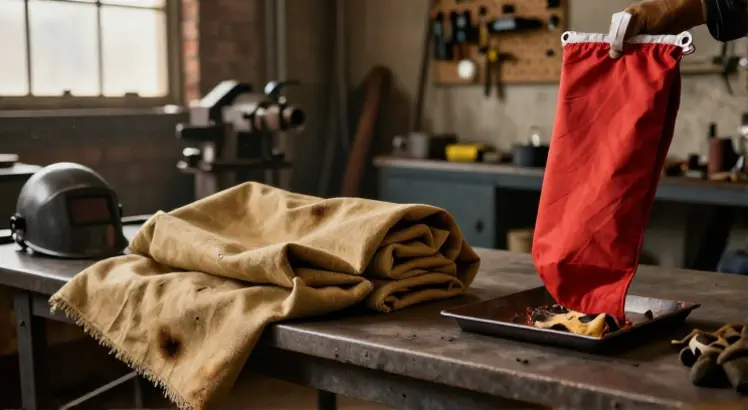
You are setting up your workshop or preparing for a home project, and you know you need heat protection. But should you grab a welding blanket or a fire blanket? They might look similar at first glance, but these two protective textiles serve very different purposes. Choosing the wrong one can lead to damaged equipment, a failed safety inspection, or worse, a burn injury. This guide breaks down the welding blanket vs fire blanket debate so you can pick the right safety gear with confidence.
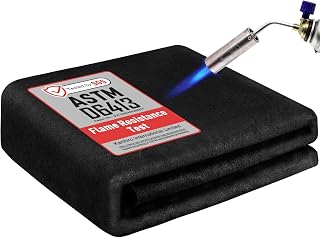
kanhiro 4×6 Feet Large Welding Blanket Fireproof Pad
Check PriceTable of Contents
What Is a Welding Blanket?
A welding blanket is a heavy-duty shield designed to protect surfaces, equipment, and people from the extreme heat, sparks, and spatter produced during welding and cutting operations. Unlike a simple cloth, these blankets are built to withstand direct contact with molten metal globs without igniting or burning through right away. They are used horizontally to cover floors, draped vertically to create protective curtains, or wrapped around flammable objects like gas cylinders and hoses.
Welding blankets come in a range of materials, each rated for different temperature thresholds and use cases. Common choices include fiberglass, silica, ceramic, and carbon felt. For a deep dive into material options, you can explore our guide on different materials used in welding blankets. A fiberglass blanket might be perfectly adequate for light-duty MIG welding, while a heavy-duty application near high-amperage arc gouging demands a heavy-duty carbon felt welding blanket that can withstand continuous temperatures above 1,800°F.
What Is a Fire Blanket?
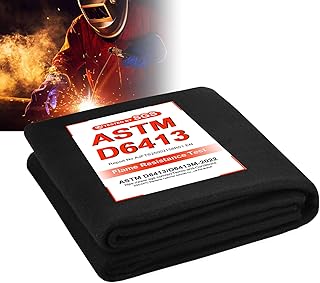
5mm 72″x96″ Large Fireproof Welding Blanket
Check PriceA fire blanket is a safety device crafted primarily to extinguish small incipient fires or to wrap around a person whose clothing has caught fire. The fabric is typically woven fiberglass or a fire-retardant treated wool. Its main job is to smother flames by cutting off the oxygen supply. Fire blankets are compact and frequently packaged in quick-release pouches, making them ideal for kitchens, laboratories, and residential garages.
While fire blankets do have some heat resistance, they are not engineered to handle the prolonged thermal assault of welding slag. Their strength lies in emergency reaction. In fact, the NFPA’s guidelines on fire blankets emphasize their use for smothering pan fires and clothing fires, not for industrial hot work. A fire blanket is your first-aid responder, not your everyday workshop barrier.
Key Differences Between Welding Blankets and Fire Blankets
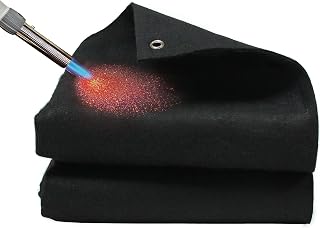
Carbon Felt Welding Blanket 4x6ft, 1800°F Fireproof
Check PriceUnderstanding the real-world distinction goes beyond just reading the label on a shelf. Here is exactly what separates a welding blanket vs fire blanket in material science, safety ratings, and daily use.
Material Composition
Welding blankets are typically made from robust materials like amorphous silica, high-temperature glass fiber, ceramic fiber, or carbon felt. These fabrics can be coated with vermiculite to improve resistance to flame and abrasion. Fire blankets, on the other hand, are usually made from woven fiberglass or treated wool that is soft, flexible, and thin enough to fold into a small container. The material in a fire blanket is not designed to resist the mechanical tearing that can occur from heavy spatter; it is designed for the soft drape needed to wrap around a burning pan or a person.
Temperature Resistance
Temperature rating is the most critical technical difference. A standard fire blanket is generally rated to around 1,000°F (540°C) for brief exposure. A welding blanket must survive much higher heat. Entry-level fiberglass welding blankets handle around 1,000°F to 1,500°F for short bursts. Silica or ceramic blankets withstand 2,000°F to 3,000°F in continuous service. When you are comparing a welding blanket vs fire blanket, think of it this way: a fire blanket is made to extinguish a pan fire, while a welding blanket is made to catch a stream of 3,000-degree molten steel droplets without failing.
Intended Applications
- Welding blankets: Used for horizontal surface protection under welding areas, vertical welding curtains, covers for hydraulic hoses and electrical panels, and heat shields during soldering or plasma cutting.
- Fire blankets: Used for smothering small stove fires, wrapping around a person to extinguish clothing fires, and as emergency backup in commercial kitchens or laboratories.
Using a fire blanket as a welding shield is dangerous. The thin fabric can burn through almost instantly when hit by MIG spatter, leaving the surface behind exposed and creating a hidden ignition risk. Always match the blanket type to the specific task.
Safety Certifications and Standards
Welding blankets are often tested to standards like ANSI/FM 4950 for welding pads and blankets, or ISO 6941 for flame spread. Fire blankets carry different certifications, such as BS EN 1869:1997 for cookery fire blankets in the UK or ASTM F1989 in the US for cooking fire suppression blankets. These differing standards highlight the separate engineering philosophies: one is for hot work containment, the other for life-saving first response.
Size and Portability
Fire blankets are compact, often stored in a 40 cm by 40 cm wall-mounted case for rapid one-handed deployment. Welding blankets are bulkier and heavier, ranging from small 3×3 foot squares used for bench work to oversized 6×8 or larger drapes that cover entire machinery. Portability is a convenience in a fire blanket, while durability and coverage are the priority in a welding blanket.
How to Choose the Right Blanket for Your Needs
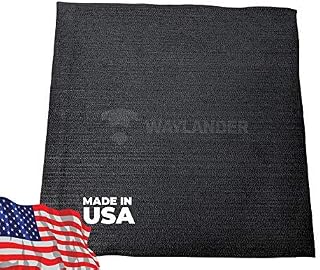
Waylander Carbon Felt Welding Blanket – Made in USA
Check PriceDecision time is simple when you separate the scenarios. Ask yourself one question: will this blanket face direct, high-velocity sparks and molten metal, or am I preparing for a small liquid or cloth fire emergency?
For Welding and Metalwork
Select a welding blanket based on your maximum heat output. If you are doing occasional stick welding on a garage bench, a lightweight fiberglass welding blanket rated to 1,000°F can work. For high-amperage MIG welding or plasma cutting, step up to silica or carbon felt rated at 1,800°F or higher. Check the blanket for hem reinforcement; edges should be double-folded and stitched with heat-resistant thread like Kevlar. Grommets are crucial if you plan to hang the blanket as a curtain. Always position the blanket so that spatter rolls away, not pooling into folds.
For Kitchen or General Fire Safety
A fire blanket belongs in the kitchen, near the grill, or in the workshop’s emergency kit. Look for a blanket that meets an established standard for cooking fires, has clear pulling straps, and is stored where it can be reached without having to cross a potential fire zone. Practice the deployment motion once: pull sharply on the straps, hold the blanket by the top edge covering your hands, and approach the fire slowly to avoid splashing burning oil. Replace a fire blanket after any use, even a test deployment, because fibers can be compromised.
For Industrial Settings
Large manufacturing floors often need both types of protection, but they serve completely independent roles. Keep certified welding blankets at every hot work station. Mount fire blankets in marked emergency cabinets along walkways, near electrical panels, and in break rooms. Never substitute one for the other; a quality manager or safety officer will flag a fire blanket used as a welding pad as a non-compliance incident. Maintaining clear separation shows adherence to workplace safety protocols.
Common Myths and Misconceptions
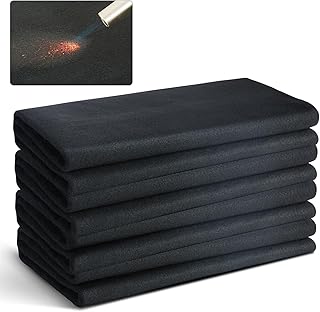
VEVOR Carbon Felt Welding Blanket 4 Pack
Check Price- A fire blanket can double as a light-duty welding blanket. False. The fabric is too thin and lacks the thermal mass to dissipate heat from slag, which can burn straight through in seconds.
- All fiberglass blankets are the same. Not true. Fiberglass used in fire blankets is often a different weave and coating than that used in welding blankets. Welding-grade fiberglass has a higher temperature coating and tighter weave.
- You can throw a fire blanket away after the expiration date. It depends on the manufacturer, but an unused fire blanket stored properly can last many years. Inspect it for visible wear, but replace it instantly if any damage is found.
How to Properly Use and Maintain Your Blanket
Both types of blankets need regular visual checks. For welding blankets, shake them out after use to remove loose debris, and store them flat or rolled, never folded in sharp creases that stress the fibers. If a hole burns through, repair it with a patch of the same material using high-temperature tape, or replace it if the damage exceeds a small puncture. When a welding blanket becomes brittle or stiff to the touch, it has lost structural integrity and should be retired.
Fire blankets need to remain in their original quick-release container. Do not fold them creatively to fit in a custom box; the manufacturer’s fold pattern ensures a smooth, tangle-free rollout. Keep the fire blanket in an accessible location, and make sure everyone in the household or shop knows its purpose and how to deploy it. After a fire incident or a practice drill, replace the blanket without hesitation.
Frequently Asked Questions
Can a welding blanket be used as a fire blanket?
Technically, you could smother a fire with a welding blanket, but it is not ideal. Welding blankets are heavy and stiff, making them hard to handle in a panic. They lack the fast-pull tabs and soft drape needed to effectively cover a pan fire or a person. You are better off keeping the right tool for each job.
Is a fire blanket adequate for soldering or light brazing?
Even light brazing can produce tiny hot splashes that exceed the thermal limit of a standard fire blanket. While the risk is lower than with arc welding, it is still safer to use an inexpensive light-duty fiberglass welding blanket rated to at least 1,000°F. This small investment prevents a damaged countertop or a fire.
How do I dispose of a spent welding blanket?
Most welding blankets are not hazardous waste, but they can be an irritant due to broken fibers. Wear gloves and a dust mask when handling a worn blanket. Place it in a heavy-duty trash bag and tape the edges to contain loose silica or glass particles. Check local regulations if the blanket has been contaminated with oil or chemicals.
What thickness of welding blanket do I need?
Thickness is measured in weight per square yard or millimeter depth. For occasional home welding, a 10 to 15 oz per square yard fiberglass blanket works well. For heavy industrial applications or overhead plasma cutting, select a 20 oz or heavier silica or carbon felt blanket. A thicker blanket provides more thermal mass to absorb and dissipate heat, which extends its useful life.
Conclusion
The welding blanket vs fire blanket question boils down to heat intensity and exposure time. A welding blanket is a tough, temperature-resistant barrier built for the direct onslaught of sparks and molten metal. A fire blanket is a life-saving emergency tool designed to suffocate flames. Using them interchangeably compromises safety. Stock your workshop with welding blankets for hot work protection and mount a fire blanket in an accessible spot for unexpected emergencies. With the right choice, you keep both your project and your space protected.