If you are researching metal fabrication or just need to fix a gate hinge, you have likely wondered, How expensive is a MIG welder? The answer is not a single number. MIG welder prices swing from under $200 for a basic flux-core machine to over $2,500 for a heavy-duty industrial unit. Understanding what drives these costs helps you avoid overspending on features you do not need or wasting money on a machine that cannot handle your projects. In this guide, you will see realistic price ranges, the biggest factors that influence the final bill, and how to pick the best machine for your budget.
A MIG welder is one of the most beginner-friendly welding processes, and the initial machine cost is only part of the equation. You also need to budget for shielding gas, a welding helmet, gloves, and consumables. However, getting started does not have to drain your savings. Many capable machines sit in the sweet spot between affordability and performance. We will break down every price tier with clear numbers so you can make an informed decision.
Table of Contents
MIG Welder Price Breakdown by Category
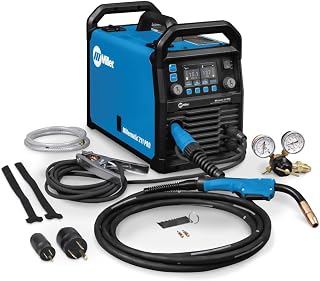
Millermatic 211 PRO MIG Welder
Check PriceTo answer how expensive is a MIG welder properly, you must separate machines into three practical groups. Each group targets a specific type of user, from the weekend hobbyist to the full-time fabricator. The price jumps between categories are driven by amperage, duty cycle, brand reputation, and additional features like infinite voltage control or advanced drive systems.
Below is a straightforward look at what you can expect to pay in 2026 for a new machine. Remember, the market shifts slightly each year, but these brackets remain consistent across major retailers like Home Depot, welding supply stores, and online platforms.
- Budget Entry-Level Models: $150 – $350
- Mid-Range Hobby and Farm Machines: $400 – $1,000
- Professional and Industrial Units: $1,200 – $2,800+
Budget models are almost always 110-volt or dual-voltage machines that run flux-core wire right out of the box. They deliver enough heat for thin materials like 16-gauge sheet metal or exhaust tubing. As you climb to mid-range, you step into 220-volt territory with much higher duty cycles and the ability to weld 1/4-inch and thicker steel in a single pass. Professional-tier machines are built for continuous use, feature pulsing functions, and handle thick aluminum when paired with a spool gun.
We previously took a deep dive into how much MIG welders can cost in specific scenarios, and the data consistently shows that most home users find their ideal match between $500 and $800. That range gives you true gas-shielded MIG capability, a solid wire drive, and a durable build without crossing into industrial pricing.
Key Factors That Determine MIG Welder Pricing
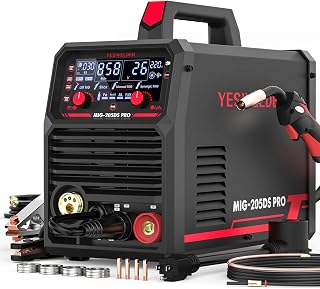
YESWELDER 205A 5-In-1 MIG Welder
Check PriceThe sticker price on a MIG welder reflects several technical and brand-driven elements. Once you understand these, the question how expensive is a MIG welder becomes a logic puzzle instead of a guessing game. You can scan a spec sheet and immediately know if the price matches the capability.
Amperage and Power Output
Amperage is the engine size of your welder. A 110-volt machine typically maxes out around 140 amps, enough for materials up to 3/16-inch thick. A 220-volt welder often pushes 200 to 250 amps, allowing you to weld 1/2-inch plate in fewer passes. More amps mean a larger transformer or more sophisticated inverter technology, both of which raise the manufacturing cost and, ultimately, the price tag.
Inverter-based welders are more expensive up front but offer better arc control and portability. A high-amp inverter machine can cost twice as much as a transformer-based unit with the same peak amperage, but the smoother weld quality and lighter weight often justify the difference for serious hobbyists.
Duty Cycle
The duty cycle tells you how long you can weld continuously without the machine overheating. Budget welders often have a 20% duty cycle at full power, meaning you weld for two minutes and let the machine rest for eight. Professional machines maintain a 60% or even 100% duty cycle at full output. A higher duty cycle demands robust cooling fans, thicker copper windings, and better thermal protection, all of which increase the purchase price significantly.
Brand Reputation and Build Quality
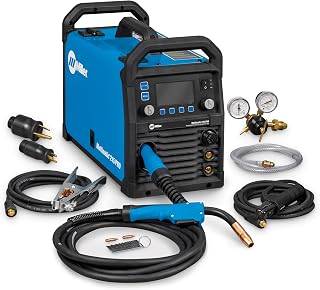
Miller Multimatic 215 PRO Multiprocess Welder
Check PriceLincoln Electric, Miller, and Hobart dominate the North American market for a reason. Their machines use high-quality feed motors, precision-machined drive rolls, and reliable circuit boards. You pay a premium for that engineering and customer support. Lesser-known brands like YesWelder or Tooliom offer aggressive pricing by using simpler designs and lighter components. The build quality difference shows up in arc stability and long-term reliability, not just on a spec sheet.
Gas vs. Gasless Capability
A true MIG setup requires a shielding gas cylinder, a regulator, and a gas hose. Machines marketed as MIG that run only flux-core wire are technically wire-feed welders and cost less because they skip the gas solenoid and related plumbing. Full MIG capability adds roughly $50 to $150 to the machine cost compared to a flux-core-only counterpart. This small price bump unlocks cleaner welds with less spatter and no slag to chip.
Included Accessories and Features
Some welders arrive ready to weld with a regulator, sample wire, and even a basic helmet, while others sell every accessory separately. Advanced features like digital displays, pulse welding programs, spot-weld timers, and memory settings push the price higher. A spool gun connection, essential for aluminum MIG welding, often adds $100 to $200 to the machine cost. For most beginners, bare-bones kits with a quality gun and a sturdy work clamp offer the best value.
Typical Price Ranges by Brand and Model
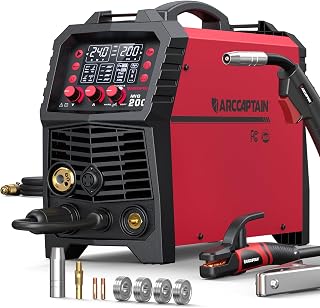
ARCCAPTAIN MIG200 6-in-1 Welder
Check PriceTo make the abstract numbers tangible, here is where popular MIG welder models land in 2026. Keep in mind that prices fluctuate with sales events, rebates, and seasonal promotions, but these brackets hold steady throughout the year.
- Hobart Handler 140: $550 – $600. A gold-standard 110-volt MIG for home shops and auto body work.
- Lincoln Electric Easy MIG 180: $800 – $950. A 220-volt workhorse that welds 1/2-inch steel and runs on a 50-amp circuit.
- Miller Millermatic 211: $1,400 – $1,600. An inverter-based dual-voltage machine with Advanced Auto-Set, beloved by mobile welders.
- YesWelder MIG-205DS: $400 – $450. A feature-packed budget dual-voltage unit with a large color screen and synergic settings.
- Forney Easy Weld 140 MP: $300 – $350. A flux-core capable machine that can be upgraded to full MIG, popular with absolute beginners.
There is a noticeable gap between the Hobart and YesWelder prices despite similar amperage claims. The difference lives in the wire drive consistency, the quality of the MIG gun, and the local service support. If you only weld occasionally, the budget option often makes sense, and you can read more about whether MIG welding is an expensive hobby once you factor in gas and wire costs.
New vs. Used MIG Welders: Should You Save More?
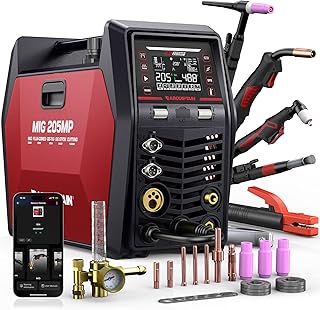
ARCCAPTAIN MIG205MP 9-in-1 Welder
Check PriceBuying a used MIG welder can cut the price by 30% to 50%, but it introduces risk. A well-maintained Lincoln or Miller can perform like new for years, while a poorly stored off-brand machine can become a money drain. The used market is full of sellers upgrading their gear, and that is where you find the best deals.
When shopping used, always test the welder under load. Listen for unusual humming, check the drive rolls for wear, and verify that the gas solenoid clicks when you pull the trigger. Factor in the cost of a new liner, work clamp, and a set of contact tips, because those small consumables add up fast. Avoid extremely cheap no-name welders with zero parts support, no matter how low the price drops.
Hidden Costs: What Else You Need to Start MIG Welding
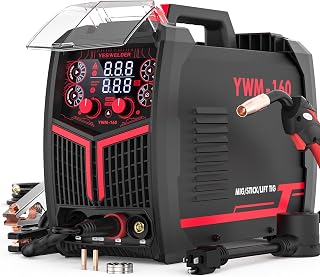
YESWELDER 160A 4-in-1 Welder
Check PriceAnswering how expensive is a MIG welder without mentioning the supporting gear gives you a false number. The machine alone is just the starting point. You must budget for the following essentials, which together can add $200 to $500 to your initial outlay.
- Shielding gas cylinder: $150 – $250 for an 80 cubic foot owner bottle, plus $30 – $50 per refill depending on mix.
- Auto-darkening welding helmet: $40 – $150. A reliable helmet protects your eyes and improves your weld accuracy.
- Welding gloves and jacket: $30 – $80. Leather is essential for comfort and safety.
- Solid wire and flux-core wire spools: $15 – $40 each, depending on diameter and material.
- Angle grinder and consumables: $50 – $100 for a basic model plus grinding and cutting discs to prep metal.
Without an auto-darkening helmet and a means to clean your metal, your weld quality will suffer no matter how much you spent on the machine. Savvy beginners often buy a complete welding starter kit that bundles some of these accessories, trimming the overall price by 15% to 20% compared to buying items individually.
How to Match Your MIG Welder Budget to Your Projects
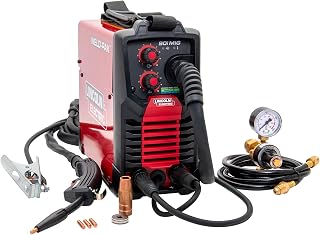
Lincoln Electric 90i Weld-PAK Welder
Check PriceYour material thickness and usage frequency dictate the budget bracket you should target. Spending $1,500 on a heavy-duty Miller when you only weld 1/8-inch brackets once a month is overkill. Conversely, frustrating thin welds with a $200 flux-core machine on a structure where a weld failure could be dangerous is equally unwise.
For automotive sheet metal, furniture, and general farm repairs, a 110-volt MIG welder in the $400 to $700 range strikes the ideal balance. These machines plug into standard household outlets and handle most mild steel up to 3/16-inch with clean results. If you plan to weld truck frames, heavy equipment buckets, or thick structural steel, you need a 220-volt machine pushing at least 180 amps, putting you firmly in the $800 to $1,200 category.
Many welders stretch their budget by starting with a flux-core machine, then adding a gas kit later. This path lets you learn bead control without a gas bottle, and you can spread the cost across several months. The key is buying a machine that already includes the gas solenoid and port, not a locked flux-core-only unit.
Welding should be safe and enjoyable, not a financial burden. If you are unsure which path to take, consider reading Miller Electric’s guide to MIG welding fundamentals to see demonstrations of the process and understand what a good weld looks like. Building skills on a reliable, mid-priced machine builds confidence and pays off in every project.
Frequently Asked Questions
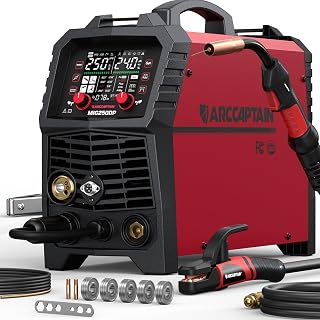
ARCCAPTAIN MIG250DP 8-in-1 Welder
Check PriceHow much is a cheap MIG welder?
A bare-bones flux-core machine can cost as little as $150 to $200. These models typically output 90 to 120 amps and work best on thin steel. They lack the gas solenoid and regulator needed for true MIG welding, so the price reflects a wire-feed welder rather than a full MIG setup.
Are expensive MIG welders worth it for a beginner?
Not usually. A beginner benefits more from a smooth arc and easy setup than from advanced pulse programs or high duty cycles. Spending between $400 and $700 on a respected brand like Hobart or Lincoln gives you a forgiving learning curve without breaking the bank. You can sell and upgrade later if your needs grow.
How much should I spend on my first MIG welder?
Aim for $400 to $700. That range buys a reputable 110-volt MIG welder with true gas capability from a known manufacturer. You get a reliable wire drive, decent duty cycle for home projects, and widely available consumables. Pair it with an $80 auto-darkening helmet and a small gas cylinder, and you have a serious starter setup.
What is the average price of a MIG welder for home use?
Most home users spend between $450 and $850. That average includes mid-range machines from Lincoln, Hobart, and Miller, as well as capable dual-voltage imports. This window covers the majority of residential welding tasks, from trailer repairs to furniture making, without paying for industrial features that sit unused in a garage.
Can I get a good MIG welder for under $500?
Yes. The Hobart Handler 125, YesWelder MIG-205DS, and Eastwood MIG 135 all hover near or below $500. These machines weld up to 3/16-inch mild steel cleanly when paired with shielding gas. They do lack the horsepower for thick plate, but for car panels, brackets, and home repairs they perform admirably and offer great long-term value.
Conclusion
So, how expensive is a MIG welder? You can spend $200 on a simple flux-core welder to stick thin metal together, or $2,800 on a professional-level machine that handles thick aluminum and runs all day without a hiccup. The real sweet spot for most readers lies between $500 and $800. That investment puts a genuine, gas-shielded MIG unit in your garage, backed by a solid warranty and a brand that stands behind its gear.
Price alone does not make a welder good. A $400 machine that produces a stable arc and feeds wire smoothly is a far better value than a glitchy $1,200 unit with bells and whistles you never touch. Match the machine to your thickest material, factor in the cost of gas and safety gear, and you will end up with a setup that pays for itself in saved repair bills and new project capabilities. Start with a reliable mid-range model, practice consistently, and your first MIG welder will quickly become your most valued tool.