If you are staring at a rusty gate or dreaming of building a custom table, MIG welding looks like the superpower you need. The smooth, almost automatic-looking wire feed makes it seem like a plug-and-play process. But before you dive in, you have to ask the big question: is MIG welding expensive? The short answer is that it is a moderately priced process. It is cheaper than TIG welding to start but pricier than basic Stick welding. The true cost hides in the details, not just the sticker price of the machine.
Many beginners make the mistake of looking only at the welder itself. The reality is that the consumables, the shielding gas, and the safety gear stack up fast. This guide breaks down every dollar you will spend. We will look at budget setups for home hobbyists and compare them to serious professional rigs. By the end, you will know exactly where your money goes and how to save some of it.
Table of Contents
What Drives the Cost of MIG Welding?
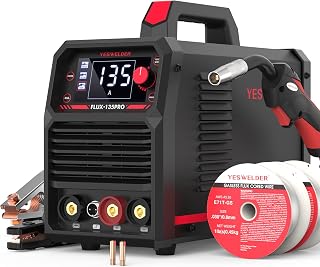
YESWELDER 135A MIG Welder
Check PriceMIG welding, or Metal Inert Gas welding, is a race between the wire and the metal. To keep that race going, you need three things constantly: electricity, filler wire, and a gas shield. Every single one of these has a recurring cost. The machine itself is a one-time hit to your wallet, but the wire and gas are a subscription service you pay for as long as you weld. Understanding this balance is the secret to knowing if the hobby is sustainable for you.
There is also a hidden fourth cost: preparation. Unlike Stick welding, MIG hates dirty metal. You might find yourself spending money on grinding discs and cleaning solvents. So, when we ask is MIG welding expensive, we must look beyond the initial purchase. We have to look at the ecosystem of accessories required to make a good weld, something we discuss often when reviewing the best welder for beginners.
The Hobbyist vs. Professional Budget
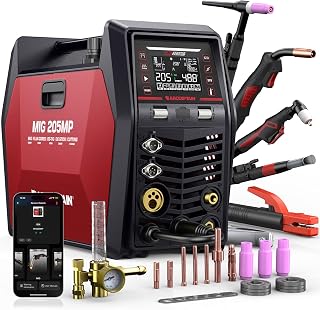
ARCCAPTAIN MIG205MP
Check PriceYour spending destination depends entirely on your welding goals. A weekend warrior fixing lawnmower decks has zero need for a $3,000 industrial machine. Conversely, a professional auto fabricator cannot rely on a cheap 110-volt box store special. To make sense of the market, let us split the costs into two clear tiers. This will help you decide if you need a simple setup or a heavy-duty workhorse.
Hobbyist and DIY Setup Costs
For most people reading this, the hobbyist range is the sweet spot. You can get into reliable flux-core or entry-level MIG welding for less than the price of a major car repair. A decent 110-volt MIG machine from brands like Hobart or Lincoln Electric often lands between $300 and $600. These machines plug into standard household outlets and are perfect for thin metal up to 1/4 inch.
However, the machine is just the start. If you run solid wire, you need a gas cylinder. A small 40 cubic foot cylinder of 75/25 Argon/CO2 mix costs about $200 to purchase outright, plus refills of around $35. Then you need a quality auto-darkening helmet. You do not need a $400 one, but do not use a $20 flip-down lens either. A safe, reliable welding helmet costs roughly $100.
- MIG Machine (110V): $300 – $600
- Shielding Gas Cylinder (Owned): $180 – $220
- Auto-Darkening Helmet: $80 – $150
- Gloves, Jacket, and Wire: $100 – $150
Professional and Industrial Costs
If you are welding thick aluminum or running continuous beads all day, the price tag jumps fast. Professional MIG machines have higher duty cycles. This means they can weld longer without overheating. These 220-volt machines often cost between $1,500 and $5,000. They also require an electrician to wire a dedicated outlet in your garage if you do not have one, adding a few hundred dollars to the install.
The consumable cost also rises. Industrial work uses large spools of wire. A 33-pound spool of quality ER70S-6 wire costs significantly more than a 2-pound hobby roll. Plus, spool guns for aluminum are an added expense. Professional setups usually include a running gear cart and a large 125+ cubic foot gas cylinder. The entry price for a professional MIG setup rarely dips below $2,500 all-in.
Breaking Down the Consumables
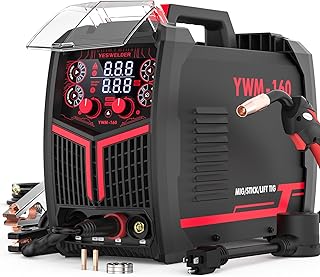
YESWELDER 160A MIG Welder
Check PriceThis is where the question, is MIG welding expensive gets answered months after the purchase. The machine sits on your shelf, lasting years. The consumables disappear constantly. MIG welding eats contact tips, nozzles, and wire. If you do not factor these in, you will feel frustrated every time you run to the store. Let us look at the recurring bills you must plan for.
The Real Price of Shielding Gas
Gas is the silent budget killer. A 100% CO2 tank is cheaper and gives deeper penetration, but it creates more spatter. A 75% Argon and 25% CO2 mix (C25) is the gold standard for mild steel. It costs more but leaves a cleaner weld with less cleanup. Pure Argon for aluminum is even pricier. You are paying for convenience and a clean look.
If you weld outdoors often, a breeze will blow your gas shield away. This causes porosity, a defect where holes appear in the weld. To fix this, you might switch to flux-core wire. Flux-core does not need a gas cylinder because the wire contains the shielding ingredients inside. Running flux-core slashes the cost of gas entirely, but the wire itself is more expensive per pound than solid wire. You have to crunch the numbers to see which method saves you more money in the long run based on your specific environment.
Contact Tips and Nozzles
These small copper pieces connect the electrical current to the wire. They live a hard life and wear out. When a tip gets clogged or arc-burned, the wire feed becomes erratic. You should buy these in bulk packs. Generic tips can cost pennies, but name-brand Miller or Lincoln tips run a dollar or two each. Dip gel, a ceramic paste, protects the nozzle from spatter buildup. Using dip gel makes your consumables last three times longer, saving you money immediately.
Cost Comparison: MIG vs. Stick vs. TIG
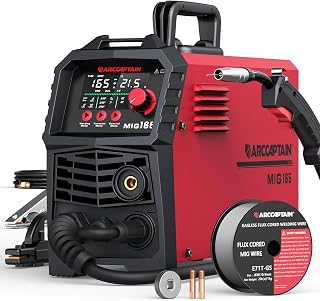
ARCCAPTAIN 165A MIG Welder
Check PriceTo truly decide if MIG is expensive, you must stack it against the alternatives. Stick welding (SMAW) is the king of cheap entry. You can find a buzz box for $150, and the electrodes cost very little. You do not need gas. However, Stick welding leaves a slag coating that requires heavy chipping and brushing. The labor time is much higher.
TIG welding (GTAW) is the premium tier. Entry-level TIG machines are affordable now, but the skill curve is steepest. The filler rods, tungsten grinders, and pure Argon gas make it the most expensive process for high-volume work. MIG sits right in the middle. It is the fastest for production work. If you value your time, the speed of MIG welding usually offsets the higher cost of consumables compared to Stick welding. It is an investment in speed.
- Stick: Lowest entry cost, high cleanup time, no gas needed.
- MIG: Moderate entry cost, fastest travel speed, requires gas or flux-core wire.
- TIG: Highest entry and consumable cost, slowest speed, best quality.
Hidden Costs New Welders Forget
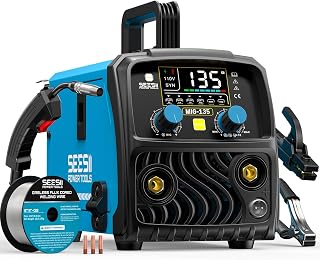
SEESII 135A MIG Welder
Check PriceThe first trip to a welding supply store is always a shock. You will leave with a cart full of things you did not know you needed. A good pair of MIG welding pliers is mandatory. They cut wire, remove nozzles, and clean spatter. A wire brush and a 4.5-inch angle grinder are non-negotiable for prepping metal. If you do not prep the steel by removing mill scale, the weld will not penetrate well.
Safety gear is another often-ignored line item. A leather jacket or a fire-resistant welding shirt is essential. Regular cotton catches fire easily. You will also need earplugs. One hot berry of spatter in the ear canal is a life-changing pain event. These hidden necessities can easily tack an extra $200 onto your startup total, pushing the realistic minimum budget to around $700 for a safe, functional setup.
How to Save Money on MIG Welding

BILT HARD 135A MIG Welder
Check PriceYou can absolutely reduce the average cost without sacrificing safety. Smart shopping and proper maintenance keep money in your pocket. The first trick is to skip the small gas cylinders. Those tiny 20 cubic foot tanks at the hardware store are a terrible deal. You pay almost the same price for a refill as a 125 cubic foot tank at a dedicated gas supplier. Always buy the largest tank you can physically handle and store safely.
Next, buy your ER70S-6 wire in 10 or 30-pound rolls whenever possible. The 2-pound spools at big box stores are wildly overpriced per pound. Also, master the technique. A steady hand with good MIG welding pattern techniques reduces spatter. Less spatter means less grinding, less wasted wire, and less wear on your consumables. Good technique is a direct financial gain.
Frequently Asked Questions
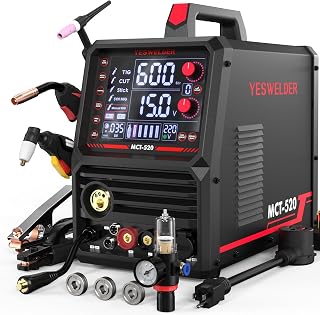
YESWELDER MCT-520
Check PriceCan I start MIG welding without gas?
Yes, you can use gasless flux-core wire. This wire has a flux inside that burns and creates a shield. You must flip the polarity of your machine to DC Electrode Negative. It runs dirtier with more spatter but saves you from buying a cylinder. It is the number one way to make MIG welding cheap for outdoor repairs.
Is a $100 MIG welder worth it?
Generally, no. A $100 flux-core welder from a generic brand struggles with feed consistency. The drive motors are weak, causing a frustrating bird nesting of the wire. You are better off saving for a $350 machine from a reputable brand. These hold their value better and actually function without constant adjustment.
Why are MIG welding gas prices so high?
You aren’t paying for the gas as much as the logistics. The cylinder must be certified, stored, and transported safely. Rare gases like Argon require energy-intensive air separation processes to extract. Supply chain issues and welding demand spikes also drive up the periodic cost of cylinder refills.
Does MIG or TIG cost more to run?
TIG usually costs more to run per project due to slower travel speeds and higher gas flow rates. However, MIG can cost more if you are doing a lot of heavy structural work because you burn through wire weight very rapidly. Overall, for the same sized bead, TIG consumables and gas costs are slightly higher.
The Verdict on MIG Welding Expenses
So, is MIG welding expensive? It is an investment in speed and ease. It is not the cheapest way to stick two pieces of metal together, that title belongs to Stick welding. However, it is the fastest and most forgiving method to learn. You are paying a premium for the shielding gas and the convenience of the wire feed motor. If you are a hobbyist, the cost is manageable and well worth the clean results.
The key takeaway is to avoid cutting corners on safety gear and gas supply. Buy a good mid-range machine from a trusted brand, even if it means saving up for an extra month. A quality machine welds better and frustrates you less. The cost of MIG welding fades into the background once you lay down a perfect stack of dimes and realize you built something that will last a lifetime. For more foundational knowledge, always refer to trusted resources like the American Welding Society’s glossary to deepen your understanding.