If you have ever browsed the tool aisle at a home improvement store or scrolled through online marketplaces, you have likely stumbled across small, portable stick welders that plug into a standard household outlet. The price tag is usually tempting, and the convenience of avoiding a 220V outlet installation is hard to ignore. But the burning question remains, are 110V stick welders any good for actual metal fabrication, or are they just toys that frustrate beginners?
The short answer is yes, they can absolutely be good, but only if your expectations align with their physical limitations. A 110V stick welder is not a replacement for a heavy industrial machine. It is a specialized tool for thin material repair, hobbyist art, and light maintenance. In this guide, we break down the raw performance, duty cycle realities, and the exact electrode rods you should use to achieve a quality weld without tripping the breaker.
Table of Contents
Understanding the Voltage Reality: 110V vs. 220V

YESWELDER 135A MIG Welder, 110V Flux Core
Check PriceBefore deciding if a 110V machine is right for you, you need to understand the physics of input power. Stick welding, also known as Shielded Metal Arc Welding (SMAW), requires a significant burst of amperage to strike and maintain a stable arc. A standard 120-volt circuit in a North American home is typically limited to a 20-amp breaker.
This creates a hard ceiling on output. A 220V machine can comfortably deliver 180 to 250 amps for heavy structural welding. In contrast, a 110V stick welder generally maxes out between 70 and 90 amps, with some premium inverter models briefly touching 100 amps. When you push a 110V unit to its maximum setting, you are pulling close to the breaker’s limit, meaning any fluctuation in the power grid or a long extension cord can cause nuisance tripping.
The Inverter Advantage
Modern technology has dramatically improved the answer to whether 110V stick welders are any good. Old transformer-based buzz boxes were heavy and inefficient. Today’s inverter-based stick welders use microprocessors to convert power much more effectively. An inverter draws less input current to produce the same output amperage, making the arc significantly smoother on a low-voltage circuit. If you are buying a 110V unit, an inverter is not a luxury, it is a necessity.
Metal Thickness Limitations: What Can You Realistically Weld?
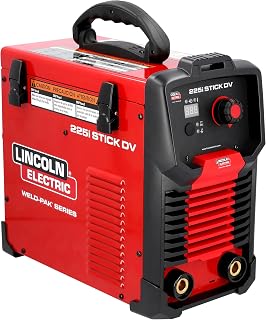
Lincoln Electric Weld-Pak 225i Stick Welder
Check PriceThe most critical factor in stick welding is penetration. Amperage equals heat, and heat equals depth. Because a 110V machine caps out at roughly 90 amps, your penetration depth is mathematically limited. You cannot cheat this law of physics. Understanding this limit will prevent catastrophic joint failure on load-bearing projects.
- Thin Material (16 gauge to 1/8 inch): This is the sweet spot. A 110V stick welder can handle sheet metal repairs, exhaust pipes, and angle iron up to 1/8 inch thick with excellent fusion, provided you use the correct small-diameter rod.
- Medium Material (3/16 inch): You can weld 3/16 inch steel, but you must perform multi-pass techniques. You will likely need to bevel the edges significantly and run a root pass followed by a hot pass to achieve structural integrity. It works, but it is slow.
- Thick Material (1/4 inch and above): This is the danger zone. While a 110V machine can stick metal together on a 1/4 inch plate, you will rarely achieve the code-quality penetration required for structural safety. For trailers, hitches, or heavy load-bearing frames, a 220V machine or a wire-feed welder is non-negotiable.
The Electrode Rod Strategy
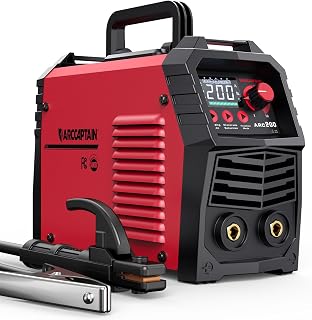
ARCCAPTAIN Stick Welder, 200A ARC/Lift TIG
Check PriceThe success of a 110V stick welder relies heavily on your choice of electrode. You cannot run a thick 1/8-inch 7018 rod efficiently on a 90-amp circuit, it will simply stick to the plate and frustrate you. To master low-amperage welding, you need to choose rods that burn fast and hot with minimal resistance.
The Best Rods for 110V Welders
- E6013 (1/16 inch and 3/32 inch): This is the king of 110V welding. The E6013 is a fast-freeze, high-titania rod designed for low amperage and smooth arc characteristics. It penetrates gently, making it perfect for thin sheet metal and rusty farm repairs where burn-through is a risk.
- E7018 (3/32 inch): You can run a 3/32 inch E7018 low-hydrogen rod on a high-end inverter at the top end of the dial (80-90 amps). It provides a stronger, crack-resistant weld than 6013, but you need to maintain a very tight arc length. If your input voltage drops due to an extension cord, the rod will stick immediately.
- E6011 (3/32 inch): This cellulose rod is aggressive and drives a deep, digging arc. It works moderately well on 110V for root passes on slightly thicker metal and is great for dirty galvanized metal, but the spatter level is high. It requires more operator skill to control the puddle without blowing holes.
Duty Cycle: The Hidden Frustration

HONE Stick Welder 140Amp ARC Welder Machine
Check PriceWhen users ask, Are 110V stick welders any good?, they are often unknowingly asking about duty cycle. The duty cycle is the amount of time you can weld within a 10-minute period before the machine overheats and shuts down. On a 110V inverter pushed to maximum amperage, the duty cycle is often a paltry 20% to 30%.
This means you can weld for 2 minutes straight, then you must sit idle for 8 minutes while the cooling fan runs. For a beginner trying to run a long bead, this interruption train is maddening. However, for a repair job where you are tacking and fitting between welds, the cool-down period often naturally aligns with your work rhythm. If you are planning long, continuous production welds, a 110V machine simply is not engineered for that thermal load.
Portability and Convenience Factors
The primary reason these machines exist is portability. An inverter-based 110V stick welder often weighs less than 15 pounds. It fits in the trunk of a compact car, and you can carry it up a ladder for gutter bracket repairs.
Imagine a scenario on a remote property where a gate hinge breaks. You can plug a dual-voltage inverter into a small generator and run a 3/32-inch 6011 rod to fix the hinge in the field without hauling a gas drive welder. The ability to plug into any residential outlet without running a sub-panel makes the 110V stick welder a hero for mobile repair. It is also an excellent educational tool. Beginners can safely learn arc length and rod angle control without the intimidation of a high-powered arc.
Common Pitfalls and How to Avoid Them
Many negative reviews of 110V stick welders stem from user error rather than tool failure. Avoid these three pitfalls to drastically improve your weld quality.
- Extension Cord Gauge: Voltage drop is the number one enemy of 120V welding. Using a thin, 16-gauge 100-foot extension cord will choke the machine down to useless levels. Always use a short, heavy-duty cord, preferably 10 or 12 gauge, and you will notice a massive improvement in arc stability.
- Ground Clamp Placement: Because the amperage is low, electrical resistance through the work clamp is amplified. Do not ground through rust, paint, or flimsy table legs. Grind a shiny spot on the workpiece and clamp as close to the weld joint as physically possible. If the arc drags and stutters, it is often a bad ground, not a bad machine.
- Incorrect Rod Storage: Low-hydrogen rods like E7018 require low moisture to run at low amps. If stored in a damp garage, these rods will sputter and fail. Keep rods in a heated cabinet or inside your house to maintain their coating integrity.
Dual-Voltage Machines: The Smart Compromise
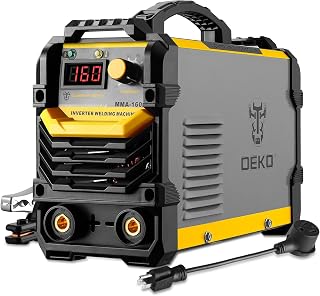
DEKOPRO 160A ARC Welder Machine IGBT
Check PriceIf you are on the fence, manufacturers have largely solved the 110V dilemma by offering dual-voltage machines. These inverters can run on 120V for thin stuff and, with an adapter, plug into 240V to deliver heavy amps. The versatility is unmatched, and checking a comprehensive beginner welder guide can help you identify models that offer this flexibility without breaking the bank.
Investing in a dual-voltage unit future-proofs your skills. You can start on standard household power today, and when you eventually wire a 50-amp outlet in your workshop, the same machine will perform like an industrial tool. Suddenly, the question becomes less about whether 110V stick welders are good and more about maximizing your investment.
Real-World Applications Where 110V Stick Welders Excel

250A Stick Welder, 110V/220V Portable IGBT
Check PriceTo avoid disappointment, you must use the tool for its intended purpose. This is not a pipeline rig. Here is where a compact 110V stick welder genuinely shines.
Artistic Metal Sculptures
Sculptors and metal artists love low-amp stick welders. The ability to tack thin gauge scrap metal together without warping is crucial. The 6013 rod creates beautiful, smooth bead patterns that can be ground and textured seamlessly.
Automotive Exhaust Work
Exhaust tubing is thin and prone to rust, both attributes that a 110V machine handles well. While MIG is usually preferred, a fast-burning 3/32 inch 6013 rod can salvage a cracked exhaust pipe in a driveway emergency, provided you watch for burn-through. Learning the basics of different processes helps, so exploring the fundamentals of arc welding will give you better control over heat input.
Farm and Ranch Quick Fixes
A broken gate latch, a cracked mower deck, or a loose handle on a utility trailer does not require heavy structural penetration. It needs a quick, strong tack. A 110V stick welder running E6011 is one of the most forgiving tools for dirty, painted, or slightly rusty farm equipment. The cellulose flux violently scours contaminants away, leaving a solid puddle.
Comparing Stick Welding to Other 110V Processes
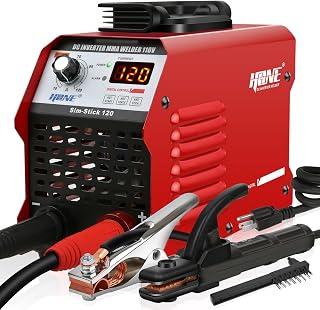
HONE Stick Welder 110V, Actual 120Amp
Check PriceThe stick welding process has unique advantages over wire-feed processes on 110V power. Small MIG machines often struggle with penetrating thick sections on 120V because their arc voltage drops under load. Stick welding, by contrast, is a constant-current process. The operator controls the arc length, giving more direct control over the melt-off rate.
The shielding gas of a MIG welder can also be blown away outdoors, making stick welding the superior choice for outdoor 110V use. There is no gas bottle to carry and no wire feed mechanism to jam. Flux-cored wire is a competitor, but stick electrodes are often cheaper and easier to switch for different materials. The simplicity of a stinger and a bare rod is hard to beat.
Safety and Electrical Considerations
Plugging a high-draw tool into standard home circuits requires respect for the electrical infrastructure. If your house has older aluminum wiring or 15-amp breakers, a maxed-out 90-amp stick welder will likely trip the breaker before you strike an arc. Always inspect your panel amperage rating before purchasing.
Furthermore, a 110V stick welder can still produce a lethal open-circuit voltage (OCV). Do not mistake low input voltage for low output danger. The welding arc emits intense UV radiation, requiring proper beginner-friendly welding helmet protection regardless of the amperage. Dry leather gloves and a clean welding jacket are mandatory because even an 80-amp arc throws significant spatter. Treat the small box with the same respect you would give an industrial Lincoln powerhouse.
Maintenance and Longevity Tips

TOOLIOM 195A Stick Welder, LCD Display
Check PriceHigh-frequency inverters are computers. The circuit boards inside a 110V stick welder dislike dust and grinding particles. Once a week, you should remove the outer shell and blow out the electronics with clean, dry compressed air. Metal dust accumulation leads to short circuits and magic smoke appearing from the vents.
The electrode holder is also a wear point. The copper jaws must clamp tightly. If the clamping pressure weakens, electrical resistance increases, heating up the stinger handle and starving the arc of amps. Regularly tightening or replacing the electrode holder ensures every amp you paid for reaches the welding rod.
Frequently Asked Questions
Can I weld aluminum with a 110V stick welder?
Technically, yes, with specialty aluminum electrodes, but it is an uphill battle. Aluminum stick welding requires massive heat because the material is highly conductive. A 110V output is usually too cold, resulting in a gummy, porous weld puddle. TIG or MIG processes are drastically better for aluminum.
Why does my rod keep sticking on a 110V machine?
Sticking is almost always caused by low amperage combined with a damp rod. Increase your amps to the maximum setting for the specific rod diameter. If you are using 3/32 inch E7018, set the machine between 85 and 90 amps. Keep a tight arc, and do not touch the coating to the puddle.
Are 110V stick welders cheaper to run than 220V models?
The energy consumption is slightly lower due to lower amperage output, but the duty cycle is shorter. The real savings are in the upfront equipment cost and the zero cost of electrical rewiring. A quality 110V inverter stick welder is one of the most affordable entries into welding.
What is the thickest steel you can weld with a 110V welder?
With a single pass, you can adequately fuse 1/8 inch steel. For 3/16 inch plate, a beveled multi-pass technique is required. Attempting to weld 1/4 inch structural steel in a single pass with only 90 amps will result in a cold lap, which is a dangerous defect that lacks fusion. For heavy material, reference an industry-standard electrical safety guide and consider a dual-voltage machine.
Conclusion: The Verdict on 110V Stick Welders
So, are 110V stick welders any good? Absolutely, as long as you view them as precision scalpels rather than chainsaws. They excel at thin gauge metal repair, hobby art, and outdoor maintenance where portability trumps raw power. The inverter technology packed into modern 110V machines delivers arc characteristics that outperform old transformer machines of decades ago.
However, you cannot beat the physics of electricity. Do not buy a 110V stick welder expecting to build heavy-duty trailers or weld thick boiler plate. Match the tool to the task. Pair your machine with the correct small diameter rods, a short 10-gauge extension cord, and a clean ground clamp, and you will lay down beads that hold strong. For a welding beginner or a mobile repair tech, a 110V stick welder is not just good, it is the most practical tool in the arsenal.