Welding is equal parts art and science, but even the most skilled hands need help keeping metal pieces exactly where they belong. That is where understanding the different types of welding clamps becomes essential. A quality clamp holds your workpiece steady, prevents warping from heat, and acts as a heat sink. Without the right clamping setup, you will fight misalignment and produce weak joints.
New welders often underestimate the value of these simple tools and grab whatever is nearby. Seasoned fabricators know that choosing the correct clamp style from the many types of welding clamps available directly impacts the final outcome. This guide walks you through the most common clamping solutions, helping you pick the right tool for your next project.
Table of Contents
Why Welding Clamps Matter
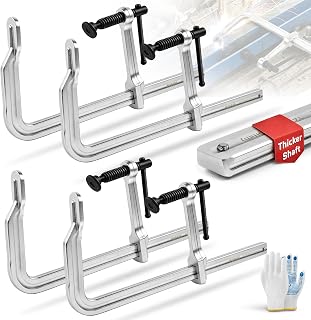
4 Pack F-Clamps, 12″ Heavy-Duty Drop Forged Steel F Clamps | Welding Clamps with 1200Lbs Clamping Force, 4-3/4″ Throat Depth
Check PriceA welding clamp does more than hold two pieces of metal together. It controls the gap between parts, maintains a square alignment, and reduces distortion as temperatures rise. When molten filler metal enters the joint, improper fixturing can cause the parts to pull away or shift, leaving you with a crooked assembly. A solid clamping strategy saves hours of grinding and rework.
Clamps also act as an electrical contact point in many setups. The ground clamp completes the circuit and needs a firm bite on clean metal. Using the wrong type of grounding clamp can cause arc blow, inconsistent bead appearance, and even damage your welding machine. Taking the time to match your clamps to the job size and material thickness is a quick route to professional results.
Finally, safety is always part of the equation. A part that slips free during welding can cause burns or pinch injuries. Properly rated clamps with enough clamping pressure give you peace of mind, letting you focus purely on running a smooth bead. Once you have experienced the stability that the right clamp provides, you will never go back to improvising with scraps.
Main Types of Welding Clamps
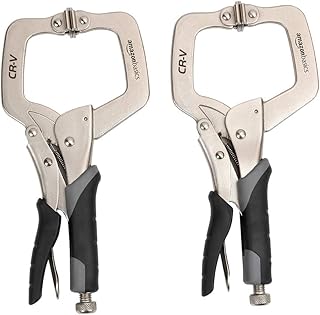
Amazon Basics Adjustable Metal Face Clamps for Woodworking, Welding, or Repairs, 3-inch Jaw Reach, 2-Pack, Black/Silver
Check PriceYou will find dozens of clamp styles on any fabrication shop wall, but most fall into a handful of core categories. Each design handles a specific set of challenges, from tight inside corners to oversized structural beams. Getting to know these varieties will help you build a versatile clamping kit that covers almost any welding task.
C-Clamps
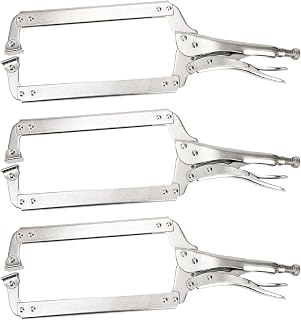
Hiceeden 3 Pcs 18 Inch Deep C Clamp with Swivel Pads, Heavy Duty Welding Clamps
Check PriceC-clamps, named for their C-shaped frame, are the workhorses of any welding table. They come in sizes from a few inches to over a foot of throat depth, making them ideal for securing flat stock, angle iron, and jigs. A threaded screw applies pressure directly to the workpiece, and many models now feature copper-plated spindles to resist weld spatter buildup.
Because of their simple design, C-clamps are nearly indestructible and provide exceptionally high clamping force. They are the go-to choice when you need raw holding power on heavy steel. One downside is that they can be slower to adjust than quick-action clamps, but their reliability makes them a staple for both beginners and professional fabricators.
F-Clamps and Bar Clamps
4 Pack F-Clamps, 12″ Heavy-Duty Drop Forged Steel F Clamps | Welding Clamps with 1200Lbs Clamping Force, 4-3/4″ Throat Depth
Check PriceF-clamps, also called bar clamps, feature a sliding jaw on a flat metal bar. They are faster to set than C-clamps because one jaw slides freely into position before you tighten the screw. This speed makes them perfect for production environments or any job where you need to reposition frequently during fit-up.
Deep throat depths allow these clamps to reach far across sheet metal or wide panels. They are lightweight and often used in combination with welding magnets for quick tacking. While they cannot match the sheer clamping pressure of a heavy C-clamp on thick material, their versatility and ease of use make them a favorite for lighter gauge welding.
Locking Pliers (Vise-Grip Clamps)
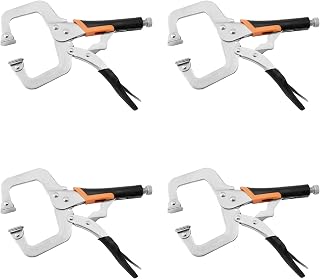
6-Inch C-Clamp Locking Pliers, Heavy Duty Vise Grip Welding Clamp With Swivel Pads for Woodworking, Home, Metalworking, Auto Repair (4 Pack)
Check PriceLocking pliers, commonly referred to as Vise-Grips, provide one-handed clamping and a toggle mechanism that locks them firmly in place. They are available in many jaw configurations, including standard curved jaws, long nose, and extra-wide openings for sheet metal. Welders keep a few sizes ready on their cart for fast tacking and holding irregular shapes.
These clamps are excellent for temporary fixturing because you can release them just as quickly as you set them. Be aware that excessive heat near the locking mechanism can weaken the spring over time. Still, they are indispensable for tight spots and quick repairs where a full-size clamp would be awkward.
Magnetic Welding Clamps
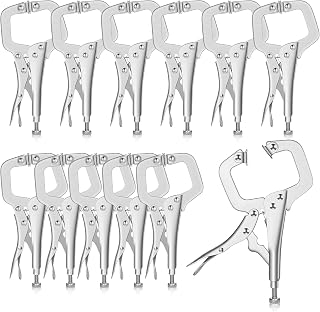
10 Pcs 6 Inch Locking C Clamp Heavy Duty Welding Clamps Pliers Vise Grip Clamps with Swivel Pad with Regular Tip and Swivel Pad for Craftsmen Home Workshop
Check PriceMagnetic clamps use powerful permanent magnets to hold ferrous metals at common angles, such as 45, 90, or 135 degrees. They eliminate the need for a bulky clamp body and allow you to work on otherwise unreachable inside corners. Simply stick the magnet to the workpieces and let it align them while you tack weld.
Switchable magnetic models let you turn the magnet on and off with a lever, simplifying cleanup and placement. However, magnetism can interfere with the welding arc on some DC processes if placed too close to the joint, so keep an eye on arc blow. Magnets also attract grinding dust and spatter, so regular cleaning helps maintain grip strength.
Ground Clamps
While not a clamping tool for the workpiece in the traditional sense, the ground clamp is a critical part of the welding circuit. It attaches the work lead to the welding table or directly to the part, and a weak connection causes resistance, overheating, and erratic arc performance. A reliable ground clamp bites through rust and mill scale to deliver a consistent current path.
Common styles include spring-loaded, C-clamp style, and magnetic grounding blocks. Choosing a high-amperage ground clamp suited to your machine size is fundamental. If you are troubleshooting arc stability, the ground connection should be one of the first things you inspect, and reviewing options for a reliable ground clamp can quickly solve many performance headaches.
Corner Clamps and Angle Clamps
Corner clamps are designed specifically to position two pieces of metal at a precise 90-degree angle. They typically have a fixed inner corner jaw and a movable pad that clamps both sides simultaneously. This makes constructing frames, boxes, and right-angle joints far quicker than using separate clamps for each axis.
Many corner clamps have V-grooves that accept round tubing as well as square stock. They are a favorite for fabricators building roll cages, gates, or furniture. Paired with a solid table, they guarantee a perfect perpendicular assembly every time.
Welding Vises and Table Clamps
A welding vise is a permanent fixture mounted directly to the table, providing a large, stable jaw that can hold parts vertically or horizontally. Many welding tables come with an integrated vise system, or you can pair a heavy-duty bench vise with a swivel base for maximum flexibility. This setup offers unmatched rigidity for chipping slag and heavy joint alignment.
Table clamps that fit into a grid of holes on a modular welding table are another popular option. They use a quick-release bolt that drops into the plate, letting you position stops and blocks precisely where you need them. This modular approach greatly speeds up repetitive production work.
Specialty and Niche Welding Clamps
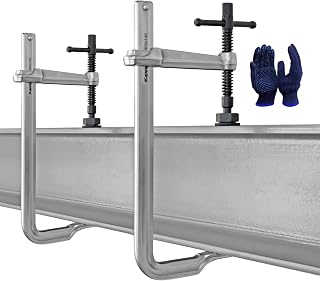
2-Pack Heavy Duty 12″ Inch F-Style Welding Clamps w/Replaceable Pad, 5-1/2-Inch(140mm) Deep Throat, Bar Size 1-1/5″ * 3/5″ Drop Forged Steel Bar Clamps, 2900LB Clamping Force
Check PriceBeyond the common types, several specialized clamps solve unique challenges. Pipe welding clamps, also called chain clamps or wrap-around clamps, use a chain to encircle large diameter pipe. They align the ends for butt welding and can handle extreme loads. They are indispensable for pipelines, shipbuilding, and structural steel.
Toggle clamps use an over-center locking mechanism for instant hold and release, often seen on production jigs where operators load and unload parts quickly. Edge clamps, sometimes called Kant-Twist clamps, exert pressure sideways to pull plates tight against a fixture without blocking the weld joint. Parrot-nose clamps and welding pliers specifically grip thin sheet metal without warping it, making them a must for auto body work.
How to Choose the Right Welding Clamp
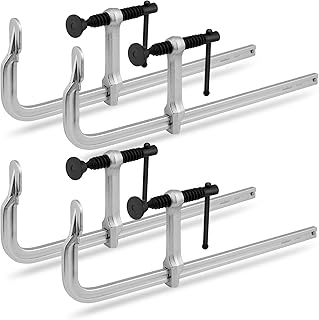
HORUSDY 4-Pack 12-Inch Bar Clamp Set, Light Duty Drop Forged Steel F Clamps, Max 450 lb Load Capacity
Check PriceMatch Material Thickness and Throat Depth
Thick structural steel demands high clamping force, so a forged C-clamp is often the best pick. For delicate sheet metal, a wide-jaw locking plier or an edge clamp will secure the work without leaving deep marks. Always ensure the throat depth reaches past the center of the weld area; a shallow reach forces you to clamp too close to the heat.
Consider Heat and Spatter Resistance
Welding clamps live in a harsh environment filled with sparks, spatter, and intense heat. Look for models with copper-plated or hardened steel threads. Copper won’t build up spatter as quickly as bare steel, which keeps the threads moving freely over years of use. Some clamps feature insulated handles that stay cooler and offer a better grip while you adjust the setup.
Speed vs. Holding Power
Quick-change clamps, like F-clamps and toggle clamps, greatly improve workflow on repetitive jobs. If you weld one-off custom fabrication, raw clamping power and versatility matter more than speed. Many fabricators keep a mix of both styles, using magnetic and locking pliers for fast tacking, then swapping to heavy C-clamps or vises for the final weld runs.
When building your kit, looking at a curated selection of top-rated welding clamps can help you balance quality and budget. Investing in a few multi-purpose designs will give you a strong foundation for almost any project.
Pro Tips for Using Welding Clamps Effectively
- Always clean the clamping area and the clamp pads. Grease, paint, and rust reduce grip and increase the chance of slipping.
- Use anti-spatter spray on clamp threads and sliding surfaces. This simple step adds years to the life of your tools.
- Tack weld before fully tightening all clamps. This sequence allows the metal to expand and contract slightly without binding.
- Keep grounding clamps away from bearing surfaces like threads and finished machined areas on the part to prevent arc marks.
- For large assemblies, start clamping from the center outward to control distortion evenly.
An external resource like the welding clamp selection guide Welds offers additional insights into advanced fixturing concepts. Checking manufacturer specs ensures your clamps can handle the heat and amperage of your particular process.
Frequently Asked Questions About Welding Clamps
What is the most versatile type of welding clamp?
A medium-size F-clamp strikes the best balance between speed, throat depth, and clamping force for general work. It handles sheet metal up to moderate plate thickness and adjusts quickly. However, every shop should also have at least one pair of locking pliers and a couple of heavy C-clamps for demanding jobs.
Can I use regular woodworking clamps for welding?
Woodworking clamps often have plastic or aluminum components that cannot withstand welding spatter or elevated temperatures. Metal particles can embed in plastic pads and later scratch finished surfaces. Dedicated welding clamps use heat-resistant materials and are designed to maintain grip under thermal cycling, making them a necessary investment.
How do I prevent arc blow when using magnetic clamps?
Place the magnet a few inches away from the immediate weld joint, and attach the ground lead to the side of the assembly opposite the magnet. If arc blow persists, experiment with alternating current or reposition the magnet. A switchable magnetic clamp makes it easy to test the effect without completely removing the fixture.
What size ground clamp do I need for my welder?
Match the clamp’s amperage rating to the maximum output of your welding machine. A small hobby welder can use a compact spring clamp, but a 300-amp industrial unit needs a heavy-duty C-clamp style ground with serrated teeth. A weak ground clamp will overheat, cause voltage drop, and shorten consumable life.
Conclusion
Mastering the different types of welding clamps gives you control over fit-up, distortion, and overall weld quality. The right clamp not only holds metal in place, it saves you from frustration and costly rework. Start with a core set of C-clamps, F-clamps, locking pliers, and magnetic squares, then expand into specialty clamps as your projects demand.
Inspect your clamps regularly, keep threads coated, and always match the clamp style to the material thickness. With a well-chosen arsenal of welding clamps, you will notice straighter frames, tighter joints, and a smoother welding experience every time you strike an arc.