Finding the correct minimum shade for MIG welding is the single most important step in protecting your vision. Many beginners assume that any dark lens will do the job, but using the wrong shade can lead to serious eye fatigue or permanent damage. This guide breaks down the exact shade numbers you need based on your amperage and welding process.
We will explain OSHA and ANSI guidelines in plain English. You will learn why shade 10 is often the starting point, but also why higher amperage requires a darker lens. By the end, you will know exactly how to set your helmet for safety and comfort.
Table of Contents
What is the Minimum Shade for MIG Welding?

Tefuawe 2×4 1/4 Gold Automatic Welding Lens, 2 Amp TIG Rating, Variable Shade with Multiple Settings, For Stick Mig Tig
Check PriceThe accepted industry standard for the minimum shade for MIG welding is Shade 10. This is the baseline recommended by ANSI Z49.1 and OSHA for gas metal arc welding (GMAW) when operating under 60 amps. However, MIG welding is rarely performed at such low amperage for extended periods.
For most home and professional MIG welding tasks, you will typically operate between 100 and 300 amps. At that range, the minimum shade requirement increases. Relying solely on Shade 10 while welding at 200 amps will likely leave you seeing spots and feeling discomfort.
Recommended Shade Chart for MIG Welding
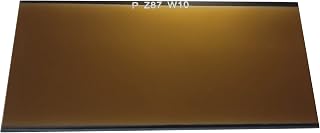
Best Welds Hardened Glass Gold Replacement Welding Lens – Advanced Passive Filter Plate 2" x 4-1/4" – Shade 9, 10, 11 & 12
Check PriceYour welding current directly dictates the intensity of the arc. A higher amperage creates a brighter arc and more ultraviolet (UV) radiation. Therefore, the minimum shade number must increase as your machine amperage increases.
- Under 60 Amps: Minimum Shade 10
- 60 to 160 Amps: Minimum Shade 10 to 11
- 160 to 250 Amps: Minimum Shade 12
- 250 to 500 Amps: Minimum Shade 14
It is important to note that these are minimums. If your eyes feel strained or you see afterimages, you should immediately move up to a darker shade. Safety standards are a floor, not a ceiling.
Why Eye Protection Matters in MIG Welding

Forney 57061 Shade-10 Gold Welding Filter Lens | Premium gold-coated replacement welding lens measuring 2-inch-by-4-1/4-inch. Provides clear eye protection.
Check PriceMIG welding produces intense ultraviolet and infrared light. Without adequate protection, you risk photokeratitis, often called welder’s flash or arc eye. This condition feels like having sand poured into your eyes and can set in hours after exposure.
Long-term exposure to bright arcs can lead to cataracts. This is why selecting the correct minimum shade for MIG welding is non-negotiable. You are not just looking for comfort, you are preventing cumulative damage to your retina.
The Role of Amperage and Wire Size
The diameter of your wire and your transfer mode affect the light output. For example, short-circuit transfer on thin sheet metal may allow you to use Shade 10 comfortably. However, switching to spray transfer with a heavy wire spool will require Shade 12 or 13.
Pay attention to the brightness of the puddle. If the light reflecting off the workpiece makes you squint behind the hood, your shade is too low. A good rule of thumb is that you should barely be able to see the unlit workpiece before the arc starts.
Auto-Darkening vs. Passive Helmets
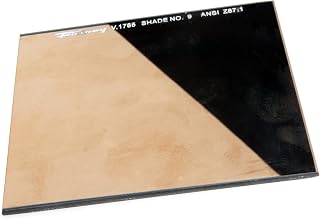
Forney 57070 Lens Replacement Gold Welding Filter, 4-1/2-Inch-by-5-1/4-Inch, Shade-9
Check PriceModern welders often prefer auto-darkening helmets. These helmets usually rest at a light state, around Shade 3 or 4. When the arc strikes, the lens instantly darkens to the selected setting, such as Shade 11 or 12.
With a passive helmet, the lens is always dark. You must flip the hood down to weld. Both types require the same minimum shade for MIG welding. The difference lies in convenience, not in baseline safety standards.
If you are using a variable shade helmet, set it to at least Shade 10. Do not rely on the “grind mode” for welding. Many welders set their auto-darkening helmets to Shade 11 or 12 and leave it there for most jobs.
Common Mistakes When Choosing a Shade

Forney 57005 Lens Replacement Hardened Glass, 4-1/4-Inch-by-2-Inch, Shade-5 , Green
Check Price- Going too light too fast: Beginners often try Shade 9 to see the weld puddle clearly. This is below the safety minimum and risks eye burns.
- Ignoring the environment: Welding outdoors in bright sunlight can make the arc seem dimmer. You should select a darker shade to compensate for the ambient light.
- Not adjusting for Pulse MIG: Pulsed MIG often appears less intense visually but still emits harmful UV rays. You still need the minimum Shade 10 or higher.
Remember that style and clarity matter. If you are using a shade lens for MIG welding that is old or scratched, the optical clarity drops. You might be tempted to lower the shade number to see better, which is the wrong solution. Replace scratched lenses instead.
Practical Tips for Finding Your Ideal Shade

ArcOne T240-10 Tradesman Horizontal Auto-Darkening Filter for Welding Helmets, 2 x 4.25 x 0.2
Check PriceStart at Shade 11 for general fabrication. Weld a test bead on scrap metal. After finishing, flip up your hood and look at a white wall.
If you see a bright spot or afterimage, your shade is too light. Increase the setting by one number. If you cannot see the seam clearly enough to track the weld, lower the shade by one number only if it remains above the minimum for your amperage.
Sensitivity and Delay Settings
Your helmet settings also influence safety. Adjust the sensitivity on your auto-darkening helmet so that it triggers reliably every time. The delay setting controls how long the lens stays dark after the arc stops.
Set the delay to a longer duration, perhaps 0.3 to 1.0 seconds. This protects your eyes from the glowing red puddle and afterglow even when the arc stops. This is a crucial step that many new welders overlook.
Health and Safety Standards

Shade 5-13 Adjustable Red Auto Darkening Welding Lens | Duke 1.0 | Best For Stick, MIG, FCAW | Red Front – Light Green Weld Puddle | 2" x 4 1/4" x 0.3" | Not Recommended For TIG
Check PriceOSHA standard 1910.133 requires eye protection that provides appropriate shade numbers. These numbers are derived from ANSI Z49.1 and AWS guidelines. They represent the minimum shade for MIG welding under specific conditions.
We recommend checking the user manual of your specific helmet. High-quality helmets, like those discussed in guides on choosing a welding helmet, will list the recommended shade ranges. Always follow the manufacturer’s specifications for your equipment.
For further reference, you can check the guidelines provided by the Occupational Safety and Health Administration (OSHA). They provide comprehensive standards for various welding processes and amperage levels.
Frequently Asked Questions
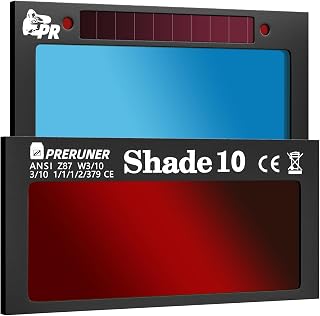
Core Series Red Shade 10 Auto Darkening Welding Lens 2"x4 1/4", Slim 0.2" Welding Lens with Teal Clarity View for Pancake & Sugar Scoop Welding Hoods
Check PriceIs Shade 10 dark enough for MIG welding?
Shade 10 is the absolute minimum for MIG welding, but only acceptable for low amperage work, usually under 60 amps. For standard welding above 100 amps, you should use Shade 11 or 12 to prevent eye strain.
Can I use Shade 9 for MIG welding?
No. Shade 9 is below the safety minimum for the MIG welding process. It does not block enough UV radiation. Using Shade 9 puts you at high risk of developing welder’s flash.
What shade is best for 200 amp MIG welding?
For 200 amp MIG welding, Shade 12 is the recommended standard. This provides a balance between visibility and protection. If you feel discomfort, move up to Shade 13.
Does wire diameter affect shade?
Yes. Using thicker wire, such as .045 inch versus .023 inch, requires more amperage. Since amperage dictates arc intensity, the thicker wire usually requires a darker shade.
Conclusion
Never compromise on eye safety. The minimum shade for MIG welding may be Shade 10, but practical experience shows that Shade 11 or 12 is the sweet spot for most fabricators. Assess your amperage and adjust accordingly.
Start with a darker lens than you think you need. Allow your eyes to adjust. It is much easier to adapt to a slightly dark lens than to recover from an arc burn. Protect your vision, and you will weld longer and more accurately.