Choosing a reliable welder often starts with trust, and in the fabrication world, the color blue usually signifies a commitment to quality. If you are a hobbyist, a DIY enthusiast, or a small business owner looking to handle metal repair and light fabrication, you have likely searched for a Miller 110V MIG welder. Bridging the gap between heavy industrial machines and cheap disposable tools, Miller Electric has engineered compact powerhouses that plug into standard household outlets, making professional-grade welding accessible right in your garage.
This article dives deep into what makes Miller’s 110-volt MIG lineup so special. We will explore the features that set these machines apart from the competition, tackle the age-old question of whether 110V is enough, and break down the specifics of their most popular models, including the Millermatic 141. Whether you are patching a exhaust pipe or building a custom table, this guide will help you decide if a blue machine deserves a spot in your shop.
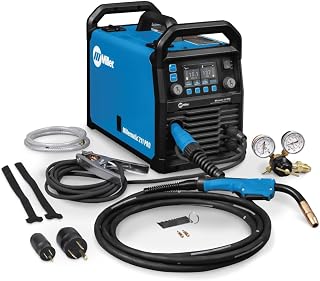
Millermatic® 211 PRO MIG Welder Machine, Dual-Voltage, Auto-Set™
Check PriceTable of Contents
Why Choose a Miller 110V Machine?
When you look at the portable welding market, price tags vary wildly. You might wonder why a Miller 110V MIG welder costs more than budget import options. The answer lies in the experience of the weld. The arc is smoother, the drive system feeds wire more consistently, and the internal components are designed for serviceability rather than disposal.
Miller’s Auto-Set feature is a game-changer for beginners learning how to weld. You simply dial in the material thickness, and the machine automatically adjusts voltage and wire speed. This vastly reduces the learning curve, but it still allows manual fine-tuning for seasoned pros who want complete control.
The True Power of Household Voltage
Convenience is the primary selling point of a 110V machine. You avoid the hassle and expense of installing a dedicated 220V circuit. Just plug the machine into a standard 20-amp breaker, hook up your gas, and you are ready to burn wire. However, understanding the limitations is key, you are not going to weld a 3/8-inch structural beam continuously, but for most sheet metal and angle iron, a Miller machine thrives where extension cords scare lesser brands away.
Millermatic 141 vs 140: Evolution of a Classic
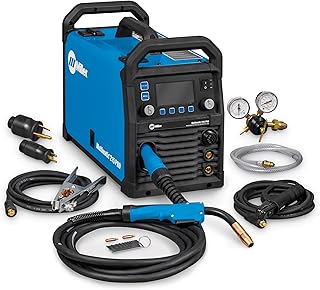
Multimatic® 215 PRO Multiprocess Welder, MIG TIG Stick, 120V/240V
Check PriceThe conversation around a Miller 110V MIG welder usually centers on the Millermatic series. While the Millermatic 140 was a long-reigning king of the garage, the Millermatic 141 represents the evolution of that design. Both offer that signature blue reliability, but the 141 brought a sleeker interface and improved energy efficiency, making it easier to run on less-than-perfect household power.
Millermatic 141: Deep Dive
Weighing in at roughly 51 pounds, the 141 is truly portable. It comes equipped with Miller’s MVP (Multi-Voltage Plug), allowing you to run on 110V standard current, but it is also ready for 220V if you ever upgrade your power supply in the future. This adaptability provides a future-proof path for those who think they might move up without buying a completely new machine.
- Auto-Set Elite: Expanded controls that provide better fine-tuning options than the older Auto-Set systems.
- Smooth Start Technology: Provides a consistent, spatter-free arc initiation. This is critical for burning into base metal without creating a mess.
- Material Thickness: Handles materials from thin 24-gauge sheet metal up to 3/16-inch steel in a single pass. With proper joint preparation, you can push it further.
- Quick Select Drive Roll: Switching between solid wire and flux-cored wire is tool-less and takes seconds.
Flux Core vs. Solid Wire with Gas
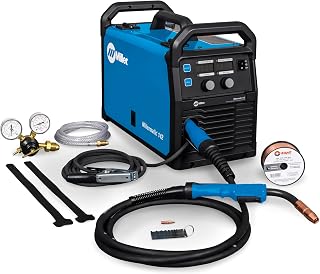
Millermatic® 142 MIG Welder, 120V Portable Wire Feed, Auto-Set™
Check PriceA standout benefit of a MIG welder is versatility in wire type. The Miller 110V MIG welder can run both .023/.030 solid wire with a shielding gas bottle, and .030/.035 flux-cored wire without gas. The difference in application is substantial.
Welding with solid wire and a C25 gas blend (75% Argon, 25% CO2) creates minimal smoke and spatter, leaving a clean weld that requires almost no cleanup, making it perfect for indoor projects or automotive body work. However, if you are working outside and a breeze blows your shielding gas away, flux-cored wire is mandatory. Flux-core generates its own shielding atmosphere, making it the superior choice for repairs on farm equipment or outdoor gates where the wind laughs at a gas bottle.
Common Projects Featuring a 110V MIG
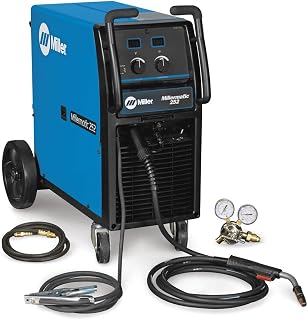
Millermatic 252 Electric MIG Welder, Wheeled, 208/230VAC
Check PriceIt is easy to think a small machine can only do small things, but the project list for a Miller is extensive. This machine is a favorite in the auto repair world, specifically for welding bed fenders thin sheet metal where a heavy 220V arc would simply blow holes through the panel.
Beyond automotive work, this class of machine is the champion of art and furniture. Creating geometric metal furniture, repairing wrought iron railings, or fabricating custom brackets is effortless. The ability to control the puddle precisely means you can make aesthetic welds that become a design feature rather than an eyesore needing grinding.
Penetration and Material Limits
To get the most out of a Miller 110V MIG welder, you must respect the technique of sound weld quality. You cannot simply point and shoot if you are at the upper limit of the machine’s capacity. If you aim to weld 1/4-inch steel, the surface must absolutely be ground clean. You should consider a bevel on the joint to increase surface area for the puddle, which is a trick often discussed in guides about a good weld vs bad weld.
Miller machines typically deliver a flatter bead profile and better wetting out at the toes of the weld than competitors. This reduces stress risers and leads to vastly stronger bonds. If you find the bead piling up without flattening, you are likely moving too fast or need to increase the voltage slightly.
Breaking Down the Duty Cycle
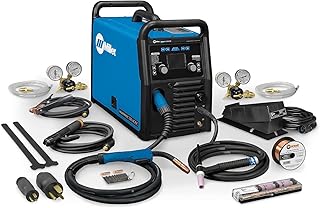
907757 Multimatic® 220 AC/DC Multiprocess Welder, 120V/240V
Check PriceOne metric that separates industrial welders from hobby ones is the duty cycle. The Millermatic 141, for example, offers a 20% duty cycle at 90 amps. In plain English, this means you can weld continuously for 2 solid minutes out of a 10-minute period before the thermal overload protection kicks in to cool the machine.
For the home user, this is rarely a problem. Welding is not a continuous process, you stop to check fit-up, chip slag, reposition, and measure. You will rarely trip the duty cycle unless you are laying down very long, continuous hot passes on a production level. This makes a Miller 110V MIG welder perfectly suited for its intended environment: the home workshop.
Setup Tips for Superior Results
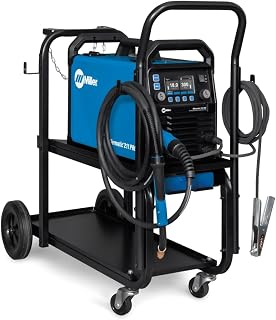
Millermatic® 211 PRO w/Running Gear/Cylinder Rack
Check PriceGetting spatter-free, beautiful welds is entirely dependent on setup. Before you even pull the trigger, check your polarity. For solid wire with gas, the machine should be set to DC Electrode Positive (DCEP). If you swap to flux-cored self-shielding wire, you must swap the leads to DC Electrode Negative (DCEN).
Speed is another critical factor. A common mistake among beginners is assuming more wire speed equals more heat. While it does increase amperage slightly, it is the voltage that determines bead profile. On a Miller, the Auto-Set gets you 90% of the way there. For that last 10%, if the wire is stubbing into the metal, turn the wire speed down, if the wire is burning back to the contact tip and popping, turn the speed up.
The Importance of Input Power
Your Miller 110V MIG welder is a hungry tool. While it plugs into a standard outlet, that outlet needs to deliver a genuine 110 to 120 volts. Often, garages have long, thin extension cords running to a single outlet shared with a freezer. That is a recipe for poor performance. You should plug the welder directly into the wall on a dedicated circuit. Using a thick, 12-gauge extension cord (shorter than 25 feet) is acceptable, but a heavy-duty cord is non-negotiable to avoid starving the transformer of power.
Protecting Yourself While Welding
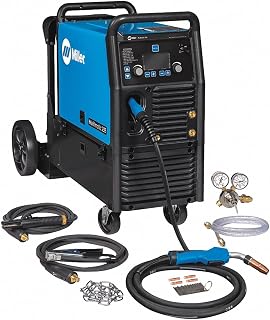
Electric – 951846 – Miller Multimatic 235 Single Phase MIG Welder
Check PriceEven with a smaller 110V unit, the arc is intensely bright and produces infrared and UV radiation. You must prioritize safety. A high-quality auto-darkening helmet is the most critical investment after the machine itself. The arc from a MIG welder requires a specific lens darkness, and selecting the correct shade lens for MIG welding is vital to prevent eye strain and flash burns.
MIG welding also generates significant heat, but generally less spatter fume than stick welding. Still, a respirator is smart, and protective clothing is mandatory. Do not weld in synthetic fabrics like polyester, they will melt to your skin if a hot spark lands on them. Stick to cotton or leather welding jackets to ensure safety.
Miller 110V vs. The Competition
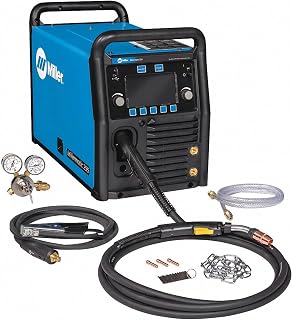
Millermatic 255 Electric MIG Welder,208/240VAC Input,Phase 1
Check PriceIt is true that a Miller 110V MIG welder costs more than the Lincoln Electric equivalent or a Vulcan model from Harbor Freight. The differences become clear when you hold the torch. Miller’s MDX-100 gun is robust and feels comfortable in the hand for hours. The drive rolls are precision-machined, not cast pot metal, leading to remarkably stable wire delivery.
Competitors often struggle with wire stuttering, a herky-jerky motion caused by cheap drive motors. Miller uses a direct-drive motor with a heavy-duty gearbox. This consistent push of the wire is the secret sauce. It eliminates the micro-stutters that cause inconsistent arc length and ugly spatter. If neat, factory-looking welds are your goal, the premium is worth it. For a broader look at choosing the right power input, check out our detailed comparison of 110V vs 220V welders for home garages.
Frequently Asked Questions
Millermatic® 211 PRO MIG Welder Machine, Dual-Voltage, Auto-Set™
Check PriceCan a Miller 110V MIG welder weld aluminum?
Technically, yes, with difficulty. You would need to buy a spool gun (like the Miller Spoolmate 100) and run pure Argon gas. The standard MIG gun will cause the soft aluminum wire to birdnest almost instantly. While it can be done for thin aluminum, it is not the ideal setup for production aluminum welding.
What is the thickest metal I can weld with the Millermatic 141?
Miller rates the 141 for a single-pass thickness of 3/16-inch on steel. However, you can weld thicker material (up to 1/4-inch) successfully by preheating the metal with a torch and creating a slight bevel for multi-pass welding. You are limited by heat input, not capability.
Does the Millermatic 141 come with a gas bottle?
No, it comes with a regulator and hose, but you must source your own shielding gas cylinder. You will typically want a C25 mix bottle, which you can purchase or lease from a local welding supply store.
Why does my Miller welder keep tripping the breaker?
The Miller 110V MIG welder draws significant amperage, often close to 20 amps at full output. If you are on a 15-amp breaker, you will trip it frequently. Ensure the circuit is 20 amps and minimize other devices running on the same line. Long, thin extension cords also increase resistance, causing the machine to pull more amps and trip the breaker.
The Verdict on Blue
Investing in a Miller 110V MIG welder is a long-term decision. It is a tool that holds its resale value exceptionally well on the secondhand market, often selling for near-retail prices, which is a testament to their longevity and reputation. You are not just buying a welding machine, you are buying an ecosystem of support with readily available parts and consumables at most local welding shops.
While the initial cost might stretch a hobby budget, the experience is superior. The smooth, predictable arc reduces the frustration of learning. If you have been struggling with a cheap welder that pops and sputters, switching to the Miller will feel like a revelation. It removes the machine variable from the equation, allowing you to focus purely on your welding technique and producing beautiful, strong welds every single time. You can consult the official Miller Electric specifications for detailed technical data.