Welding exposes your hands to extreme temperatures, sparks, and molten metal. If you have ever picked up a pair of gloves before striking an arc, you have probably wondered, are welding gloves heat resistant enough to keep you safe? The short answer is yes, but that heat resistance has clear limits and depends heavily on the materials, the type of welding you do, and how well you maintain the gloves.
Most welding gloves are made from specific types of leather, often lined with insulating fabrics, to block radiant heat and brief contact with hot objects. However, they are not magical shields. Understanding exactly how that protection works helps you avoid painful burns and choose the right gear for the job.
Table of Contents
How Do Welding Gloves Protect Against Heat?
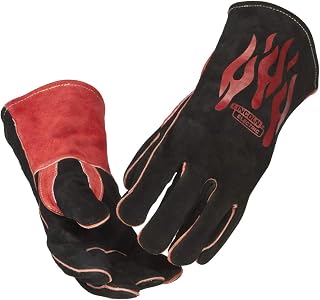
Lincoln Electric Traditional MIG/Stick Welding Gloves
Check PriceWelding gloves protect your hands through a combination of material density, thickness, and layered construction. They are designed to reflect radiant heat away from your skin and provide a barrier that slows down conductive heat transfer when you accidentally touch a hot workpiece.
The outer leather layer chars and sacrifices itself rather than letting heat instantly reach your skin. This buys you precious seconds to drop a hot piece of metal before a burn occurs. A quality pair of welding gloves creates a thermal envelope that keeps your hands comfortable during long passes.
The Role of Material in Heat Resistance
The type of leather is the single biggest factor determining how much heat a glove can handle. Cowhide, pigskin, goatskin, and deerskin all behave differently under high temperatures. Cowhide offers the best all-around heat resistance for heavy fabrication work, while pigskin handles moisture better but can stiffen faster under repeated heat cycles.
Top grain and split grain construction also matter. Split leather, with its rough, suede-like texture, is thicker and more heat resistant than smooth top grain, which is why you see it used heavily in stick and MIG gloves. Deerskin and goatskin are softer and give better dexterity, but they trade some raw heat tolerance for the flexibility that TIG welders need.
Inside the glove, insulating liners made from cotton, wool, or heat-reflective aluminized fabric add another protective layer. A full cotton lining can increase a glove’s overall heat resistance by trapping air, while an aluminized back reflects radiant heat away from your hand during an overhead weld.
Understanding Heat Resistance Ratings
To answer the question “are welding gloves heat resistant” with precise numbers, you need to look at standardized testing. The most common rating system is the European standard EN 407, which tests gloves for resistance to flammability, contact heat, convective heat, radiant heat, small splashes of molten metal, and large splashes of molten metal.
Under EN 407, contact heat resistance is rated on a scale from 1 to 4. A rating of 1 means the glove can withstand a 100°C surface for at least 15 seconds without the inside temperature rising by 10°C. A rating of 4 means it can handle 500°C under the same conditions. Most general-purpose welding gloves achieve a contact heat rating of 2 or 3, which translates to 250°C or 350°C respectively.
Another critical test checks behavior in a flame. A glove with a low flammability rating might catch fire and continue to burn after the flame source is removed. Quality welding gloves self-extinguish almost instantly. Always check for these ratings on the manufacturer’s label or website before you buy.
Limits of Heat Resistance in Welding Gloves
No welding glove is entirely heatproof. Holding a glowing hot stub of filler rod or pressing your palm against a freshly welded bead will eventually burn through the leather. The glove buys you time, not invincibility. Prolonged exposure to a heat source above the glove’s rating will cause the leather to char, shrink, and crack.
Moisture dramatically lowers a glove’s heat resistance. Wet or sweat-soaked leather conducts heat much faster, turning steam into a serious burn hazard. That is why experienced welders insist on keeping their gloves completely dry and storing them in a ventilated area between shifts.
Repeated exposure to high heat also degrades the leather over time. Even top-of-the-line gloves lose their insulating ability as the fibers break down. Knowing when to retire a pair is just as important as choosing the right glove in the first place.
Different Welding Processes and Heat Exposure
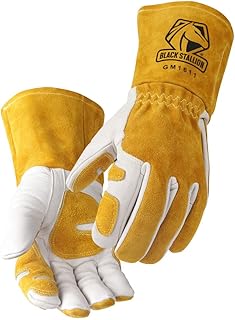
Black Stallion Top Grain Leather Cowhide MIG Welding Gloves
Check PriceNot all welding arcs produce the same level of heat stress on your hands. The amperage, process type, and position all change how much radiant and convective heat reaches the glove. Stick welding with a 7018 rod at 130 amps throws a tremendous amount of spatter, while TIG welding at 70 amps with no spatter demands a completely different glove.
Stick and MIG Welding Gloves
Stick and MIG processes generate intense radiant heat, heavy spatter, and a need for high insulation. Gloves designed for these jobs are almost always thick, split cowhide or elk skin, with a full cotton liner and a reinforced thumb strap. They prioritize heat reflectivity over finger sensitivity.
When you are running 6010 rods on a pipe joint, your hands are often just inches from the arc. The glove has to deflect that energy and catch globs of spatter without shrinking onto your skin. This is where heavy-duty gauntlet cuffs really shine, protecting your wrists from the same radiant heat that would otherwise travel right up your sleeve.
Many stick welders double up their protection by using heat shields or backhand pads stitched onto the glove. You can learn more about selecting the right pair for high-amperage work by exploring our guide on choosing the best welding gloves for every process.
TIG Welding Gloves and Heat Requirements
TIG welding asks for a different kind of heat resistance, one that is more about shielding warmth while still allowing you to feed a thin filler rod. These gloves are often made from goatskin or deerskin, cut slim at the fingers, and have minimal padding on the palm.
Because the TIG arc is cleaner and produces almost no spatter, the glove does not need to resist direct contact with molten metal droplets. Instead, it has to insulate against the constant radiant heat coming off the torch and the workpiece while giving you the dexterity to manipulate tiny tungsten electrodes. A thick stick glove would make TIG welding nearly impossible.
That does not mean TIG gloves are weak. High-quality goat leather can still handle momentary contact with hot metal, and a well-built pair lasts through hundreds of hours of delicate work without losing its insulating core.
Factors That Affect Heat Resistance Over Time
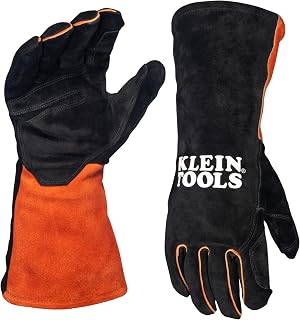
KLEIN TOOLS MIG Welding Gloves
Check PriceA new pair of welding gloves fresh out of the package will perform differently than the same pair after six months of daily use. Understanding why that happens helps you spot dangerous degradation before you get hurt.
Wear, Tear, and Moisture
Every time leather heats up and cools down, the natural oils bake out. This makes the fibers brittle, leading to cracks in high-flex areas like the knuckles and the crease at the base of the thumb. Once a crack forms, heat penetrates much faster through that thin spot.
Moisture is the silent enemy. If you weld while wearing damp gloves, the trapped water turns to steam almost instantly on contact with hot metal. This scalding steam can cause second-degree burns in less than a second, so professional welders always rotate several pairs and avoid wearing the same wet gloves all day. Our article on why welders rely on leather for heat protection covers the science behind this material choice in more detail.
Proper Care to Maintain Heat Protection
Storage matters a lot. Leaving gloves crumpled on a cold concrete floor allows moisture to soak in, while hanging them open-side down near a warm but not hot area lets them dry naturally. Never place gloves on a running radiator or directly in front of a forced-air heater, because rapid drying stiffens the leather and ruins the flexible heat shield.
Cleaning is another overlooked factor. Wipe spatter and grime off the surface with a dry rag but avoid soaking gloves in water or using harsh detergents. If the inside liner gets sweaty and compacted, gently hand wash with a damp cloth and let them air dry completely. A well-cared-for pair of heavy-duty gloves can last months longer than a neglected set.
How to Choose Heat-Resistant Welding Gloves
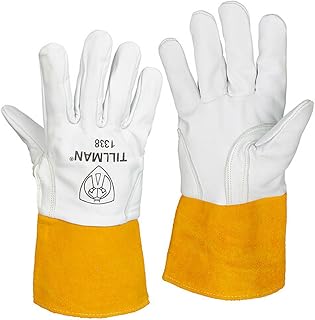
Tillman Goatskin TIG Welding Gloves
Check PricePicking the right glove means matching the heat resistance level to the actual heat load you will face. Look beyond the price tag and focus on the features that keep burns off your hands.
Key Features to Look For
- Thick split cowhide or elk leather on the palm and back for maximum contact heat resistance
- A full cotton or wool liner that provides an air gap without restricting movement
- Kevlar stitching throughout, because standard cotton thread burns through fast
- Reinforced thumb crotch and stress points to prevent blowouts on hot metal edges
- Gauntlet-style cuffs that overlap your jacket sleeve and stop sparks from dropping inside
- EN 407 or ASTM F1060 ratings clearly printed on the packaging or tag
Always try gloves on with the sleeves you typically wear while welding. A cuff that feels roomy in a t-shirt might be too tight to fit over a thick leather jacket. For authoritative specifications on heat performance, refer to the guidelines from Lincoln Electric’s safety experts.
Frequently Asked Questions
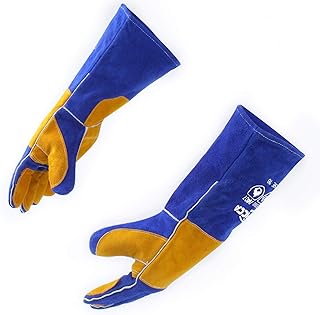
RAPICCA 16-Inch Fireproof Welding Gloves
Check PriceAre welding gloves fireproof?
Welding gloves are flame resistant, not fireproof. They will resist ignition and self-extinguish when the flame source is removed, but they will eventually burn if held in a continuous open flame.
Can welding gloves melt?
Pure leather welding gloves do not melt like synthetic fabrics. Instead they char, shrink, and harden. However, gloves with synthetic liners or nylon stitching can melt, which is why Kevlar thread is the industry standard for quality heat-resistant gloves.
How hot can leather welding gloves get before they fail?
Most split cowhide welding gloves can handle brief contact with surfaces up to 350°C (662°F) before the inner temperature rises enough to cause a burn. The exact limit depends on the leather thickness, the liner, and how long the contact lasts.
Do all welding gloves have the same heat resistance?
No. Thin TIG gloves prioritize dexterity and can offer significantly lower contact heat resistance than thick stick welding gloves. Always check the manufacturer’s ratings to match the glove to your specific process.
How can I test my gloves without specialized equipment?
Hold a hot piece of scrap metal with a pair of tongs and briefly touch the glove surface, never while wearing them. Watch how fast the inside warms up. If the inner face gets hot almost instantly, the thermal barrier has broken down and the gloves need replacing.
Conclusion
So, are welding gloves heat resistant? Absolutely, they are specifically engineered to shield your hands from the intense heat of the arc, the spatter, and accidental contact with hot metal. The key is understanding that this heat resistance is not infinite. It depends on the type of leather, the liner, the rating, and the condition of the glove.
Always match the glove to the process. Use thick, split leather gauntlets for stick and heavy MIG work, and switch to dexterous goatskin for TIG. Check the EN 407 or ASTM rating before you buy, replace gloves the moment you feel heat soak through, and never weld with wet hands or damp leather.
Your gloves are the last line of defense for your most valuable tools, your hands. Treat them as critically as you treat your helmet, and they will handle the heat shift after shift.