If you are new to metal fabrication, you have probably heard that plasma cutting is fast and precise. But when you unbox your first machine, a pressing question often stops you in your tracks. Do plasma cutters use compressed air, or do they rely on expensive bottled gases? It is a foundational question that dictates your setup cost, operating expenses, and the quality of your cuts.
The short answer is yes, most modern plasma cutters, especially handheld units, rely almost exclusively on compressed air. However, simply hooking up any air compressor is not always enough. The air must be clean, dry, and delivered at a precise pressure and volume. Without the right air supply, you will struggle with poor cut quality, excessive electrode wear, and frustrating downtime.
In this guide, we strip away the technical confusion. We will explain exactly why compressed air is the standard, how your machine uses it to create a flame hotter than the surface of the sun, and the specific air requirements you must meet to get clean, professional results.
Table of Contents
Why Plasma Cutters Need Gas

Hobart 500564 Airforce Plasma Compressor
Check PriceTo understand the air question, we first need to look at how plasma cutting actually functions. A plasma cutter does not melt metal like a traditional torch. Instead, it creates an electrically conductive channel of superheated, ionized gas, which is technically the fourth state of matter. This “plasma” arc transfers energy from the power supply to the workpiece.
The gas plays two distinct roles here. First, it acts as the plasma gas, the actual medium that conducts the electricity. Second, it serves as the shield gas, blowing away the molten material to leave a clean kerf. Without a constant, high-speed flow of gas, the circuit breaks and the cutting stops.
Historically, industrial shops used combinations of argon, hydrogen, and nitrogen for exotic alloys. But for the average fabricator cutting mild steel, compressed air is the most economical and effective gas on the planet.
Do Plasma Cutters Use Compressed Air? A Detailed Breakdown
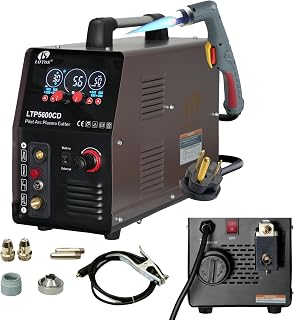
LOTOS LTP5600CD Compressor Non-Touch App-Style
Check PriceLet us answer the core question directly. Do plasma cutters use compressed air? Absolutely. In fact, compressed air is the lifeblood of entry-level and mid-range plasma cutting systems. Most machines sold to home users, automotive shops, and light industrial facilities are explicitly designed to run on standard shop air.
Compressed Air vs. Bottled Inert Gases
It helps to visualize the difference between running a machine on a shop compressor versus a high-pressure cylinder. While large CNC tables often use bottled nitrogen for stainless steel or aluminum, compressed air works perfectly for mild steel. The oxygen in the compressed air actually helps create an exothermic reaction with the steel, giving you a faster travel speed.
High-end units often feature a multi-gas capability. You can switch between air, nitrogen, or an argon-hydrogen mix. However, for 95% of users looking at a best plasma cutter for home use, running compressed air is the only option you will ever need. The ability to use shop air eliminates the recurring cost of gas bottle leases and refills.
Machines with Built-in Air Compressors
A growing segment of the market includes plasma cutters with built-in air compressors. These machines are incredibly portable. You plug them into a 110v or 220v outlet, and the internal pump provides the air flow. However, these are typically limited to lower amperage cuts, often maxing out around 30 amps. They are designed for thin sheet metal and true portability, but they lack the duty cycle of an external industrial compressor.
If portability is your main concern, you might look into a best 110v plasma cutter that pairs easily with a small pancake compressor. But for thick steel, a dedicated external compressed air system remains the king.
The Exact Air Requirements for Plasma Cutting
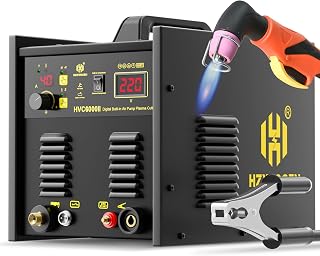
HZXVOGEN Machine Compressor Inverter Technology
Check PriceKnowing that a machine uses air is step one. Step two is providing the right air. This is where most beginners stumble. A plasma cutter requires a specific balance of pressure (measured in PSI) and volume (measured in CFM). If you ignore these numbers, you will destroy consumables in minutes.
Understanding PSI (Pressure)
Most handheld plasma cutters require a dynamic air pressure between 65 and 75 PSI. You check this while the air is flowing through the torch, not just a static reading from the tank gauge. If the pressure drops too low during the cut, the arc will sputter and fail to penetrate. If it is too high, the arc can blow out, or you might deflect the plasma stream.
You should always set your compressor regulator to deliver the manufacturer’s recommended pressure. A common mistake is running a long, narrow hose from the compressor, which causes a massive pressure drop by the time the air reaches the cutter.
Understanding CFM (Volume/Flow)
Pressure means nothing without adequate volume, measured in Cubic Feet per Minute. A plasma cutter is an air hog. A small 30-amp machine might need 3.5 to 4.5 CFM at 70 PSI. A larger 50-amp or 60-amp machine can demand 5.5 to 7.0 CFM.
If your air compressor cannot keep up with the CFM demand, the tank reserve will drain quickly. Once the tank pressure falls below the cutoff, the machine fails to cut. This is why even a 30-gallon compressor struggles with a high-demand cutter if the pump is too slow. Always match the compressor’s rated CFM to the plasma cutter’s requirement.
Why Air Quality Matters More Than Quantity
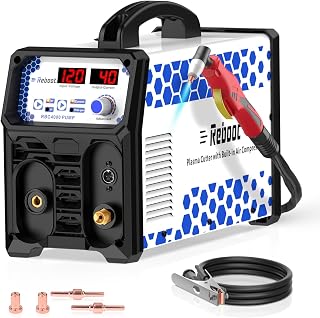
Reboot Compressor Inverter Digital Frequency
Check PriceHaving a massive compressor is useless if the air is filled with water and oil. Plasma cutters are extremely sensitive to contamination. The inside of a torch cap contains a tiny swirl ring, electrode, and nozzle with precise tolerances. Moisture causes rapid electrode wear (green or black pitting) and destroys the nozzle orifice.
Moisture and Oil Contamination
Compressed air naturally creates water vapor as it cools inside the tank. Oil-lubricated compressors can also push trace amounts of oil into the line. For a plasma cutter, this is catastrophic. It leads to an erratic arc start, bad bevel angles, and short consumable life.
The Three-Stage Filtration Solution
A simple water trap at the compressor is not enough. You need dedicated air preparation for any plasma cutter setup. The minimum recommended setup includes a particulate filter to catch rust and scale, a coalescing filter to remove oil aerosols, and a desiccant dryer to strip the remaining water vapor.
- Particulate Filter: Catches rust, dust, and solid particles down to 5 microns.
- Coalescing Filter: Removes oil mist and water aerosols down to 0.01 microns.
- Desiccant Dryer: Uses silica beads to absorb remaining humidity, achieving a low dew point.
If you cut occasionally, a Motor Guard M-30 filter mounted close to the plasma cutter inlet is a popular and effective solution. For high-volume production, a refrigerated air dryer is a long-term investment that solves the moisture issue entirely.
Compressor Sizing: How to Choose the Right Pairing
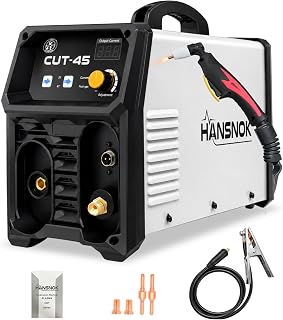
HANSNOK Compressor Inverter Portable Frequency
Check PriceChoosing the right air compressor is a critical part of the “do plasma cutters use compressed air” conversation. You cannot simply grab a small pancake compressor designed for nail guns and expect it to cut steel.
Tank Size and Pump Output
Think of the tank as your battery and the pump as your charger. A 60-gallon tank provides a huge buffer, but if the pump only delivers 5 CFM and your cutter needs 6 CFM at 90 PSI, you will eventually drain the tank and have to wait for recovery. For sustained cutting with a 50-amp unit, a two-stage compressor with a minimum of 5 HP and a 60-80 gallon tank is the industry standard.
For hobbyist use with a 30-amp unit, a 26-gallon single-stage compressor delivering 4 CFM at 90 PSI can work, but you will experience pauses during long cuts. Always upsize your compressor slightly above the tool’s requirement to account for hose losses and future expansion.
Plumbing and Hose Considerations
Do not choke your machine with a 1/4-inch hose over a long distance. A standard 3/8-inch ID hose is the minimum for plasma cutting. For permanent plumbing, black iron pipe or a rapid-air system keeps the flow high. Quick-connect couplers are often the worst bottleneck in a system. Standard industrial (M-style) couplers typically have narrow internal passages. Upgrading to high-flow “V-style” couplers can instantly increase the available air at your machine inlet.
Frequently Asked Questions
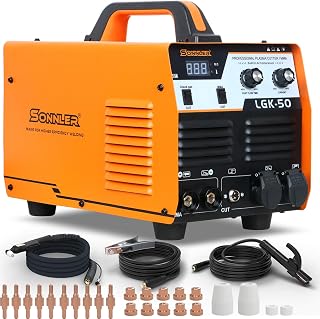
SONNLER Digital Inverter Machine Compressor
Check PriceCan I run a plasma cutter on nitrogen?
Yes, you can run many machines on bottled nitrogen. It provides a clean, inert cutting environment and is particularly effective on stainless steel to prevent oxidation. However, for mild steel, compressed air is cheaper and produces a cleaner cut because the oxygen content aids the burning process. Switching to nitrogen requires a high-pressure regulator and a machine with multi-gas ports.
What happens if I try to cut without enough air?
If air pressure drops below the required threshold, the internal safety pressure switch will prevent the machine from firing. If you manage to start the arc with marginal air, the torch body will overheat almost instantly. You will also experience a “flamethrower” effect where the plasma arc fails to constrict, turning your precise cutter into a messy torch that ruins nozzles.
Is a built-in compressor plasma cutter worth it?
These machines are worth it for specific niche tasks like onsite duct work, auto body repair, or mobile art installations. They are incredibly lightweight and convenient. However, the duty cycle is typically low, and the internal compressor is often the first component to fail under heavy use. For workshop fabrication, a separate compressor system offers far better reliability and value.
Do I need a special filter for plasma cutting?
Absolutely. A standard general-purpose water trap is better than nothing, but it will not stop micro-mists of oil and fine rust. You need a high-efficiency coalescing filter. Many manufacturers will void a warranty for consumable damage if they can prove it was caused by dirty, wet air. Inexpensive disposable inline desiccant filters are a minimal cost that saves hundreds of dollars in nozzles and electrodes.
The Bottom Line on Plasma Cutter Air Supply
So, do plasma cutters use compressed air? They do, and mastering your air supply is the secret to mastering the plasma cutter itself. Electrical theory and amperage settings are important, but the gas flow is where the physical cutting happens. If you are feeding your machine garbage air, you will get garbage cuts, plain and simple.
Investing in a proper plasma cutter without investing in air preparation is a classic beginner mistake. According to the team at Hypertherm, a leading authority on plasma technology, contaminated air is the number one cause of premature consumable failure and poor cut performance globally.
Focus on clean, dry, high-flow air. Ensure your compressor matches the CFM demand of your amperage level. Filter the air close to the point of use, not just at the tank. When you nail the air equation, the plasma cutter transforms from a finicky machine into a tool that slices through steel plate like a hot knife through butter.