You need to weld but the only outlet in your garage is a standard 110V wall plug. You have probably wondered, are 110V MIG welders any good, or are they just cheap toys that shut down every ten minutes? It is a fair question. The market is flooded with small, portable wire-feed units promising pro-level results from a household outlet. The truth is not as simple as yes or no. These machines can lay down beautiful beads, but they have hard physical limits. The key is matching the machine to the metal, not matching the machine to your dream project.
I have run countless pounds of wire through both 110V and 220V systems in home garages and professional shops. I know exactly where these small units shine and where they fail. In this guide, we cut through the marketing hype to explain exactly what you can and cannot build with a 110V MIG unit. We look at the internal components, the duty cycle reality, and the specific welding rod sizes that work. By the end, you will know if this voltage class fits your specific workflow.
Table of Contents
The Voltage Reality: Input Power Dictates Output
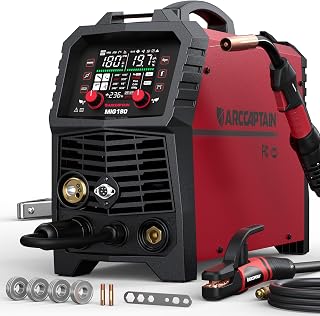
ARCCAPTAIN 180A MIG Welder
Check PriceTo understand if a 110V MIG welder is good, you must understand the physics of the wall plug. A standard 15-amp household circuit operating on 110 volts theoretically delivers about 1650 watts of power. However, electrical codes demand continuous loads stay at 80 percent of breaker capacity. This means a safe, continuous power draw caps out around 1320 watts. When a welding machine converts this AC power to DC, there are efficiency losses. You generally lose about 15 to 20 percent of that total input power to heat dissipation inside the transformer or inverter board.
This leaves you with about 1100 to 1250 watts of usable welding power. Translated to arc output, this limits most quality 110V machines to a maximum realistic amperage of about 90 to 100 amps. Even if the machine has a digital readout showing 140 amps, it cannot bypass the physics of the wall plug. It might spike to that number for a fraction of a second, but you cannot weld a heavy structural joint with it. You are effectively capped at the heat level needed for thin materials.
Metal Thickness: The Hard Physical Limit
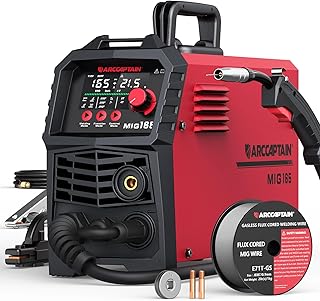
ARCCAPTAIN 165A MIG Welder
Check PriceThe most frequent question is about metal thickness. With a dedicated 120V input, using a high-quality flux core or MIG solid wire with gas, you can achieve proper fusion on steel up to 3/16 of an inch in a single pass. With beveling and multiple passes, you can theoretically weld quarter-inch steel, but the risk of cold lap and lack of fusion is high. If you are building a roll cage, a trailer hitch, or repairing heavy farm equipment, a 110V machine is the wrong tool. The weld may look pretty on the surface, but the root will lack penetration.
For sheet metal auto body work, a 110V MIG welder is actually the preferred tool. The lower heat input helps minimize distortion on thin door skins, quarter panels, and floor pans. The low end of the amperage range allows you to weld 24-gauge or 22-gauge steel without blowing holes. This is where these machines truly outperform larger industrial units that struggle to run stable arcs at single-digit voltage settings. If you are restoring a classic car or fixing a rusty lawn mower deck, the 110V class is perfect.
The Duty Cycle Trap
Raw amperage is only half the story. The duty cycle is where budget 110V machines often disappoint beginners. The duty cycle is the percentage of a ten-minute period a machine can run at a given amperage without overheating. A cheap machine might boast 100 amps but have a 10 percent duty cycle at that output. This means you weld for one minute, then you must wait nine minutes for the cooling fan to save the internal components.
Better inverter-based 110V machines offer duty cycles of 30 to 60 percent at 90 amps. This allows for much better workflow consistency. Brands that utilize advanced cooling and IGBT technology push the usable limit closer to continuous welding on the low end. If you plan to weld long beads without stopping, you need to look for a machine with a stated duty cycle of at least 30 percent at full output. Modern inverter technology is far superior to the old transformer buzz boxes that weighed a ton and overheated quickly.
Inverter vs. Transformer: Weight and Arc Quality
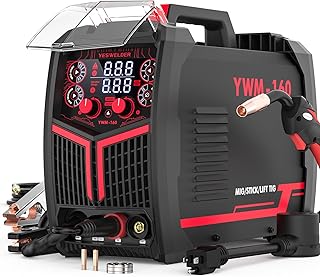
YESWELDER 160A MIG Welder
Check PriceModern 110V MIG welders fall into two distinct categories, and the technology deeply affects how good the welder feels. Traditional transformer welders are heavy, simple, and usually found in cheap big-box store deals. They use a large magnetic core to step down voltage. These machines often have tapped voltage settings, meaning you only get four or five voltage choices instead of a smooth infinite dial. The arc quality is coarse, and the spatter is noticeable. They are difficult to dial in precisely for thin sheet metal.
Inverter welders use circuit boards and microprocessors to control the arc. They weigh less than 25 pounds, making them highly portable. The arc quality is significantly smoother, and they regulate the wire speed better during fluctuations in stickout. An inverter machine draws less input current to produce the same output heat compared to a transformer. This makes them less likely to trip a standard 15-amp breaker. If you are asking if a 110V welder is any good, the answer often depends on whether you choose inverter technology.
Real-World Applications and Success Stories
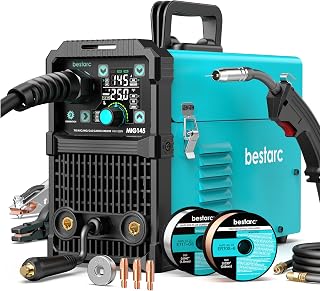
Bestarc 145A MIG Welder
Check PriceStop thinking of these machines as scaled-down industrial tools. Think of them as specialized light fabrication tools. They excel at repetitive short welds on thin wall tubes. A 110V unit is perfect for building cooking grills, custom bicycle frames using chromoly steel, arts and crafts sculptures, exhaust pipe fabrication, and household furniture repair. Artists love them because they require no special high-voltage wiring in a studio apartment or rented industrial bay.
Many heavy-duty repair shops also keep a small 110V machine on the shelf. If a heavy 220V engine-driven welder breaks down, the small 110V unit, paired with a high-quality flux core wire, can make emergency repairs on a truck cab or a non-structural bracket. It is a fantastic backup tool. It is also the king of on-site maintenance in facilities where the only available plug is a standard wall outlet near a broken gate or a loose handrail.
The Gas vs. Gasless Decision
One of the biggest factors affecting performance is your wire choice. Running a solid wire like ER70S-6 with a 75% Argon and 25% CO2 shielding gas produces the cleanest results on a 110V machine. The arc is stable, and the bead appearance is flat and attractive with no slag to chip away. However, using gas means you lose the portability advantage. You must carry a heavy cylinder, and a breeze can blow away your shielding gas outdoors.
Self-shielded flux core wire is the game-changer for 110V machines. Running a Lincoln NR-211 or similar wire allows you to weld outdoors in the wind. The flux vaporizes and protects the weld puddle. However, this process runs hotter and penetrates deeper at the same amperage setting. This is an advantage if you are pushing the thickness limit. The downside is visible fumes, smoke, and a rough slag coating you must clean with a wire brush. For maximum penetration on a 110V circuit, gasless flux core is often superior to gas-shielded solid wire.
Common Problems and How to Solve Them
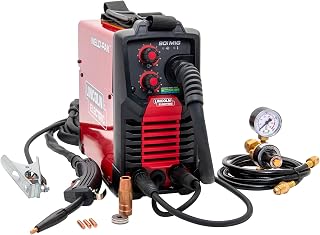
Lincoln Electric 90i Weld-PAK
Check PriceTripping breakers is the number one frustration. If you plug into a Garage circuit that also powers lights, a freezer, or a battery charger, you have very little available amperage left. Dedicate a single outlet to the welder. Swap the standard 15-amp breaker for a 20-amp breaker only if the existing wiring is 12-gauge or thicker. Do not put a 20-amp breaker on 14-gauge wiring, it is a fire hazard. A dedicated circuit eliminates 90 percent of nuisance trips.
Another common issue is bird-nesting of the wire at the drive rolls. This happens when small machines use cheap plastic feed mechanisms. High-quality 110V welders use metal drive rolls with a grooved design that grips the wire tightly. If you encounter this issue, reduce the drive tension slightly. The tension should be just tight enough to feed the wire through the gun cable without slipping, but loose enough that the motor stalls and the roll spins on the wire if you block the tip.
Key Features That Make a 110V Welder Good
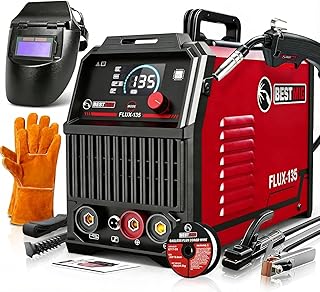
BESTMIG 135A MIG Welder
Check Price- Infinite voltage control: A smooth dial allows you to fine-tune the heat input precisely, unlike tapped settings that jump from too cold to too hot.
- Aluminum wire feed system: Look for a lightweight gun and smooth U-groove drive rolls. Pushing soft aluminum wire through a 10-foot gun with a 110V motor is the ultimate test of feeder quality.
- Dual voltage capability: Machines that accept both 110V and 220V offer a massive safety net. You can weld light sheet metal today, and swap the plug adapter tomorrow to weld quarter-inch plate if you gain access to a 220V outlet.
- Metal construction: Plastic case halves flex during transport and misalign drive rolls. A stamped steel internal frame maintains perfect alignment of the wire path.
Safety and Power Requirements
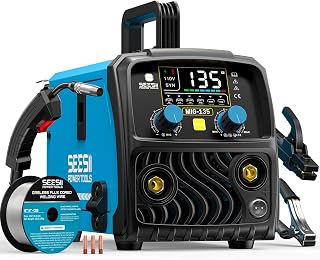
SEESII 135A MIG Welder
Check PriceDo not assume an extension cord will work. A long, thin orange extension cord starves a welder of voltage. The machine tries to compensate by drawing higher amperage, tripping the breaker, and overheating the input capacitors. If you must use an extension, use a 12-gauge or 10-gauge heavy-duty short cord, no longer than 25 feet. Check the plug temperature during welding. If the plug feels hot to the touch, you are losing power to resistance and risk melting the receptacle.
Proper eye protection remains critical even though the arc is small. A 110V MIG arc emits intense ultraviolet and infrared radiation. If you are seeking a reliable helmet for this process, you need full coverage and a fast reaction time to protect your vision. The wrong lens shade causes eye fatigue after a long day of sheet metal work. It is crucial to understand auto-darkening welding helmets if you plan to be productive without constantly lifting your hood.
Material Preparation: The Equalizer for Low Power
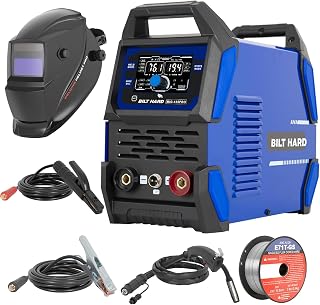
BILT HARD 135A 3-in-1 Welder
Check PriceYou compensate for the lack of raw power with extreme cleanliness. A 220V machine can punch through a bit of rust or mill scale. A 110V machine cannot tolerate contamination. You must grind the base metal to bright, shiny steel before starting the arc. A clean surface reduces the electrical resistance and allows the small arc to establish a stable puddle immediately. If you skip the grinding step, the arc will stutter, spatter violently, and leave a tall, sooty bead with zero penetration.
Joint fit-up is equally critical. Gaps must be tight. A wide root gap pulls heat away from the puddle and requires filler metal to bridge the void. A 110V unit simply does not have the excess energy to fill a large gap and still penetrate the base metal. Cut your pieces with a tight tolerance. If there is a gap, the machine will fill it with surface metal that sits on top of the joint like a blob of glue instead of fusing the root. This is the leading cause of structural failure in home projects.
Frequently Asked Questions
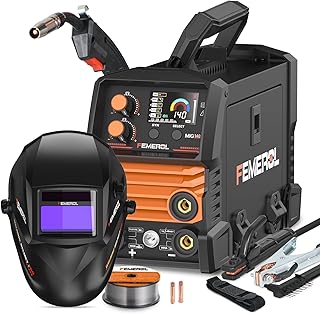
FEMEROL 140A 3-in-1 MIG Welder
Check PriceCan I weld aluminum with a 110-volt MIG welder?
Technically yes, but it is not ideal. You need a spool gun or a push-pull system because aluminum wire is soft and will bind in a long standard gun liner. The thermal conductivity of aluminum wicks heat away rapidly. This means a 110V machine is limited to eighth-inch aluminum stock. It works for small repairs on boats or trailers, but you need 100% Argon shielding gas, not the mix you use for steel.
What is the thickest steel a 110V MIG can weld?
For structural strength, 3/16 of an inch is the hard limit for a single pass using flux core wire. You can weld quarter-inch steel with a V-groove butt joint preparation, a slight preheat with a propane torch, and multiple passes, but the weld may not pass a destructive test. For cosmetic work on thick plate, it works fine as long as load-bearing is not required.
Do 110V welders use a lot of electricity?
No. Because they operate on a standard household circuit, the maximum potential draw is limited. They cost very little in electricity to run per hour compared to arc gouging or large engine-driven machines. You might spend more on the shielding gas bottle rental than on the actual power consumption.
Is a 110V MIG welder better than a stick welder?
For sheet metal and clean indoor fabrication, MIG is the clear winner for ease of use. However, a 110V stick welder often performs better on rusty, dirty, or thick metal because a 6010 or 6011 electrode has a forceful, deep penetrating arc that cuts through contamination. They serve different niches. You may also want to research if 110V stick welders are any good for your specific outdoor repair needs.
The Verdict: Who Should Buy One?
If you are a DIY mechanic, a hobbyist building art projects, or a mobile repair technician fixing light-gauge gates and railings, a 110V MIG welder is not just good, it is the ideal solution. It offers a level of convenience that heavy industrial machines cannot match. You can carry it with one hand, plug it in anywhere, and weld delicate parts that a bigger machine would vaporize. The low initial cost means you can get into MIG welding with gas for a very reasonable investment.
If you are a heavy equipment operator, a farmer repairing cast iron and thick plow blades daily, or an off-roader fabricating one-ton axles, you will hate a 110V welder. You will constantly hit the thermal overload, and your welds will likely crack under stress. For heavy structural fabrication, you need the aggressive arc pressure of a 220V machine. The 110V class is designed for finesse and portability, not brute force. The Lincoln Electric headquarters provides excellent technical guides on wire selection if you want to learn more about electrode compatibility from Lincoln Electric.
Conclusion
Are 110V MIG welders any good? Yes, they are excellent labor-saving tools within their specific design envelope. Do not grade their performance by comparing them to 300-amp industrial units powered by three-phase electricity. They succeed brilliantly at thin metal fabrication, sheet metal auto body repair, and light home maintenance. Their compact size and inverter efficiency make them the best friend of the mobile welder who needs to fix a gate or an exhaust without running a generator.
To get the best results, invest in a quality inverter-based machine with a metal drive system, use the correct wiring and breaker setup, and always grind your metal perfectly clean. Treat it as a precision assembly tool, not a melting weapon. With those expectations set, a 110V MIG welder becomes an indispensable part of any fabrication shop. Check out our guide on the best 110v MIG welders to find a unit that can handle your next repair without tripping the breakers in your garage.