If you work with metal, you have probably heard terms like MIG, TIG, or stick welding. But a cold welding machine might be a new concept for many. Unlike traditional methods that rely on intense heat to melt and fuse metal, a cold welding machine joins materials without any external heat. This solid-state process creates durable bonds at room temperature, making it a valuable tool in industries where heat distortion, sparks, or fumes are a problem.
Understanding what a cold welding machine is can open doors to repairing delicate parts, working in explosive environments, and achieving clean, strong joints on non-ferrous metals. This guide breaks down everything you need to know, from the science behind the process to the types of machines available and when you should use one.
Table of Contents
What Is a Cold Welding Machine?
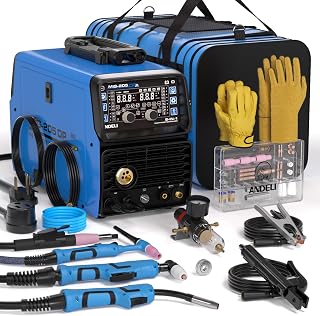
ANDELI Multiprocess MIG Welder, Plasma Cutter Welder Combo MIG-205DP
Check PriceA cold welding machine is a device that bonds two metal surfaces together using pressure, not heat. The process relies on the principle of solid-state diffusion. When two perfectly clean, flat metal surfaces are brought into close contact under high force, their atoms share electrons and form a metallurgical bond that can be as strong as the parent materials.
These machines are commonly used to join soft, ductile metals like aluminum, copper, silver, gold, and nickel. Because no filler metal or shielding gas is required, the process is clean, fast, and safe. Cold welding machines come in handheld, benchtop, and fully automated industrial versions, each designed to deliver consistent clamping force and precise alignment.
It is important to note that the term “cold welding machine” can be confusing. Some products marketed as cold welders actually use micro-pulses of electricity to deposit material, similar to a micro-TIG welder. However, true cold welding machines operate purely on mechanical pressure and do not generate heat at the bond line.
How Does Cold Welding Technology Work?

AWT LED Display 180A Cold TIG Welder with DC Pulse
Check PriceThe cold welding process at its core is a solid-state joining technique. To achieve a perfect bond, the machine must overcome the oxide layers and surface contaminants that naturally coat metals. The process happens in three essential steps.
- Surface preparation: The metal surfaces are wire-brushed, scraped, or machined to remove oxides and dirt right before welding.
- Plastic deformation: The machine applies tremendous pressure, causing the metal to flow plastically. This deformation breaks up any remaining oxide film and exposes pure, atomically clean metal.
- Atomic bonding: With virgin metal surfaces in intimate contact, electrons are shared across the interface. The result is a continuous metallic bond without any melting.
For aluminum and copper, the required deformation is significant, often reducing the joint thickness by 60% or more. But the resulting weld line is nearly invisible, and the electrical conductivity across the joint remains excellent. This is why cold welding is extensively used for wire and cable joining applications.
Types of Cold Welding Machines
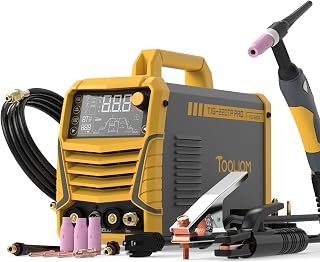
TOOLIOM 220A 7-in-1 Cold TIG Welder 110/220V Dual Voltage
Check PriceThe term cold welding machine covers several equipment categories. Your choice depends on production volume, material thickness, and the shape of the parts you need to weld.
Handheld Cold Welding Machines
Handheld units are compact, portable tools often used for spot repairs, jewelry work, and thin sheet metal. They use a manual or pneumatic clamp mechanism to press two electrodes against the workpiece. These are common in automotive dent repair and for fixing small aluminum or copper heat exchangers.
Many handheld devices marketed as “cold welders” for body shop use are actually resistance spot welders or capacitive discharge stud welders. Genuine handheld cold welding machines focus on pure pressure bonding and work best on ductile non-ferrous metals in wire or strip form.
Benchtop Cold Welding Machines
Benchtop models provide higher, repeatable clamping force and better alignment than handheld tools. They are used in electronics manufacturing to cold-weld copper leads, in HVAC for sealing aluminum tubes, and in aerospace for bonding delicate sensor wires. The controlled pressure and die design ensure uniform deformation every time.
Automated Industrial Cold Welders
Large-scale manufacturing relies on automated cold welding machines for high-speed joining of wire coils, battery tabs, and cable lugs. These systems integrate material feeding, cutting, stripping, and multiple weld heads. They can perform thousands of consistent welds per hour, completely free of heat-related defects.
Key Applications of Cold Welding Machines
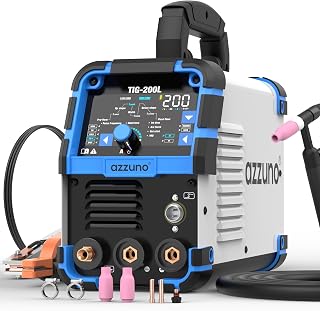
AZZUNO Cold TIG Welder With Pulse 200A
Check PriceCold welding machines excel in situations where heat would damage sensitive components or create safety hazards. Some of the most common industries and use cases include:
- Wire and cable joining: Butt welding copper and aluminum wires without solder or crimp connectors ensures low electrical resistance.
- Aerospace and defense: Creating hermetic seals on aluminum enclosures for electronics and sensors where flux or fumes are unacceptable.
- Heat exchanger repair: Welding aluminum fins and tubes without distorting thin walls or compromising thermal performance.
- Battery pack assembly: Joining nickel or aluminum tabs in lithium-ion battery manufacturing, where heat could damage cell internals.
- Jewelry making: Bonding precious metals without discoloration, oxidation, or the need for post-weld polishing.
- Underground mining and oil & gas: Making electrical connections in explosive atmospheres because the process produces no arc, spark, or flame.
Advantages and Limitations of Cold Welding

AZZUNO Cold TIG Welder With Pulse 180A
Check PriceUnderstanding the pros and cons of a cold welding machine helps you decide if it fits your project. The technology offers unique benefits, but it is not a universal replacement for arc or laser welding.
Advantages
- No heat-affected zone: The base metal retains its original mechanical and electrical properties.
- No filler material, flux, or shielding gas needed, reducing cost and consumables.
- Clean and spark-free operation, ideal for volatile environments.
- High electrical conductivity across the joint, perfect for electrical connections.
- Excellent bond strength, often achieving a weld as strong as the parent metal.
Limitations
- Restricted to ductile, non-ferrous metals. Steel and titanium cannot be cold welded reliably without specialized surface activation.
- Demands immaculate surface preparation. Any oxide or grease prevents bonding.
- Requires significant plastic deformation, which can thin the material excessively.
- Limited to lap and butt joint configurations. Complex fillet or corner welds are not feasible.
Cold Welding Machine vs. Traditional Welding

ANDELI 8 in 1 AC/DC Cold Aluminum TIG Welder 200Amp
Check PriceThe table below highlights the fundamental differences between a true cold welding machine and common fusion welding processes. This comparison assumes a genuine pressure-based cold welder, not a micro-TIG machine.
- Heat generation: Cold welding uses none, while MIG, TIG, and stick welding use intense heat to melt metals.
- Consumables: Cold welding needs no filler rod, wire, or gas. Traditional processes require shielding gas, electrodes, or flux.
- Material suitability: Cold welding is limited to ductile, non-ferrous metals. Fusion welding can handle steel, stainless steel, cast iron, and dissimilar metals.
- Joint strength: Cold welds can reach parent material strength but only in properly prepared, flat interfaces. Fusion welds often have higher tensile strength in complex geometries.
- Skill level: A cold welding machine set up correctly requires less operator skill for repetitive wire joining. Manual fusion welding requires significant practice.
- Portability: Handheld cold welders are very compact, but industrial units are stationary. Portable MIG or stick welders are more versatile on job sites.
How to Choose a Cold Welding Machine
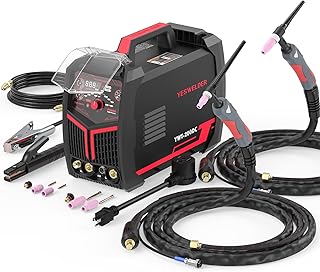
YESWELDER Cold TIG Welder 7 In 1 Cold Spot Lift TIG/Stick
Check PriceSelecting the right cold welder depends on your application, not just price. Whether you are shopping for a handheld repair unit or considering one of the best cold welding machines for your workshop, keep these factors in mind.
Material Type and Thickness
Match the machine’s die design and clamping force to the metal you work with most. Copper and aluminum require different deformation ratios. A machine built for thin wire will not handle thick bus bars, and vice versa.
Clamping Force and Deformation Control
Look for adjustable pressure settings, especially if you weld multiple material combinations. Consistent, well-calibrated force prevents under-welding or excessive thinning. Digital force readouts are a plus in benchtop and automated machines.
Die Geometry and Interchangeability
The shape of the dies determines the weld footprint and joint appearance. Machines with interchangeable dies let you switch between butt welding wires and flat sheet overlap welds. Check for die availability before you commit to a brand.
Production Speed and Automation
For occasional repairs, a manual handheld cold welder is sufficient. For manufacturing lines producing thousands of battery packs, automated systems with wire feed, strip, and weld in sequence are essential. Consider integration with your existing production control software.
Safety and Operational Environment
One of the biggest advantages of a cold welding machine is its intrinsic safety. Without arcs or heat, you eliminate fire and explosion risks. Still, ensure the machine’s pinch points are guarded and it meets local electrical safety standards. In hazardous locations, confirm ATEX or similar certification if required.
Maintenance and Safety Tips
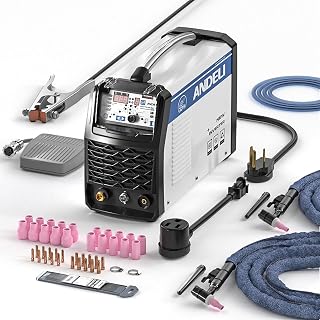
ANDELI TIG Welder Multifunctional Cold Welding Machine TIG-250MPL
Check PriceKeeping your cold welding machine in top condition ensures repeatable bond quality and extends equipment life. Regular care is simple but must not be overlooked.
- Clean die surfaces daily. Any aluminum oxide buildup or debris reduces effective pressure and causes incomplete welds.
- Lubricate moving parts according to the manufacturer schedule. Use non-contaminating lubricants to keep weld surfaces pristine.
- Inspect pneumatic or hydraulic lines for leaks in automated machines. Pressure drops lead to inconsistent deformation.
- Verify calibration monthly with a force gauge or by testing sample welds on a pull tester. Drifting settings are the main cause of field failures.
- Always wear snug-fitting clothing and keep hands clear of the die area. The high-pressure clamping motion can cause severe crush injuries.
Frequently Asked Questions
Can a cold welding machine join steel?
True cold welding works poorly on steel because steel’s surface oxide is hard, brittle, and does not readily deform to expose clean metal under practical pressures. Special surface activation processes exist in laboratories, but for practical repair and manufacturing, arc welding remains the standard for ferrous metals.
Do cold welding machines use any electricity?
Yes, most machines use electricity to power a motor, hydraulic pump, or pneumatic valve that generates the clamping force. The electricity does not heat the workpiece, it only drives the mechanical deformation system.
What is the difference between a cold welding machine and a spot welder?
A spot welder uses electrical resistance to generate heat at the joint and melt the material into a nugget. A cold welding machine uses only pressure and plastic deformation, no melting occurs. Spot welders can join steel and many alloys, while cold welders are limited to ductile non-ferrous metals like aluminum and copper.
Is cold welding as strong as traditional welding?
When performed correctly on compatible materials, a cold weld can equal the tensile strength of the base metal in the direction of applied force. However, the joint is sensitive to peeling or bending loads if not designed appropriately. For butt joints in wire, the strength is excellent, for lap joints with thin materials, the thinned cross-section can be a weak point.
What metals can you cold weld?
Aluminum, copper, silver, gold, nickel, and their alloys are the most common. Lead, tin, and zinc can also be cold welded. The key is high ductility and the ability to flow plastically without cracking. Metals that work-harden rapidly or have stubborn oxide layers, like magnesium or titanium, are challenging but possible under very high vacuum conditions.
Conclusion
A cold welding machine is a specialized tool that bonds ductile metals without heat, smoke, or spatter. It solves problems that traditional welding cannot touch, especially in electrical, aerospace, and explosive atmosphere applications. By using high pressure and perfectly clean surfaces, it creates joints that are often as strong as the original material.
The right machine for you depends on your material, production volume, and budget. Start by identifying the wire gauges or sheet thicknesses you handle most, then look for a machine with adjustable force, compatible dies, and a solid calibration routine. For more detailed buying guidance, check out our roundup of the best cold welding machines currently on the market.
When used correctly, cold welding is safe, repeatable, and cost-effective. It may not replace your MIG welder for heavy steel fabrication, but it is an indispensable addition to any workshop dealing with sensitive copper or aluminum assemblies.