If you have ever squinted behind a standard welding hood, you know that seeing the weld puddle clearly is the difference between a strong bead and a messy repair. The debate about true color vs green lens welding helmet visibility centers on how much detail you can actually detect while the arc is lit. Modern true color lenses promise a near-natural view, while traditional green lenses have protected generations of welders with their distinct tint. Understanding this difference helps you choose a helmet that reduces eye fatigue and improves weld quality.
Table of Contents
What Is a True Color Welding Lens?
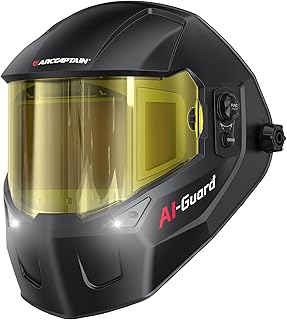
ARCCAPTAIN Intelligent Auto-Darkening Welding Helmet, 180° True Color Hood
Check PriceA true color welding lens uses advanced liquid crystal technology to filter the welding arc without casting an overwhelming green hue over your workspace. Brands like Miller’s ClearLight, Lincoln’s 4C, and Optrel’s Crystal lenses manipulate the light spectrum to maintain a balanced color palette. Instead of seeing everything in shades of green, you see the weld puddle, filler metal, and base material in colors that are close to what you would observe without the helmet on.
The underlying mechanism is still auto-darkening, with sensors detecting the arc and instantly switching to a dark state. However, the LCD filters are tuned to allow more wavelengths through in a controlled way. This technology is often paired with an optical clarity rating of 1/1/1/1, the highest class defined by the European EN379 standard. Such ratings mean minimal distortion, uniform shading, and consistent light transmission across the entire viewing area.
True color lenses are not about making the arc less bright, they still provide full UV and IR protection at the needed shade. What changes is the color rendering index inside the helmet. Welders can finally see the exact color of the glowing puddle, heat-affected zone gradations, and even the joint alignment without flipping the hood up repeatedly.
What Is a Green Lens Welding Helmet?
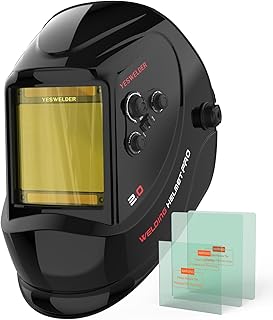
YESWELDER Auto Darkening Welding Helmet, Large View LYG-M800H
Check PriceGreen lenses are the original workhorses of welding eye protection. Passive welding helmets always use a fixed shade green glass filter, typically a polycarbonate shell with a green-tinted glass plate. Many entry-level auto-darkening helmets also produce a green tint, either because they use a simpler LCD formula or because the filter leans heavily on the green spectrum to combat the intense light of the arc.
The green color arises from the metals and pigments used in the glass or LCD to block infrared and ultraviolet radiation. A standard green shade 10 lens does its job, it protects your eyes from flash burns and retinal damage. However, everything you see takes on a uniform green cast. The weld pool, the filler rod, the slag rolling off a stick weld, all become variations of green.
For decades, welders adapted to this monochrome view and produced excellent work. Green lenses are affordable, durable, and widely available. If you compare our gold lens vs green lens comparison, you will see that even within passive optics green is not the only option, but it remains the benchmark for budget-friendly visibility.
True Color vs Green Lens: Key Differences in Visibility
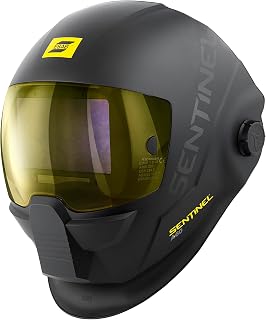
ESAB Sentinel A60 Welding Helmet, Black Low-Profile Design
Check PriceWhen you put the two technologies side by side, the differences in true color vs green lens welding helmet visibility become immediately obvious. Let’s break down the critical aspects.
Color Perception and Contrast
True color technology gives you a view where the base metal looks silvery, the weld puddle glows orange-white, and any discoloration from overheating shows up as blue or straw tints. This is crucial for alloy identification and judging if you are applying the correct heat. A green lens washes away those clues, making it harder to tell if you are burning through the material or if your gas coverage is failing.
Contrast also improves because true color filters preserve more of the natural brightness gradient. You can see the joint seam, the edges of the puddle, and any gap filler without guessing. With a green lens, depth perception can suffer because the reduced color spectrum compresses visual information into a flat green field.
Clarity of the Arc and Puddle
Optical clarity ratings are often better on true color lenses. A 1/1/1/1 rating guarantees no angular distortion, uniform shade across the lens, and no double imaging. Many green-tinted auto-darkening helmets only achieve a 1/1/1/2 rating, where the slight variation in shade can create a cloudy or blurry spot in one corner. True color lenses deliver crisp, high-definition views of the arc cone and the solidifying bead behind it.
This clarity lets welders react faster to changes in the puddle. You can see a keyhole opening in TIG or a cold lap forming in MIG before it becomes a defect. That immediate feedback loop reduces rework and saves grinding time.
Eye Strain and Fatigue
Staring at a bright arc through a green filter for an eight-hour shift is hard on the eyes. Many welders report headaches, dry eyes, and a temporary loss of contrast sensitivity after prolonged use. True color lenses reduce this fatigue by presenting a more natural light spectrum. The brain does not have to constantly compensate for monochrome input, so you stay more comfortable and alert.
In an industry where losing focus means a safety risk, the difference in daily comfort is significant. Even hobbyists notice they can weld longer without needing a break when they switch from a standard green auto-darkening hood to a true color model.
Application-Specific Visibility
Not all welding processes demand the same level of detail. However, true color visibility often gives you an edge across the board.
- TIG Welding: You need to read the puddle color to manage heat input precisely. True color makes it easy to see when aluminum reaches the right wetting temperature.
- MIG Welding: Spray transfer arcs are bright, but a true color lens lets you monitor the fine line between a fluid puddle and a globby mess.
- Stick Welding: Slag chipping and restarts are simpler when you can see the joint clearly. Green lenses hide the subtle boundary between slag and metal.
- Plasma Cutting and Gouging: Following a cut line is far easier with natural color vision, especially on patterned or marked plates.
Which Welding Process Benefits Most from True Color?
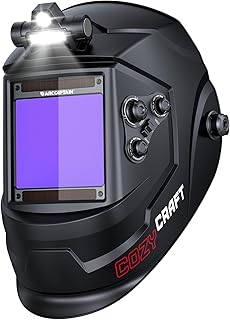
ARCCAPTAIN Auto Darkening Welding Helmet with Light, 3.94″X3.66″ Large View
Check PriceWhile any welder can appreciate the upgrade, TIG operators see the most dramatic transformation in true color vs green lens welding helmet visibility. TIG relies on subtle color cues: a puddle that shifts from dull red to bright yellow tells you the exact moment to add filler. With a green lens, those transitions blend together. Stainless steel TIG, in particular, demands that you catch the first sign of sugaring or oxidation; true color makes those flaws jump out.
MIG welders gain better control over the leading edge of the puddle and can watch the wetting action more clearly. For stick welders working in the field, true color helps differentiate between hot slag and the molten pool, reducing trapped slag inclusions. Even hobbyists using a 110-volt MIG machine at home will notice improved bead consistency simply because they can see what they are doing.
Cost and Value: Is True Color Worth It?
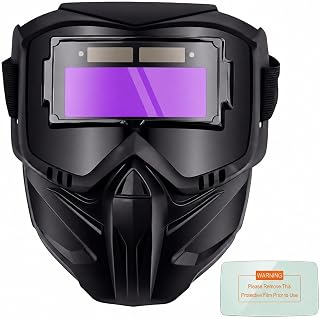
Auto-Darkening Welding Helmet, True Color View UV IR Adjustable Headband
Check PriceThere is no denying that true color helmets carry a higher price tag. A basic green lens passive hood might cost under $30, while a basic auto-darkening with a green tint can be found for under $80. True color helmets typically start around $150 and can exceed $500 for top-tier professional models with large viewing areas and integrated respirators.
The investment, however, often pays for itself in reduced grinding, fewer faulty pieces, and less fatigue. If you weld daily, a true color lens is not a luxury, it is a productivity tool. For those researching the best options on the market, our best welding helmets for superior visibility guide breaks down performance at every budget level.
Beginners can start with an affordable auto-darkening green lens and still learn the fundamentals. But once you have experienced the clarity of a true color shield, going back feels like watching a modern movie through a tinted window.
Expert Tips for Choosing Between True Color and Green Lens
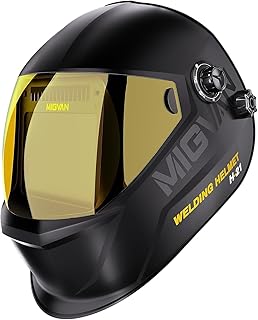
MIGVAN Welding Helmet Auto Darkening True Color Large Viewing
Check PriceUse these practical guidelines to decide which technology suits your work:
- Check the optical class: Look for a 1/1/1/1 rating if you go true color. Even some green-tinted models achieve 1/1/1/2, which is decent but not top tier.
- Test the switching speed: A true color lens must still darken quickly. Ensure the reaction time is under 0.1 milliseconds to avoid flash burn.
- Consider your primary process: TIG and aluminum welding justify the highest-end true color. Stick welding on thick steel in bright sunlight can work fine with a quality green lens.
- Try before you buy: If possible, visit a welding supplier and look through a true color helmet. The difference is immediate.
- Don’t forget fit and sensors: Even the best lens technology is wasted in a heavy, poorly balanced hood that slips. Choose a helmet that feels comfortable on your head for hours.
Many professional helmets, like those featuring Miller’s ClearLight lens technology, combine true color with a large viewing area and multiple arc sensors. This setup ensures you maintain full situational awareness even in tight corners.
Frequently Asked Questions
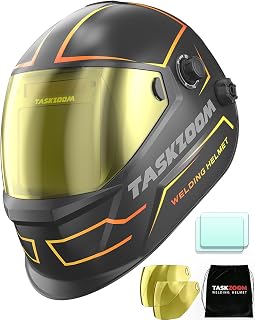
TASKZOOM Auto Darkening Welding Helmet True Color Large View
Check PriceIs true color just a marketing gimmick?
No. The underlying LCD technology is engineered to shift the visible spectrum. Independent tests and welder feedback confirm you see more natural colors. It is a measurable improvement in color rendering, not just a sales pitch.
Does a true color lens provide less UV protection?
Not at all. True color helmets must meet the same ANSI Z87.1 and EN379 safety standards. The shade level, typically 10-13, still blocks 99.9% of harmful UV and IR radiation. The filter simply changes how visible light passes through.
Can I upgrade my green lens to true color?
Only if your helmet is an auto-darkening model with a replaceable cartridge. You can often buy a true color replacement lens from the same brand. Passive green glass hoods cannot be converted.
Which shade number works best with true color?
The shade selection does not change. Use shade 10 for general welding, 11-13 for high-amperage processes. True color lens visibility remains excellent at any shade because the filter is designed to perform uniformly across the darkening range.
Do green lenses have any advantages over true color?
Cost and simplicity are the main advantages. A passive green lens never needs batteries, has no electronics to fail, and provides a consistent view that many old-school welders prefer. For occasional use or remote field work where reliability is paramount, a green lens passive hood is still a solid choice.
Conclusion
True color vs green lens welding helmet visibility is not a debate where one is always right. It is about matching the tool to the task and your budget. True color lenses deliver a crystal-clear, natural view that reduces eye strain and helps you produce cleaner welds, especially in TIG and aluminum applications. Green lenses remain a reliable, cost-effective solution for stick and basic MIG welding where you do not rely on subtle visual cues.
If you weld for a living or strive for professional results in a home shop, upgrading to a true color helmet is one of the smartest steps you can take. The boost in visibility leads to better welds, less fatigue, and more confidence under the hood. Visit a local distributor and try one, the difference will be instantly clear.