Choosing between a PAPR and a standard respirator for welding can feel overwhelming. Both systems protect your lungs from hazardous fumes, but they do it in very different ways. The right choice depends on your work environment, the hours you weld, and your budget. This guide breaks down exactly how powered air purifying respirators stack up against traditional half-mask options, so you can breathe safely while striking an arc.
Table of Contents
What Is a PAPR Welding System?
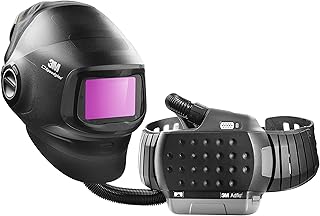
3M Speedglas Welding Helmet G5-01 with ADF and High-Altitude PAPR Assembly | G5-01TW ADF, Adflo PAPR, Bluetooth, Natural Color Technology, 46-1101-30i
Check PriceA PAPR, or powered air purifying respirator, uses a battery-operated blower to pull contaminated air through a filter before delivering clean air to your breathing zone. In welding, the PAPR is often integrated directly into a welding helmet. The blower unit sits at your waist, and a hose connects it to the hood.
This constant flow of purified air creates positive pressure inside the helmet. Because the pressure is slightly higher than the surrounding air, fumes and particles cannot leak in around the face seal. That makes a PAPR one of the most protective options available for welders working in confined spaces or with particularly nasty materials like galvanized steel.
Modern PAPR units typically use a high-efficiency particulate air filter, often rated P100, combined with a pre-filter for larger particles. The powered airflow also keeps you cooler, which becomes a massive benefit during summer months. Many welders report significantly less fogging and sweat buildup compared to non-powered masks.
What Is a Traditional Welding Respirator?

Miller ML00894 Lpr-100 Respirator W/Filters
Check PriceA traditional welding respirator usually refers to a tight-fitting half-mask or full-face elastomeric respirator. These masks rely on your own lung power to draw air through replaceable cartridges. The filters trap particulate matter, and sometimes organic vapors, before you inhale.
To work correctly, the mask must form a perfect seal against your skin. Any facial hair, even stubble, can break that seal and allow unfiltered air to sneak in. These respirators are compact, lightweight, and fit easily under most standard welding helmets. For many hobbyists and part-time welders, a dedicated half-mask respirator strikes a sweet spot of protection and affordability.
Cartridges are available in various levels of filtration, from N95 up to P100. The P100 cartridges filter 99.97% of airborne particles, similar to a PAPR. However, since you are pulling air through the filter without mechanical help, breathing resistance can become a real issue after several hours. Fatigue sets in faster, especially during heavy fabrication work.
Key Differences Between PAPR and Half-Mask Respirators

ANDELI Welding Helmet with Respirator,99.95% PAPR Filtration Efficiency Panoramic 180° Large Viewing Powered Air Purifying Respirator Auto Darkening Welding Helmet with Light
Check PriceFiltration Efficiency and Protection Level
Both a P100-equipped half-mask and a PAPR with a HEPA filter offer roughly the same particle filtration efficiency. The assigned protection factor, however, is often higher for a properly fitted PAPR. Tight-fitting respirators only achieve maximum protection during a successful fit test, which must be repeated annually.
Loose-fitting PAPR hoods do not require a fit test because they do not depend on a face seal. This means you can wear a PAPR with glasses, a beard, or sideburns without worrying about leakage. That design advantage often translates into more consistent real-world protection on a busy shop floor.
Comfort and Breathability During Long Welds
The powered airflow in a PAPR makes a dramatic difference in comfort. You are not fighting resistance with every breath, so you stay fresh longer. The air moving inside the helmet also reduces humidity and heat, which can lower your core temperature on hot days.
Standard half-mask respirators trap heat and moisture against your face. Over an eight-hour shift, the constant pressure on your nose and cheeks can cause sore spots. While you can mitigate this with gel seals and periodic breaks, the physical drain remains higher compared to a blower-driven system.
Weight, Bulk, and Maneuverability
A half-mask respirator weighs only a few ounces. You barely notice it under a lightweight passive or auto-darkening hood. This low profile excels for work in tight spaces, such as inside a ship compartment or under a pipeline, where you need maximum range of motion.
A PAPR system adds a belt-mounted blower unit, a battery pack, and a breathing hose. The combined weight can reach several pounds. While modern designs distribute that weight well, you cannot escape the physical bulk. Some welders find the hose catches on fixtures or limits mobility in cramped positions.
Cost Comparison: Initial and Maintenance
The upfront cost difference is stark. A quality half-mask respirator with a pair of P100 cartridges rarely exceeds fifty dollars. On the other hand, a welding helmet with integrated powered air protection often starts well above one thousand dollars. That initial investment can be daunting for a small shop or a weekend welder.
Maintenance expenses also diverge. Replacement cartridges for a half-mask cost a few bucks and need changing whenever breathing becomes difficult or dirt loading is visible. PAPR filters last longer because the pre-filter catches the bulk of debris, but replacement HEPA filters and battery packs each cost significantly more over the life of the unit.
Battery Life and Operational Considerations
A half-mask respirator needs no power, so it never quits mid-shift. A PAPR, however, depends entirely on battery life. Most modern units run eight to twelve hours on a single charge, but you must stay disciplined about charging stations and spare batteries.
If the battery dies, the blower stops. Though the filter still offers passive protection, breathing through a non-powered PAPR feels far more restrictive than a dedicated half-mask. That makes battery management a non-negotiable part of your daily routine with a powered system.
When to Choose a PAPR Over a Standard Respirator
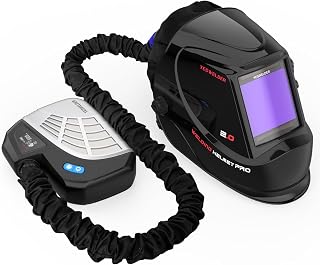
YESWELDER Powered Air Purifying Respirator Auto Darkening Welding Helmet LYG-M800H Welder Hood
Check PriceCertain jobs practically demand a PAPR. If you weld stainless steel or high-chromium alloys regularly, hexavalent chromium exposure is a serious concern. A PAPR provides an extra layer of confidence because it eliminates face seal leaks that plague tight-fitting masks.
Welders who work in hot, humid environments often find the constant airflow indispensable. It keeps you focused on the puddle instead of wiping sweat from your eyes. Likewise, anyone with facial hair that prevents a reliable seal should default to a loose-fitting PAPR hood. The convenience of simply flipping the hood down and having clean air instantly cannot be overstated.
Long-duration TIG welding on exotic metals also favors a PAPR. The low-fume nature of TIG might make a half-mask seem adequate, but the blower’s cooling effect reduces fatigue during those marathon bench sessions. Combined with an auto-darkening lens, a PAPR welding helmet becomes an elite productivity tool.
When a Simple Respirator Is the Smarter Choice

3M Half Facepiece 6391 Respirator Kit
Check PriceNot every welding bay needs a two-thousand-dollar helmet. For home hobbyists, farm welders, and occasional maintenance tasks, a high-quality elastomeric half-mask does the job admirably. If you weld outdoors with plenty of natural ventilation, the fume concentration may never push a PAPR’s added protection factor into the necessary range.
Tight, awkward positions also punish PAPR wearers. Crawling under a vehicle to weld an exhaust bracket leaves little room for a blower unit and hose. A low-profile half-mask underneath a compact hood lets you reach areas that a bulky powered system simply cannot access. The simplicity and zero-power requirement mean one less thing to fail on a remote job site.
Budget-conscious shops often equip each welder with a personal half-mask while maintaining one or two PAPR units for special applications. This hybrid approach balances cost and protection, ensuring everyone has at least baseline respiratory defense. It also keeps training simple, because the entire crew learns fit testing and cartridge change schedules.
Practical Tips for Using Either System Safely
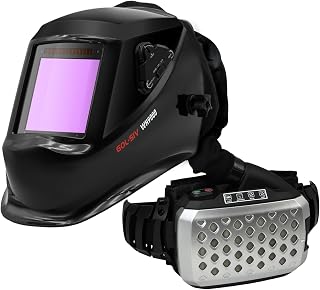
Auto-Darkening Welding Helmet (with Filter) – Optical Grade 1/1/1/1 External Adjustment – Powered Air Purifying Respirator – High-Precision Filtration Technology Ensures Welding Safety
Check PriceRegardless of which respirator type you choose, proper use determines real-world protection. Start by reading the manufacturer’s instructions cover to cover. An expensive PAPR is worthless if you install the pre-filter backward or neglect to seal the battery compartment against moisture.
For half-mask users, perform a seal check every single time you put the mask on. Cover the exhalation valve and exhale gently, the mask should bulge slightly without leaking. For PAPR hoods, always confirm the airflow feels strong and steady before you strike an arc. Low airflow often signals a clogged filter or a dying battery.
Store your equipment inside a clean, sealed bag when it sits idle. Grit and grinding dust will degrade headgear and seals faster than regular wear. Replace filters on a schedule based on your local conditions, not just when they look dirty. According to OSHA respiratory protection guidelines, a change schedule must be written into your workplace respiratory protection program.
Finally, never mix components between different manufacturers. Cartridges from one brand must never be forced onto another maker’s mask. Stick with a single, NIOSH-approved system for your head, face, and breathing protection ensemble.
Frequently Asked Questions
Can you use a PAPR without a fit test?
Yes, loose-fitting PAPR hoods do not require a fit test. The positive pressure design protects you regardless of face shape or facial hair. Tight-fitting PAPR masks, however, still mandate a quantitative fit test to verify the seal.
Do PAPR systems provide better fume protection than a P100 half-mask?
The filter media itself offers comparable efficiency. The practical difference lies in the assigned protection factor. A loose-fitting PAPR often gives a higher factor because it removes the variable of an imperfect face seal that human error or stubble can compromise.
How often should I replace PAPR filters during heavy welding?
Pre-filters may need replacement daily in dusty environments, while the HEPA main filter can last months. Always follow the manufacturer’s guidance and change filters immediately if you notice reduced airflow or a strange odor inside the hood.
Is a powered air purifying respirator worth the cost for a hobby welder?
It depends on how much you value comfort and convenience. A PAPR removes breathing resistance and cools your face, which makes longer sessions more enjoyable. If you weld only an hour a week, a quality half-mask likely delivers enough protection at a fraction of the price.
Conclusion
Both PAPR and standard respirator systems have a solid place on the shop floor. Your decision should hinge on your specific welding environment, the duration of your typical weld session, and whether you can maintain a reliable face seal. A PAPR offers unmatched cooling, works with facial hair, and delivers consistent protection even in the worst fumes. A half-mask respirator costs far less, weighs almost nothing, and slips into the tightest spots without a power cord or a hose to tangle.
Take stock of your daily grind. If you cook under a hood for ten hours a day while fighting high chromium dust, invest in a quality PAPR, your lungs will thank you decades from now. If you weld outside on the farm a few times a month, grab a well-fitted half-mask and spend the savings on better filler metal. Whichever path you choose, commit to wearing it every single time you light up. The best respirator on earth means nothing if it hangs on a hook while you breathe in a cloud.