You have probably felt the strain of a heavy hood digging into your neck after a long day under the hood. The promise of a lightweight welding helmet sounds like a dream for your spine, but it immediately raises a critical question. Are lightweight welding helmets safe, or are you trading protection for comfort? The short answer is that modern lightweight helmets are absolutely safe, often matching or exceeding the protection of their heavier ancestors thanks to advanced material science. Your safety does not depend on how heavy the shell feels, it depends entirely on the engineering and certifications behind it.
Many veteran welders remember the old heavy fiberglass helmets that felt like a brick strapped to your forehead. Those helmets were thick because the materials were primitive. Today, you can buy a helmet that weighs under 500 grams and still blocks more harmful radiation than old models. I have spent years testing gear in the field, and I can tell you that the shift to lightweight gear has been the biggest ergonomic win for our trade. Let’s break down exactly why a lighter hood does not mean a weaker shield.
Table of Contents
Understanding the Safety Science Behind Weight
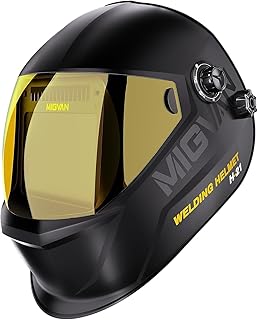
Welding Helmet Auto Darkening True Color Large Viewing, Welding Hood Solar/Rechargeable Battery Powered
Check PriceTo understand why lightweight helmets are safe, you must first separate the weight of the helmet from its protective capabilities. The job of a welding helmet is to filter out intense ultraviolet (UV) and infrared (IR) radiation while shielding your face from sparks and spatter. The actual physical impact protection comes from the shell’s shape and material density, not from sheer thickness. A modern, injection-molded polymer can dissipate impact energy just as effectively as a thicker layer of outdated fiberglass.
The primary safety function is optical, not physical. Even a flimsy piece of plastic could theoretically block a physical spark, but you would still be blinded instantly. The real magic happens in the lens, whether it is a passive glass shade or a sophisticated auto-darkening filter. As long as that lens meets the ANSI Z87.1 standard, your eyes are protected from the invisible light that causes arc eye, a painful burn of the cornea.
How Auto-Darkening Filters (ADF) Reduce Bulk
Old passive helmets require a thick, heavy piece of tinted glass. This glass is inherently weighty. An auto-darkening filter, however, uses a liquid crystal display (LCD) sandwiched between layers of UV/IR interference filters. These layers are measured in microns, not inches. The electronics and the sensors add minimal mass, but the core protective element is drastically lighter than mineral glass. This allows the helmet shell itself to be streamlined.
The technology allows for an ultra-clear state when you are grinding or setting up. The weight reduction here is not just a comfort feature, it is a safety feature. A heavy helmet that causes you to crane your neck forward can obstruct your peripheral vision. A lighter helmet, like some of the high-end Miller or Lincoln Electric models, balances perfectly on the best welding caps you can wear, keeping your field of view wide open.
Material Technology: High-Impact Polymers
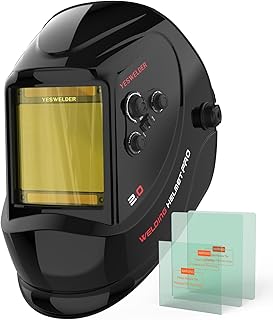
YESWELDER Auto Darkening Welding Helmet, Large View, LYG-M800H
Check PriceThe shell is where the weight savings physically happen. Traditional materials like vulcanized fiber or phenolic resin are dense. They offer high heat resistance but come with significant mass. Modern lightweight helmets use high-impact polyamide (nylon) and polycarbonate blends. These thermoplastics offer a staggering strength-to-weight ratio. They are the same class of materials used in riot shields and bullet-resistant glass, just engineered for thermal resistance against hot slag.
You might worry that these plastics will melt under a shower of sparks. However, high-grade nylon has a melting point well above 400 degrees Fahrenheit. Hot spatter tends to skitter across the smooth, non-porous surface of a polymer helmet rather than sticking and burning in like it does on a weathered cloth-covered fiberglass hood. If you are looking specifically for the latest in polymer engineering, checking out a list of best lightweight welding helmets reveals just how far the materials have come.
Heat Resistance in Thin Shells
A valid concern is whether a thinner shell can withstand overhead welding. Overhead work places extreme thermal stress directly above your face. Manufacturers address this not by making the entire hood thick, but by using radiant heat reflectors in the critical crank and crown areas. Materials like aramid fibers (similar to firefighter gear) are sometimes laminated inside lightweight hoods. This creates a thermal barrier, not a heavy physical one. A thin, reflective silver coating on the interior helps bounce radiant heat away from your skin without adding any ballistic weight.
Decoding Safety Standards
Do not look at the weight to determine safety, instead, you should look at the stamp. In North America, the rigorous ANSI Z87.1 standard is the gatekeeper. If a helmet has this certification, the weight is irrelevant to its protective score. The standard tests for impact resistance by dropping a one-inch steel ball onto the lens from a height of 50 inches. The lens and shell must not crack or deform to touch the eye.
Lightweight helmets are tested identically to heavy ones, with zero leeway given for thin shells. The optical clarity rating is also independent of weight. A cheap, heavy passive helmet might score a 1/1/1 optical rating, which means it has distortion and poor angular uniformity. A premium lightweight auto-darkening hood usually scores 1/1/1/1, meaning it has zero distortion and perfectly uniform shading. Your eyes strain far less under a high-quality lightweight lens. The Occupational Safety and Health Administration (OSHA) references ANSI standards, meaning your boss cannot tell you a lightweight hood is unsafe if it has the marking.
Neck Strain and Secondary Safety
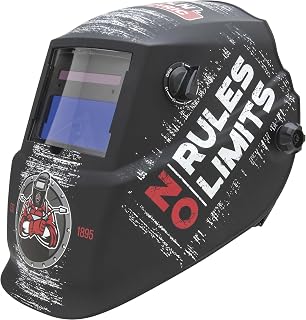
Lincoln Electric No Rules No Limits Welding Helmet K4983-1
Check PriceSafety does not stop at the plastic shell, it extends to your musculoskeletal system. A heavy 2.2-pound helmet creates a pendulum effect on your cervical spine. When you flip a heavy hood down, the inertia can strain the small muscles in your neck. Over a thirty-year career, this leads to chronic cervicalgia, headaches, and even pinched nerves. By switching to a lightweight helmet weighing under 1 pound, you are protecting your long-term health.
A fatigued welder is a dangerous welder. If a heavy helmet is causing you fatigue by noon, you are more likely to cut corners or skip a position check just to get the weld over with. A lightweight hood keeps you fresh. You are more likely to maintain a proper stance and avoid placing your body in the path of fumes. This is where ergonomics directly intersect with immediate work safety.
The Balance Factor
Safety is also about stability. If a helmet is front-heavy, it wants to slide forward over your face. This puts pressure on the bridge of your nose and often forces you to overtighten the headgear. Overtightening causes tension headaches. Modern lightweight designs integrate the electronics close to the pivot points, keeping the center of gravity near the crown of your head. This prevents the hood from bouncing during a stick weld. A hood that bounces can cause you to momentarily lose sight of the weld pool, leading to defects or safety violations in a code shop.
Common Myths About Thin Shells

VILSIN Welding Helmet Auto Darkening Solar Powered Welding Hood
Check PriceLet’s tackle a myth I hear constantly on the job site. Many believe that if a hammer hits a lightweight helmet, it will shatter like an eggshell while a heavy one survives. This is simply not true. Heavy vulcanized fiber is incredibly brittle on impact despite its thickness, it does not absorb shock, it transmits it directly to your neck. High-impact nylon is engineered to flex. It absorbs kinetic energy by temporarily deforming and returning to shape. In a side-by-side crush test, many nylon shells deform and bounce back while a thick fiberglass shell cracks.
Another myth is that lightweight helmets are only for hobbyists doing light TIG welding at a bench. While some ultra-compact models are designed for tight spaces, major brands produce lightweight heavy-duty helmets used daily in structural stick welding. The best welding helmets on the market today almost universally prioritize weight reduction without compromising the lens response time. A response time of 1/25,000th of a second is industry standard, preventing even micro-arc flash regardless of the shell’s thickness.
Durability of Lightweight Hoods
Durability relates to safety because a cracked helmet must be retired immediately. Some worry that lightweight polymers will degrade faster. While UV light can degrade cheap plastic over time, premium welding helmets use UV-stabilized nylon. This prevents the shell from becoming brittle after years of exposure to shop lighting and the sun. Furthermore, the clean geometry of a molded polymer does not have the nooks and crannies that trap grinding dust and moisture, agents that often cause old-school phenolic hoods to delaminate.
Selecting a Safe Lightweight Model
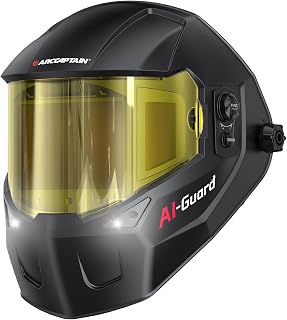
ARCCAPTAIN Intelligent Auto-Darkening Welding Helmet, 180° True Color Hood
Check PriceWhen you are shopping, do not just grab the lightest hood you see and assume it is safe. You must verify the safety rating. Always check the inside of the shell or the ADF holder for the ANSI Z87.1 or Z87+ stamp. The + symbol indicates high-impact certification. If you see only a CE mark, ensure it references EN 175 and EN 379 for welding filtration. Without these marks, a lightweight helmet is just a toy. You also need to match the shade to your process. A too-light shade, like a #5 on a 400-amp arc gouge, will damage your eyes even through a thick gold lens.
- Check for the ANSI Z87.1+ stamp on the lens and shell.
- Verify the optical class rating, look for 1/1/1/2 or better for fine TIG work.
- Ensure the headgear provides a 360-degree grip to distribute the low weight evenly.
- Test the flick mechanism, a smooth flip prevents the neck jolt heavy hoods cause.
Environmental factors matter here. If you are doing heavy flux-core overhead in a shipyard, a pure polycarbonate shell might not have enough heat reflectivity. You would want a lightweight composite that includes a heat shield insert. For general fabrication under 200 amps, a standard lightweight nylon shell is more than adequate.
The Value of Professional Headgear
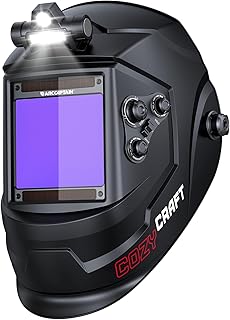
ARCCAPTAIN Auto Darkening Welding Helmet with Light, 3.94″X3.66″ Large View
Check PriceSometimes the safety risk in a lightweight system is not the shell but the headgear. To hit a sub-one-pound weight target, some budget brands use flimsy plastic adjustment bands. If the headgear slips while you are in a cramped position inside a pipe, you could be exposed to arc flash. A truly safe lightweight helmet never compromises on the ratchet mechanism. It uses sweat-wicking materials and a multi-point star ratchet for a locked fit, even if the overall mass is low.
You can test this easily. Put the helmet on, tighten it comfortably, and nod rapidly. A safe lightweight helmet stays planted. A poorly designed one slides down your forehead. This slide can also scratch your safety glasses, creating optical interference. One of the best resources for understanding how these shields stack up is the comprehensive guide provided by the American Welding Society (AWS), which discusses ergonomic safety standards in depth.
Respiratory Integration and Lightweight Shells
You might wonder if a lightweight shell can support a Powered Air Purifying Respirator (PAPR). In the past, PAPR bladders and hoses required rigid, heavy mounting points. Today, low-profile ducting systems attach directly to rear-mounted blowers, removing the hose torque from the hood. This means even a respirator rig can maintain a feather-light feel on your neck. A lightweight shell is not a limiting factor for fume safety anymore, as the filtration blower sits on your belt, not your head.
Frequently Asked Questions
Welding Helmet Auto Darkening True Color Large Viewing, Welding Hood Solar/Rechargeable Battery Powered
Check PriceCan a lightweight helmet handle heavy grinding?
Yes, but you must switch to the grind mode if it is auto-darkening. The high-impact polycarbonate shell resists grinding debris effectively. However, never rely on an auto-darkening lens in its darkened state for grinding, you cannot see the spark stream clearly. A fixed shade lightweight hood works similarly to a heavy one for grinding, but the lower mass reduces arm fatigue when you are cutting off bolts for hours.
Do lightweight welding helmets degrade faster in the sun?
Only cheap ones. Industrial-grade nylon contains UV inhibitors that prevent photodegradation. A high-end lightweight helmet left in a truck for a year will remain structurally sound. Vulcanized fiber, while heavy, can degrade quickly if its sealing coat is scratched. It is a wash between the two if you maintain them, but the polymer handles moisture much better in humid environments.
Are passive lenses safer than auto-darkening in lightweight hoods?
They are equally safe optically if they carry the same shade rating. A passive glass lens in a lightweight hood offers a simpler failproof shield for nuclear-grade work. However, the auto-darkening lens in a lightweight hood prevents the constant neck-whipping motion of flipping the lid. For repetitive tack welding, the auto-darkener actually keeps you safer by eliminating the moment of blind adjustment.
What is the weight cutoff for a safe lightweight helmet?
You should not think in terms of a cutoff. A 16-ounce helmet can be safer than a 24-ounce one if the 16-ounce model has a superior optical clarity rating. Generally, anything under 20 ounces is considered lightweight. The safety floor is about 12 ounces, below that, you are likely looking at unrated hobby visors that lack proper impact certification. Extreme lightweight models around 1 pound are perfectly fine if they are ANSI approved.
Does a lightweight helmet require different safety glasses underneath?
Yes, always wear Z87 safety glasses under any welding helmet, regardless of weight. A lightweight helmet is usually low-volume, sitting closer to the face. You need slim-profile wraparound safety glasses that do not bump the ADF unit. The lower mass reduces the helmet’s tendency to pull glasses down your nose, which is a welcome change from heavy rigs that constantly pinch your temples.
Conclusion: Prioritize Engineering Over Heft
Are lightweight welding helmets safe? Absolutely, the data and certifications prove that modern polymers and advanced multi-layer lenses offer complete protection without the mass. You are not compromising your vision or your skull by shedding a pound of shell weight. Instead, you are investing in your neck health, your situational awareness, and your stamina for the long shifts ahead. Do not let the nostalgia of a heavy leather hood convince you that lightweight gear is a hobbyist gimmick.
Your buying decision should rest on the four standards stamped on the filter plate, not the weight displayed on the spec sheet. Look for impact resistance, optical clarity, thermal stability, and headgear retention. When you find a feather-light hood that hits all four marks at a 1/1/1/1 rating, you have found the safest tool in the shop. Treat weight as a feature of modern efficiency, not a measure of strength. I suggest heading to a local welding supply store and putting a 1-pound polymer hood on your head right after holding a 2-pound passive tank, the difference in control and comfort will sell you instantly.
Keep the helmet clean, store it away from direct chemical spills, and inspect the ratchet headgear monthly. A well-maintained lightweight helmet will serve you reliably for years while your heavy hoods gather dust in the corner. Make the switch, your neck and your eyes will thank you.