You have probably seen those compact, handheld devices online and wondered, do battery spot welders work, or are they just a gimmick? The short answer is yes, they absolutely do work, but only when they are matched with the right job. These are not the massive, industrial machines you see in automotive factories, rather, they are precision tools designed for thin, conductive metals, primarily nickel strips used in battery pack building.
Understanding the physics behind them is crucial. A spot welder uses electrical resistance to generate heat, melting two pieces of metal together at a specific point. A battery-powered unit stores energy in a high-discharge lithium polymer (LiPo) pack or a supercapacitor bank, and dumps it all in a fraction of a second. This process is clean, fast, and surprisingly strong when done correctly.
Many hobbyists turn to these tools because soldering directly onto batteries is dangerous. Excessive heat from a soldering iron can damage the internal chemistry of a lithium cell, causing thermal runaway or permanent capacity loss. A spot welder avoids this by delivering a high-current pulse so short that the heat doesn’t have time to travel deep into the battery terminal.
Table of Contents
How Does a Battery Spot Welder Function?
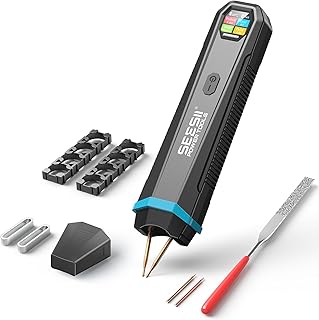
SEESII Battery Spot Welder, Custom Welding Settings, Max 0.15mm Pure Nickel
Check PriceTo grasp why these machines are effective, you need to look at the core mechanism. Unlike a traditional welder that uses an electric arc or a gas flame, a battery spot welder relies on the principle of Joule heating. When a high current passes through the electrical resistance of the metal, it generates intense heat at the contact point.
The heart of the system is the power source, typically a high-performance battery or a supercapacitor array. The control board uses MOSFETs (Metal-Oxide-Semiconductor Field-Effect Transistors) to act as a high-speed switch, pulsing the current for milliseconds. The two copper electrodes press down on the nickel strip, completing the circuit and directing the energy precisely where fusion is needed.
The Role of Pulse Current
The secret ingredient is the pulse current. A standard lithium-ion cell in a power bank cannot do this, you need a high C-rate battery capable of dumping hundreds of amps instantly. The pulse time is usually adjustable, ranging from 1 millisecond to 20 milliseconds. This burst is enough to melt the nickel plating but short enough to prevent the entire battery tab from heating up.
Supercapacitors vs. Lithium Batteries
There are two main types of portable spot welders, and they perform differently. Understanding the difference helps you decide which one actually “works” for your specific needs.
- Supercapacitor Welder: These use large capacitors to store energy. They often require a separate high-current power source to charge quickly, like a large car battery. They provide incredibly consistent pulses because the voltage drops linearly, and they don’t wear out like chemical batteries.
- Lithium Battery Welder: These are fully self-contained, using a high-drain RC hobby battery. They are extremely portable but are sensitive to the battery’s state of charge. If the internal battery is low, the weld pulse will be weaker, leading to inconsistent results.
What Materials Can a Battery Spot Welder Handle?
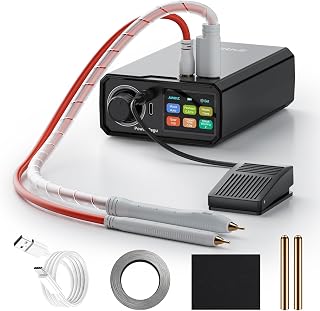
10000mAh Battery Spot Welder, Rotary Knob Operation 100 Gears Adjustable Foot Pedal Operated
Check PriceThis is where the limitations become clear. If you ask, “do battery spot welders work on thick steel?” the answer is a definitive no. These devices are designed for a very specific niche of thin, high-resistance metals. The most common application is welding pure nickel or nickel-plated steel strips, which are the standard for building 18650, 21700, and 26650 battery packs.
Pure nickel is ideal because it has a higher electrical resistance than copper. This resistance is what generates the heat. If you try to spot weld pure copper, which is highly conductive, the electricity passes through without generating enough heat to melt the metal, often resulting in a blown MOSFET on the welder board instead of a weld nugget.
Thickness Limitations
Most consumer-grade battery spot welders top out at 0.15mm to 0.2mm thick pure nickel. High-end units with modified firmware and heavy-gauge wiring might push 0.3mm copper, but this requires pulsed argon gas and specialized tungsten electrodes. For standard DIY welders, sticking to 0.15mm nickel is the sweet spot for reliability.
Common Applications
- Lithium Battery Packs: The primary use case for electric bikes, skateboards, power walls, and cordless tool rebuilds.
- Jewelry and Thermocouples: Fine wire welding for delicate metals that cannot be soldered.
- Thin Foil Repair: Fixing small circuit traces or thin metal screens.
Key Factors That Determine Weld Quality
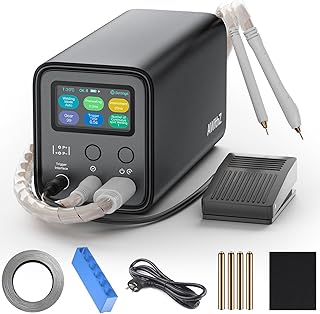
Capacitor Battery Spot Welder, AWithZ UF20B 10.5KW Spot Welder, 3-in-1 Auto & Manual & Foot Pedal
Check PriceJust owning the tool doesn’t guarantee it will work effectively. The operator’s technique and the setup are just as important as the hardware. Many negative reviews online stem from user error rather than the device failing. When you master the variables, a battery spot welder works remarkably well, producing a clean, shiny “nugget” that bonds the strip to the cell.
Electrode Pressure and Condition
The pressure you apply with the handheld pen is critical. Too little pressure creates a high-resistance contact, causing arcing, sparking, and a blown hole in the nickel. Too much pressure decreases the contact resistance too much, driving the current deep and sticking the electrode to the metal. You need a firm, consistent press. The electrode tips must also be clean and sharp, as oxidation acts as an insulator.
Surface Preparation
You cannot weld through dirt, glue, or oxidation. The positive terminal of a lithium cell is often made of a different metal than the negative casing, requiring different energy settings. Always lightly sand or clean the contact area with alcohol. Island-style probes, which separate the positive and negative electrodes, can also help prevent energy loss through the nickel strip itself, a common issue known as “shunting.”
Comparing Battery Spot Welders to Traditional Units
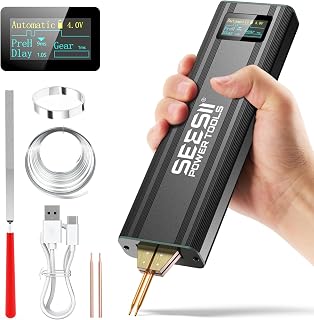
SEESII Battery Spot Welder, Durable Aluminum Casing, Max 0.15mm Pure Nickel
Check PriceTo truly understand their place, compare them to the type of spot welder you might see in a professional shop. A traditional benchtop spot welder plugs into a 110V or 220V mains outlet and uses a massive transformer to step down the voltage and massively increase the current. These machines are often foot-pedal operated and can weld thick steel sheets together.
Battery spot welders lose instantly in a raw power fight. They cannot weld structural steel. However, they win on portability and precision for thin materials. A traditional transformer machine would vaporize a 0.1mm nickel strip on a lithium cell, even on its lowest setting. The battery welder offers the fine control necessary for modern electronics, making it the only viable option for most makers.
Common Pitfalls and How to Avoid Them
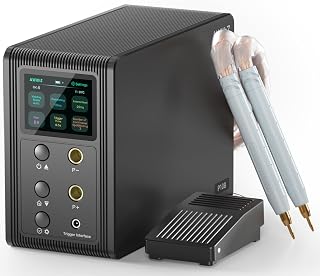
14.6 KW Capacitor Battery Spot Welder, AWithZ Spot Welder, 2-in-1 Automatic & Foot Pedal
Check PriceIf your battery spot welder is not working, it is rarely the tool’s fault. The most common failure point is the power supply. If you are using a cheap lead-acid battery to power a supercapacitor unit, internal resistance might be too high. Always use a powerful, fully charged lithium source or a high-quality AGM battery.
Another pitfall is the wiring gauge. The cables connecting the battery to the control board and the electrodes must be as short and thick as possible, usually 8 AWG or thicker. Long, thin wires increase resistance, heating the wires instead of the weld spot. This is a fundamental engineering issue that causes many DIY kits to underperform.
- Blown MOSFETs: Caused by trying to weld metals that are too thick or too conductive like copper.
- Sticking Electrodes: Caused by too much pressure or too long a pulse duration.
- Weak Welds: Caused by low battery, dirty surfaces, or inadequate electrode pressure.
Safety Considerations for Operation
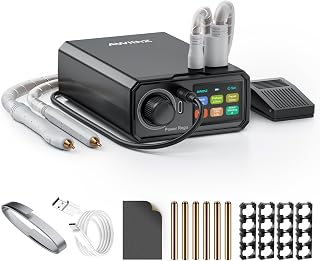
10000mAh Battery Spot Welder, AWithZ 1650A Output Current Max 100 Gears Adjustable
Check PriceWorking with high-current pulses requires respect for the tool. The primary danger is the lithium battery itself. A short circuit during a failed weld can turn the internal battery into a fireball. Always ensure the electrodes are insulated, and never touch them to a conductive surface while the unit is armed.
Eye protection is also non-negotiable. While the arc is small, it is still a bright flash of UV light that can cause eye strain or damage. It is also a good idea to perform the work in a ventilated area, as the vaporizing nickel and adhesives can release fumes. For a deeper look at essential protective gear, you might want to review our guide on the best welding gloves for handling materials.
Choosing the Right Tool for Your Project
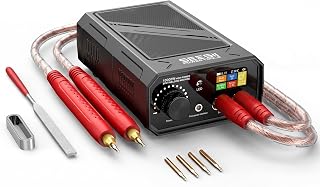
SEESII 10KW Battery Spot Welder: Cordless Spot Welding Equipment, Color LCD Display
Check PriceIf you are looking to build a power wall or repair a drill battery, a budget mini spot welder likely won’t cut it. You need a unit with a known track record of handling 0.15mm nickel consistently. Look for a welder that uses a 3S or 4S LiPo battery directly, or a supercapacitor model that can be powered by a 12V car battery.
For occasional use, a supercapacitor welder is often more reliable because it doesn’t degrade sitting in a drawer. A lithium-based welder requires the battery to be stored at a storage charge, around 3.8V per cell, to maintain its lifespan. If you are just starting out, understanding the difference between tack welding and spot welding can help you decide if this pulse method is truly what you need.
Testing Weld Strength
A visual check is not enough. You need to perform a destructive test. Weld a nickel strip onto a dead cell and then rip it off with pliers. A proper weld will leave a small crater in the nickel strip, proving that the base metal fused before the strip tore. If the strip simply peels off cleanly, leaving no mark, your weld was cold and weak.
Frequently Asked Questions
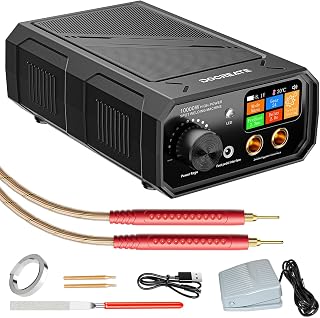
Battery Spot Welder, 10000W Cordless Spot Welding Machine with LCD Display
Check PriceDo battery spot welders work on 18650 cells?
Yes, building battery packs with 18650 cells is the primary reason these tools exist. The voltage and current pulse are perfectly calibrated to fuse nickel strips to the positive and negative terminals without overheating the sensitive lithium chemistry inside the cell.
Can a battery spot welder weld copper?
Standard hobbyist welders struggle with copper because it has very low electrical resistance. To weld copper, you need a welder with much higher current capability, often using tungsten electrodes and a short, high-energy pulse. Most consumer models will fail or burn out trying to weld copper thicker than 0.1mm.
Is it better to solder or spot weld batteries?
Spot welding is vastly superior and safer for battery building. Soldering requires prolonged heat application, which can boil the electrolyte inside the battery and cause permanent damage or a fire. However, spot welding requires a more expensive tool, while soldering requires only a basic iron.
How long does a battery spot welder last?
The longevity depends on the type. Supercapacitor banks can last for hundreds of thousands of cycles without degradation. Internal lithium battery packs will begin to lose capacity and punch after a few hundred cycles, or sooner if stored improperly. The control board MOSFETs can also fail if overloaded frequently.
Why is my spot welder blowing holes through the nickel?
Blowing holes indicates excessive energy. Turn down the pulse time or current setting. It can also be caused by poor electrode contact, where the high resistance creates a micro-arc that instantly vaporizes the thin metal. Ensure your probes are sharp and you are applying even pressure.
Maintaining Your Spot Welder for Long-Term Use
To ensure your tool continues to work reliably, maintenance is simple but vital. The copper electrodes will oxidize and mushroom over time. Use a fine file or sandpaper to reshape them to a fine point regularly. A dull electrode spreads the pressure over too large an area, reducing the current density and making the weld weak.
Keep the circuit board clean. Metal dust from grinding nickel strips can settle on the PCB and create short circuits across the delicate electronic traces. A blast of compressed air or a gentle brush with an anti-static tool can prevent catastrophic failures. For more insights on maintaining your gear, looking at resources like this expert guide on welding safety can help you build a safe workspace.
The Verdict on Battery Spot Welders
So, do battery spot welders work? They work exceptionally well within their intended design envelope. They are not a replacement for a MIG welder, an arc welder, or a heavy-duty transformer spot welder. They are a specialized precision tool for small-scale electrical resistance welding. If you need to build a lithium battery pack, they are the only correct tool for the job, offering a combination of speed, safety, and strength that soldering cannot match.
However, be prepared to spend a bit more on a quality unit. The cheapest generic boards often come with undersized wires and low-quality MOSFETs, leading to inconsistent results. A reliable spot welder, paired with proper technique and quality pure nickel strips, will produce professional-grade battery packs that last for years. The tool works, but only if you set it up correctly and respect its limitations.