Walking into a welding supply store or browsing online, you will quickly notice that Lincoln Electric dominates the shelf space. This brand has built a legacy on reliability and is often the first choice for trade schools and professional fab shops. If you are a beginner or a hobbyist, finding a quality machine that won’t frustrate you is critical, and that leads you to ask, what is a good Lincoln MIG welder? The answer depends heavily on your power supply, the thickness of the metal you plan to weld, and your budget.
A good Lincoln MIG welder is one that balances smooth arc performance with long-term durability. A cheap machine that constantly jams or sputters will make learning impossible. We are going to break down the traits that separate an entry-level home unit from a professional workhorse, ensuring you pay for capabilities you will actually use and not just for a red paint job.
Table of Contents
What Defines Quality in a Lincoln MIG Welder?

K4876-1 POWER MIG 215 MPi Multi-Process Welder
Check PriceBefore picking a specific model number, you need to understand the internal components that make a Lincoln stand out. The quality gap between a big box store special and an industrial welding supply machine is significant. A good Lincoln MIG welder typically features all-metal wire drive systems, not the plastic tensioners found on disposable hobby tools.
The arc characteristics are the most important factor. Lincoln machines are famous for a soft, forgiving arc that feels wet, meaning the puddle fluidity helps prevent cold lap. If the arc is harsh and creates excessive spatter, operator fatigue sets in quickly, and clean-up time doubles.
You should also look for a machine that offers infinite voltage control rather than tapped settings. Tapped settings limit your fine-tuning ability. With infinite control via a dial, you can dial in the exact heat required for thin sheet metal without blowing holes, which is a common frustration for novices who bought a machine with only four heat settings.
The Importance of Continuous Voltage Control
Many cheap welders use a tapped transformer, giving you a few coarse power levels. A good unit uses chopper technology or a solid-state rectifier that allows a smooth sweep of power. This is the difference between melting through a car exhaust and laying a perfect bead on thin gauge steel.
- Allows precise heat input adjustments for varying metal thicknesses.
- Prevents warping and burn-through on sheet metal.
- Enables a crisper, more stable spray transfer arc at higher voltages.
Home Hobbyist vs. Industrial Fabrication Needs
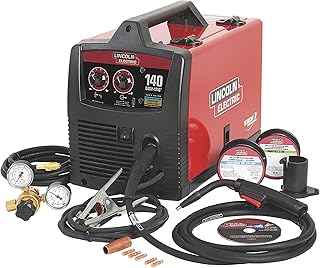
EASY MIG 140 Welder
Check PriceNot everyone needs a 600-pound industrial powerhouse. However, misjudging your needs is expensive. If you are working out of a residential garage, your primary limitation is input power. Assuming you are restricted to a standard 120-volt wall outlet, your definition of a good Lincoln MIG welder shifts to machines that maximize 20-amp circuits.
For the home user, portability and multi-process capability often define value. Machines like the Lincoln Power MIG 210 MP have become the gold standard. This is a multi-process unit, allowing you to switch from MIG to Stick or DC TIG welding. It bridges the gap between a hobbyist toy and a shop tool.
If you are outfitting a farm or a structural shop, your definition changes, and for a choosing a machine for a home garage, you likely don’t need an industrial unit. Conversely, serious fabricators require a machine with a high duty cycle, usually 60% or better at rated amperage, and the ability to run 33 to 44 pound spools of wire.
Duty Cycle and Arc Time
A good duty cycle rating is essential for avoiding thermal overload shutdowns. The duty cycle tells you how many minutes out of ten a welder can run at a specific amperage before it needs to cool down. For heavy 1/4-inch plate work, you need a machine that can sustain welding without constant interruptions.
Lincoln’s entry-level Home Depot models typically run a 20% duty cycle at 90 amps, which is fine for spot welding but miserable for long beads. A step up to a unit like the Power MIG 215 provides a 60% duty cycle at 130 amps, allowing you to run multiple passes on heavy structural steel without the thermal breaker cutting you off.
The Leading Contenders: A Practical Breakdown
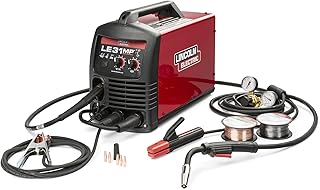
140 Amp LE31MP Multi-Process Stick/MIG/Flux-Core/TIG, 120V, Aluminum Welder with Spool Gun Sold Separately K3461-1
Check PriceTo answer the question specifically, we must look at the three tiers of Lincoln’s popular MIG lineup. The Handy MIG is the cheap beginner stick-out, the Easy MIG 180 is the bridge tool, and the Power MIG 211i or 215 is the advanced home-shop hero. They all spray metal, but the user experience is worlds apart.
If you start with the Easy MIG 180, you are getting a reliable transformer machine. It provides 180 amps of output on a 230-volt input. This machine is notoriously smooth, forgiving, and nearly indestructible. It’s a good Lincoln MIG welder for entry-level auto body and hobby farm use, but it lacks the digital displays and fine-tuning of inverter machines.
Moving up to the Power MIG 215 or 211i, you gain the ability to run on either 120V or 230V power. This is critical for someone who wants to weld heavy stuff at the shop but might take the machine to a buddy’s garage for bodywork with a simple adapter. These machines use inverter technology, making them light enough to carry with one hand.
The Magnum Pro 100SG Spool Gun Connection
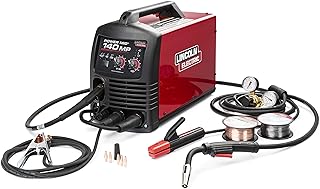
K4498-1 – MIG Welder 140MP Power MIG Multi-Process Welder
Check PriceA major deciding factor for many buyers is aluminum capability. A Lincoln MIG welder is only as good as its ability to handle different materials. Units that can plug directly into the Magnum PRO 100SG spool gun offer a distinct advantage over aftermarket additions.
This spool gun places the push-pull mechanism right at the gun, eliminating birdnesting of soft aluminum wire. When looking for a good unit, always check if the machine has a spool gun ready switch. This changeover should be tool-free and intuitive. Without this feature, welding aluminum becomes a frustrating battle of clearing tangled wire from the drive rolls.
For a direct comparison of Lincoln models, you must look past the amperage numbers and check the drive system flexibility. A machine that handles 2-pound and 10-pound spools with ease gives you more versatility. The tensioning system on units like the 211i is calibrated with specific number dials, making it repeatable and precise.
Why the Power Source Matters More Than the Brand
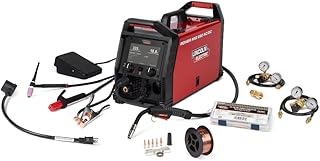
POWER MIG 220 AC/DC multi-process welder
Check PriceEven the best machine will perform poorly if plugged into an undersized extension cord. A good Lincoln MIG welder requires clean, dedicated power. If your garage has shared wiring that dims the lights when a fridge kicks on, an inverter welder might trip constantly because it is sensitive to voltage drops.
Transformer-based units like the older Weld-Pak and Easy MIG series are heavy, but they are extremely tolerant of dirty power from generators. If you plan to weld strictly off engine-driven power or in rural areas with fluctuating grid voltage, a transformer machine is often the more practical choice. The extra weight is literally copper and iron, which acts as a buffer against power spikes.
Gas vs. Gasless Flux-Core Setup
Your definition of a good welder changes if you never intend to hook up a shielding gas bottle. Many Lincoln MIG welders are sold as flux-core ready. However, to switch them to solid MIG wire, you need to reverse the polarity of the gun and ground clamp, and install a gas solenoid.
A good machine makes this polarity change easy, often via clearly marked studs inside the wire feed door. Cheaper models require a tool swap that confuses newbies, leading them to weld MIG in flux-core polarity, resulting in intense spatter and poor fusion. Always look for a model that labels DCEN and DCEP clearly, as a reliable source like the visit the official Lincoln Electric website often details these features.
Actionable Buyer’s Checklist
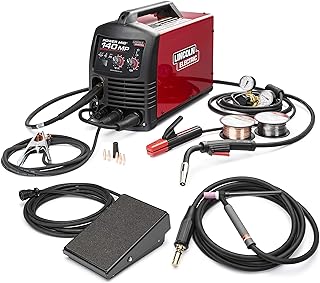
Lincoln Power MIG 140MP Multi-Process Welder TIG One Pak K4499-1
Check PriceBefore clicking buy, run through a practical checklist tailored to Lincoln’s lineup. Identify your maximum steel thickness. If it is under 3/16-inch, a 140-amp class machine on 120V might suffice. If it is 1/4-inch or thicker, you need 180 amps minimum and a 230-volt circuit.
- Verify the wire drive is all-metal, not plastic.
- Check if the machine includes an Argon mix regulator in the box.
- Prioritize a model with Magnum series torch compatibility.
- Look for a 5-year warranty on the transformer and 3 years on electronics.
You also need to account for the initial power draw. Starting an arc on thick metal pulls a massive inrush current. If the machine’s panel breaker is 20 amps and your garage circuit is 15 amps, you will pop the breaker constantly. A good Lincoln MIG welder for a beginner is one that fits safely within your electrical infrastructure without requiring a total panel upgrade.
Frequently Asked Questions

Weld-Pak 225i Stick Welder, Dual Voltage
Check PriceIs a Lincoln Easy MIG 180 good for auto body work?
The Easy MIG 180 is excellent for replacing frame sections and heavy brackets, but it is too hot for rusty old body panels. It has a minimum amperage that can sometimes blow holes in thin 20-gauge metal. For auto body specifically, an inverter unit with lower bottom-end amperage provides better control.
Can I use a Lincoln MIG welder on a 30-amp breaker?
Yes, and this is actually the sweet spot for the 200 to 215 amp class machines. Lincoln manual specifications usually overstate the peak current, but real-world welding rarely trips a 30-amp, 230-volt dryer outlet. Ensure the plug matches your receptacle, or use a UL-listed adapter rather than modifying the machine’s plug end.
What is the difference between the Weld-Pak and the Power MIG?
The Weld-Pak is an entry-level, tapped voltage machine usually found in big box retailers. The Power MIG is a dealer-focused line featuring continuous voltage control, higher duty cycles, and better drive systems. The Weld-Pak can weld steel, but the Power MIG provides a significant upgrade in puddle control and arc softness.
Does a good Lincoln MIG welder need a special shielding gas?
It does not need a special gas, but a standard C25 blend (75% Argon, 25% CO2) produces the best results on mild steel. Straight CO2 is cheaper and penetrates deeper, but the arc is more violent and spatters a lot. If you want the Lincoln soft arc reputation to shine, you must use a C25 mix.
Conclusion
Finding out what is a good Lincoln MIG welder means looking past the brand sticker and at the core components. The Power MIG 211i or the Power MIG 215 represents the best value for a serious home user who wants MIG, Stick, and TIG capability in one compact box. They offer the legendary Lincoln arc quality while being portable enough to store on a shelf.
If you do not need multi-process and want pure brute strength, the older transformer-based Easy MIG 180 remains a bulletproof choice that handles dirty farm steel without complaints. Just remember that your skill advancement is tied directly to the machine’s adjustability. Choose a Lincoln MIG welder with infinite voltage control, a robust cast-aluminum wire drive, and a comfortable Magnum torch. That specific combination defines what makes the investment worth every dollar.