Choosing a good starter MIG welder feels overwhelming when you are new to welding. The market is packed with machines, each promising easy learning curves and great results. The truth is, the right entry-level wire-feed welder can shorten your learning time dramatically, while the wrong one leads to frustration and wasted metal. This guide breaks down exactly what to look for in a beginner-friendly MIG welder, which features matter most, and the models that help you lay clean beads from day one.
MIG welding, short for Metal Inert Gas welding, is widely recommended for beginners because it is cleaner and faster than stick welding. The wire feeds automatically, so you can focus on gun angle and travel speed instead of maintaining an arc gap. A good starter MIG welder takes those advantages and packages them with intuitive controls, forgiving arc starts, and a power range suitable for thin sheet metal and light fabrication. Once you understand the core specs, you can quickly narrow down the options to a machine that fits your garage, budget, and project list.
Table of Contents
What to Look for in a Good Starter MIG Welder
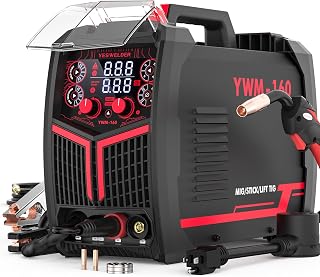
YESWELDER 160A MIG Welder, 110V/220V MIG/Flux Core/Lift TIG/Stick
Check PriceBefore browsing specific models, it helps to define the key criteria that separate a true beginner welder from an industrial unit. A good starter MIG welder balances power, duty cycle, and ease of use without overwhelming the user with unnecessary settings. Most hobbyists and DIY welders never need a machine that pushes 250 amps. They need a reliable wire-feed welder that runs on standard household power and handles material thicknesses commonly found in auto body repair, furniture making, and home maintenance.
Power Input and Amperage Range
The vast majority of beginner-friendly MIG welders operate on 110V or 120V household current. This eliminates the need for a dedicated 230V outlet, making the machine truly plug-and-play. A 110V MIG welder typically delivers between 70 and 140 amps, which is perfect for welding mild steel from 24-gauge up to 1/4 inch thick. For a good starter MIG welder, look for variable voltage settings rather than just two or three fixed taps. More granular voltage control lets you fine-tune the arc for different metal thicknesses and avoid burn-through on thin sheet metal.
Some starter machines also offer dual-voltage capability, running on both 110V and 230V. This future-proofs your investment if you later want to weld thicker plate, but it is not a must-have for most first-timers. Stick with a 110V unit rated for at least 90 amps, and you will comfortably cover the bulk of DIY projects.
Duty Cycle for Home Projects
Duty cycle describes how long a welder can run continuously before it must cool down, expressed as a percentage over a 10-minute period. A good starter MIG welder often has a 20% to 30% duty cycle at its maximum output. In practical terms, that means you can weld for about 2 to 3 minutes out of every 10 at full power. For home use, this is more than adequate because you spend significant time positioning parts, chipping slag, and checking fit-up. High duty cycle machines cost more and are unnecessary unless you are welding production-style, so do not get hung up on huge numbers.
Gas vs. Flux-Core Capability
A critical decision point is whether your starter MIG welder uses shielding gas, self-shielded flux-core wire, or both. True MIG welding uses a shielding gas, typically a mix of argon and CO2, which produces cleaner welds with very little spatter. However, the gas cylinder and regulator add cost and complexity. Many beginners start with flux-core wire, which does not require gas and works well outdoors, even in breezy conditions.
A good starter MIG welder that supports both gas and gasless operation gives you the most flexibility. You can learn with flux-core wire and switch to gas for prettier welds later, all on the same machine. Simply changing the polarity, adding a gas bottle, and installing solid wire transforms the welder from flux-core to gas-shielded MIG. Our roundup of beginner-friendly MIG machines highlights several models that handle both modes effortlessly.
Portability and Weight
Small inverter-based MIG welders now weigh under 20 pounds, making them easy to carry to different parts of the shop or out to the driveway. A compact, lightweight machine encourages more practice because you are not wrestling a 70-pound transformer unit. When evaluating a good starter MIG welder, consider one with a comfortable handle and a small footprint. Portability adds value without sacrificing performance.
Ease of Setup and Beginner-Friendly Controls
Entry-level MIG welders should have clear, simple controls. Look for clearly labeled voltage and wire speed knobs, a wire feed speed chart printed inside the door, and a quick-release drive roll system. Some machines include an auto-set or synergic mode that automatically adjusts voltage and wire speed based on material thickness and wire diameter. This feature reduces the guesswork and helps a new welder get the settings close to optimal before fine-tuning by ear and eye.
Top Features That Make a MIG Welder Beginner-Friendly
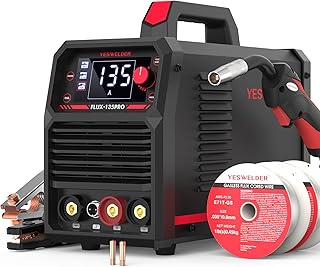
YESWELDER 135A MIG Welder, 110V Flux Core Gasless MIG/Lift TIG/Stick 3-in-1
Check PriceCertain features consistently show up on the best starter MIG welders. These are not afterthoughts, they are engineering choices that prioritize learning and safety. Keep an eye out for the following when comparing models.
- Infinite voltage control instead of stepped switches, allowing precise arc tuning.
- Easy polarity changes for switching between flux-core and MIG gas welding.
- Built-in thermal overload protection that shuts the welder down before damage occurs.
- Quick-change drive rolls that accept different wire diameters without tools.
- A durable metal wire feed mechanism for consistent wire feeding on long weld passes.
Additionally, a good starter MIG welder will include a complete accessory package right out of the box. A MIG gun, ground clamp, contact tips, and a sample spool of wire reduce the number of separate purchases. Some entry-level machines even come with a basic handheld welding mask and a brush/hammer, though you will soon want to upgrade your protective gear. For a comfortable and safe experience, pair your machine with a welding helmet for beginners that features an auto-darkening lens and a lightweight shell.
Recommended Good Starter MIG Welder Models
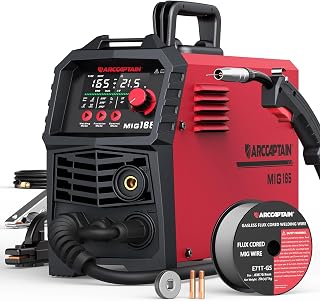
ARCCAPTAIN 165A MIG Welder 110V 220V 4-in-1 Gasless Gas MIG Stick Lift TIG
Check PriceWhile specific model availability changes over time, several manufacturers have consistently delivered reliable entry-level machines that strike the right balance of cost and capability. The following categories represent the most popular paths for new welders. No matter which direction you lean, remember that a good starter MIG welder does not have to be the most expensive, it simply needs to run a stable arc and survive the learning phase.
Budget-Friendly Options Under $500
There are impressive sub-$500 wire-feed welders that produce solid welds on mild steel. Models like the Hobart Handler 140 and Lincoln Electric Easy MIG 140 are often recommended because they accept both 4-inch and 8-inch wire spools and run on standard 110V outlets. These units offer tapped voltage settings with four or five positions, which simplifies the learning curve. Although you will not get the infinite control of a premium inverter, the tapped settings are well-chosen for typical material thicknesses.
For those who plan to weld strictly with flux-core wire outdoors, even simpler and more affordable flux-core-only machines like the Forney Easy Weld 140 FC-i drop the price further. Such a welder eliminates the need for a gas cylinder entirely and can still produce strong, functional welds. Just be prepared for more spatter and a slightly rougher finish compared to gas-shielded MIG. According to industry guidance on selecting your first machine, a 140-amp unit covers the vast majority of home and light farm projects without overcomplicating the setup.
Mid-Range Dual-Voltage Starters
If your budget stretches to the $700 to $1000 range, dual-voltage inverter MIG welders like the Lincoln Power MIG 210 MP or Miller Multimatic 215 offer exceptional versatility. These machines run on both 120V and 240V, so you can plug into a standard outlet for thin material or get higher amperage on thicker plate. They often include multi-process capability, meaning you can also stick weld and, in some cases, DC TIG weld. Having all three processes in one box is overkill for many beginners, but it is a worthwhile investment if you suspect your welding hobby will scale up quickly.
While these premium machines are still a good starter MIG welder, the extra features add complexity. If you feel intimidated by a screen menu, stick with a simpler single-voltage unit and master the basics first. You can always upgrade later.
Essential Accessories for Your First MIG Welder

ANDELI 110V/220V MIG Welder 135A,PULSE Flux Core/Lift TIG/Stick 4-in-1
Check PriceBuying the welder itself is only part of the equation. A good starter MIG welder must be supported by quality accessories to ensure safety, good results, and longevity. The following items are worth purchasing alongside your machine, especially if they are not included in the box.
- An auto-darkening welding helmet with a shade range of 9 to 13 for comfortable eye protection.
- Welding gloves made from durable leather, designed for MIG heat and spatter.
- A welding jacket or flame-resistant cotton sleeves to protect your arms.
- A dedicated welding cart to secure the gas cylinder and organize cables safely.
- Extra contact tips and a wire brush to keep the nozzle clear.
If you intend to weld with solid wire and shielding gas, you will need a cylinder of 75% argon / 25% CO2 mix, a flowmeter regulator, and hoses. Factor this into the total startup cost because the gas setup can add $150 to $250 on top of the welder price. Many beginners start with flux-core wire to defer that expense and add gas later when they are comfortable laying consistent beads.
Setting Up Your Good Starter MIG Welder
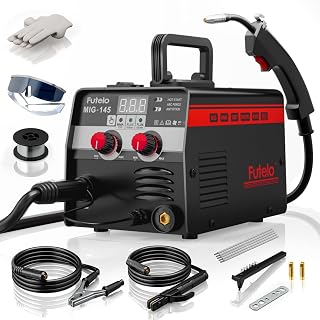
145A MIG Welder, 3 in 1 Flux Core/Lift TIG/Stick Welding Machine 110V
Check PriceA methodical setup prevents most issues beginners face, such as erratic wire feed and excessive spatter. After unboxing, verify that the drive roll groove matches your wire diameter and that the roll tension is tight enough to feed but not so tight that it deforms the wire. Open the side door and confirm the polarity, solid wire with gas uses electrode positive, while most flux-core wires run electrode negative. Check the polarity connections on the terminal studs inside the machine.
Connect the ground clamp to clean, bare metal as close to the weld joint as possible. Poor grounding is the number one cause of an unstable arc. Set the voltage and wire speed according to the chart on the door, then tweak by sound. A proper short-circuit MIG arc should sound like bacon sizzling steadily, not popcorn popping or harsh machine-gunning. Practice on a scrap piece of the same metal you intend to weld, and adjust settings until the bead profile is slightly crowned with good tie-in at the toes.
Common Mistakes Beginners Make with a MIG Welder

BILT HARD 135A 3-in-1 IGBT Inverter Welder with Synergic Control
Check PriceOwning a good starter MIG welder does not automatically guarantee perfect welds. Many first-timers run into the same avoidable errors. Recognizing these mistakes early keeps you from developing bad habits.
Incorrect Polarity
Switching from flux-core to gas without reversing the polarity leads to a sputtering, ugly arc. Always double-check the polarity connections when changing wire types. A good starter MIG welder makes this easy with clearly marked terminals and quick-change jumpers.
Wrong Wire Type or Diameter
Beginners often buy 0.035-inch wire for thin sheet metal, which requires more heat than a 110V machine can deliver cleanly. For body panels and thin tubing, 0.024-inch or 0.030-inch solid wire works much better. Running 0.030-inch flux-core wire offers a good compromise for outdoor work up to 1/8 inch. Use the wire diameter recommended by the welder’s chart and match the drive roll and contact tip accordingly.
Poor Ground Connection
A rusty or painted ground spot creates resistance that makes the arc flicker and the wire stub into the puddle. Always grind a clean spot for the ground clamp, even on small test pieces. A secure low-resistance connection is as important as any setting on the welder itself.
Frequently Asked Questions
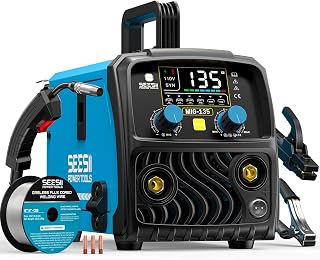
SEESII 135A MIG Welder 110V – 3-in-1 Gasless Flux Core/Lift TIG/Stick
Check PriceWhat is the best amp range for a starter MIG welder?
For a good starter MIG welder, an output range of 30 to 140 amps works best for home and hobby projects. This covers thin 24-gauge sheet metal up to 1/4 inch steel in a single pass. A 110V machine typically delivers 90 to 140 amps at full power, which is ideal for learning and most DIY tasks.
Should I get a gas or gasless MIG welder?
If you plan to weld indoors and value a clean, spatter-free bead, a gas-shielded MIG welder is the better choice. If you work outdoors, lack space for a cylinder, or want to minimize upfront cost, start with a gasless flux-core setup. Many good starter MIG welders support both, giving you the option to change later.
Can a good starter MIG welder weld aluminum?
Welding aluminum with a standard MIG machine is difficult and requires a spool gun, pure argon gas, and a lot of practice. Most entry-level MIG welders are designed for steel. If aluminum welding is a priority, look for a more advanced machine with a spool gun connection, but understand it is not a typical beginner process.
What thickness of metal can a beginner MIG welder handle?
A 110V starter MIG welder can reliably weld mild steel from 1/8 inch up to 1/4 inch in a single pass with flux-core wire, and slightly less with gas. For thinner metal like 18-gauge or 20-gauge, turn down the voltage and wire speed to avoid blowing holes. With proper technique, a good starter unit handles the full range found in home and auto projects.
How much should I spend on my first MIG welder?
Set aside $350 to $500 for a reputable brand 110V MIG welder that runs both flux-core and gas. This price range gets you a durable machine with a metal feed mechanism, good customer support, and a solid warranty. Spending much less often results in unreliable wire feeding and a frustrating learning curve.
Conclusion
A good starter MIG welder removes the barriers that keep new welders from reaching satisfying results quickly. Focus on a 110V unit with infinite voltage control, the ability to run both flux-core and gas-shielded wire, and a duty cycle that matches your pace. Pair the welder with a quality auto-darkening helmet, sturdy gloves, and a clean work bench, and you have the perfect recipe for developing real skills.
Start with simple joints on scrap metal, dial in your settings by sound, and resist the urge to chase the highest amperage numbers. The most reliable starter machines are those that are easy to set up and forgiving when your hand speed fluctuates. With the right machine and a bit of practice, you will be repairing, fabricating, and creating with confidence sooner than you think.